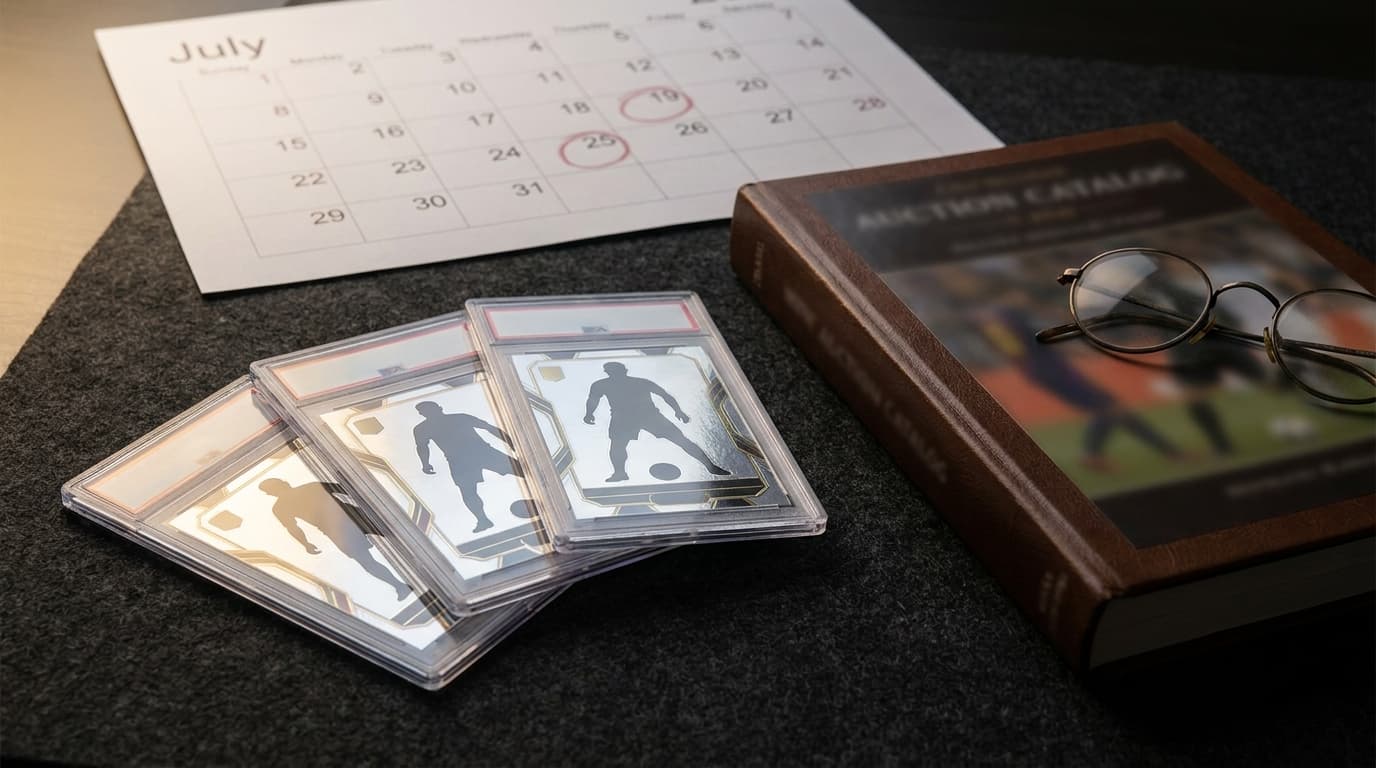
Two dates are fixed on the calendar, and the space between them is the whole argument. The 2026 FIFA World Cup final was played July 19, 2026, at MetLife Stadium in East Rutherford, New Jersey — a roughly 3:00pm ET kickoff, confirmed by the venue and FIFA. Six days later, on July 25, Goldin's Global Football Auction Part 2 closes. Between the two lies an unspoken assumption worth naming out loud: that six days of afterglow survives the final whistle and shows up in hammer prices.
That is a testable premise, not a certainty. So test it.
The thesis, stated plainly
An auction that closes a week after the sport's biggest match is, functionally, a bet. The bet is that championship euphoria — the emotional catalyst that drives event-driven collectibles — is still intact when the hammer drops on July 25. If it is, consignors who waited get paid on a fresh peak. If it isn't, they've handed their lots to the market on the back half of a fade. The question is which way the observed hype curve actually runs: does euphoria carry into hammer prices, or does the catalyst decay before the gavel?
What the timing data suggests about peak demand
The uncomfortable part for the six-day thesis is that soccer-card demand appears to peak during and just before the final — not after it. On-pitch results, not post-tournament reflection, are what move these cards. Coverage of the tournament's first nine days reported that knockout-stage eliminations triggered roughly "20% to 40% value compression within 48 hours" of full-time whistles. When a player's team goes out, the cards don't drift lower over weeks — they gap down over a weekend.
The hobby's own timing heuristics point the same direction. The common rule of thumb is to sell within seven days of a clinching or championship game, on the logic that "the hangover begins immediately after." And ahead of the final itself, analysts were explicit: sell before July 19, warning that Lamine Yamal-type World Cup trajectories "often face sharp corrections once tournament play finishes."
None of this is subtle guidance. The prevailing advice was to be out, or laddering out, on or before the day the auction thesis is quietly counting on.
The six-day gap problem
Put the two timelines side by side and the friction is obvious. If the seven-day post-clinch window is when demand holds, a July 25 close sits at day six — inside that window's tail, not at its front. It's not catching a fresh peak; it's catching the part of the curve where sellers were already told to be gone.
Non-soccer comparables give a rough shape to the decay that follows. NBA title spikes have tended to hold for about seven to ten days before entering a longer compression of roughly 45 days. Nikola Jokic's 2023 Prizm Silver PSA 10 fell about 35% by September after his championship run; a Jalen Brunson PSA 10 was flagged to slide from around $2,000 toward roughly $1,000 by late summer. Different sport, different mechanics — but the same event-driven pattern: a short plateau, then a grind lower. A close that lands a week out is closer to the plateau's edge than its center.
The counter-case for the auction house
This is where the argument gets honest, because it isn't one-sided. The decay figures above describe the broad market — raw, common, and mid-tier cards that trade on sentiment. Goldin's Part 2 catalog isn't that. Curated, scarce, high-end material — 1/1s, game-used, marquee lots — behaves differently. A one-of-one SuperFractor has no comparable to compress against; its price is set by two determined bidders on a given night, not by an aggregate demand curve.
The live catalysts of this cycle show how top-end soccer cards can run: a Lamine Yamal 2026 Panini Prizm 1/1 SuperFractor reportedly sold near $396,500; a Messi 2022 Prizm base #7 PSA 10 pushed past its roughly $200–$277 baseline after a June 17 hat trick; Jonathan David cards spiked as his Golden Boot odds moved from 100-1 to +2000. At that tier, an auction house's reach — a global bidder pool, marketing, and the credibility of the imprint — can plausibly offset six days of cooling sentiment. Scarcity and curation are precisely the variables that afterglow decay is worst at pricing.
So the counter-case is real: for the chase lots, Goldin's audience may matter more than the calendar. For everything below the chase, the calendar likely wins.
The consignor's decision: open market now vs. auction later
That split is the actual decision facing a seller today. The open market — eBay, COMC, direct sales — lets you exit into real-time peak hype the moment it exists. You see the bid, you take it, you're done. An auction consignment does something different: it defers your sale to a fixed future date and bets that the house's audience, on July 25, values the lot more than the open market did during the final.
For raw and common cards riding pure sentiment, that deferral fights the decay window. For genuinely scarce, high-grade, or one-of-one material, the deferral buys reach and price discovery that the open market can't replicate. The dividing line is roughly: sentiment-priced cards want speed; scarcity-priced cards can afford patience.
Reading the July 4–22 cluster as a liquidity gauge
You don't have to guess whether attention is holding — the calendar gives you a live readout. July 2026 stacked catalysts back to back: [Pokémon Pitch Black (July 4–17), Fanatics Fest NY (July 16–19, billed as the largest hobby event), the World Cup final (July 19), and Topps Chrome Baseball (July 22)](https://www.yardbarker.com/soccer/articles/july_2026_sports_card_market_four_events_that_make_this_the_most_active_month_of_the_year/s1_17615_44020980). That cluster is a liquidity backdrop you can measure against.
Watch where the volume goes. If Fanatics Fest floor activity and release-week attention are still rotating around soccer through the 19th and into the 22nd, the afterglow thesis has some support. If attention visibly rotates — into Topps Chrome baseline product, into the next chase — that's the tell that the emotional catalyst is already draining ahead of a July 25 close. The event calendar is the closest thing to a real-time sentiment meter this window offers.
Practical guidance
The most defensible strategy in this environment isn't trying to time the exact top — it's laddering out of it. The guidance that keeps showing up is to aim for the top 20% of the price range, not the top 1%: sell into belief rather than trying to catch the peak tick, and spread exits across the window rather than betting on a single day.
Segment by tier. Sentiment-priced commons and raw cards are the ones the decay figures describe, and they're the ones a late-July auction close serves worst — those are candidates for a real-time open-market exit. Chase 1/1s and game-used lots are the ones where a curated auction can still make sense despite the timing. And watch for post-final rotation: once the final is over, capital tends to move on — into Topps Chrome baseline, into whatever's next — and that rotation is itself a signal about how much afterglow is left to sell into.
The buyer's angle
Flip the thesis and it becomes an opportunity. If the catalyst has genuinely faded by July 25, a post-peak auction close is an entry point, not a trap. The bidder's job is discipline: price the lot against a decaying catalyst, not against the euphoria of the final. Residual hype in the room is exactly what pushes hammer prices above where the card will settle in the 45-day compression that comparable curves suggest. Bidding as if the afterglow is permanent is how buyers overpay; bidding as if it's already fading is how they don't.
The close
The premise is clean and testable: two fixed dates, six days apart, and a wager that the second one still catches the heat of the first. The trade-reported evidence — demand peaking pre-final, the seven-day sell rule, 20–40% compression within 48 hours of eliminations, the explicit advice to sell before July 19 — tilts toward decay. That doesn't doom a July 25 close, especially for scarce, high-end lots insulated by curation. But it does mean that timing a late-July auction close is a bet placed against the observed hype curve, not with it. Read the July cluster, segment your lots, and price the afterglow for what it looks like: a fading catalyst, not a fresh peak.
A note on the evidence: aside from the final date (FIFA, Wikipedia, MetLife Stadium) and the Goldin close date (Auction Report), the price-behavior figures here come from hobby and aggregator outlets — Yahoo Sports, Athlon, Yardbarker, PreGradeCards — rather than primary, audited transaction datasets. Treat the decay percentages as trade-reported heuristics, not settled market data.
Related reading
Sources
-
[Goldin Auctions calendar](https://goldin.co/calendar)
-
World Cup 2026 Cards: What the First 9 Days Did to Prices — Yahoo Sports
-
[July 2026 Sports Card Market: Four Events That Make This the Most Active Month — Yardbarker (Athlon)](https://www.yardbarker.com/soccer/articles/july_2026_sports_card_market_four_events_that_make_this_the_most_active_month_of_the_year/s1_17615_44020980)
-
When to Sell Your Graded Cards: Timing Strategies for 2026 — PreGradeCards
Note: This article contains AI-assisted content and has been reviewed in our editorial workflow.
DISCLAIMER: PureGrail articles are for informational and entertainment purposes only. Nothing on this site constitutes financial, investment, or legal advice. Collectibles are speculative assets and values can decrease significantly. Always conduct your own research before buying or selling. Past price performance does not indicate future results.