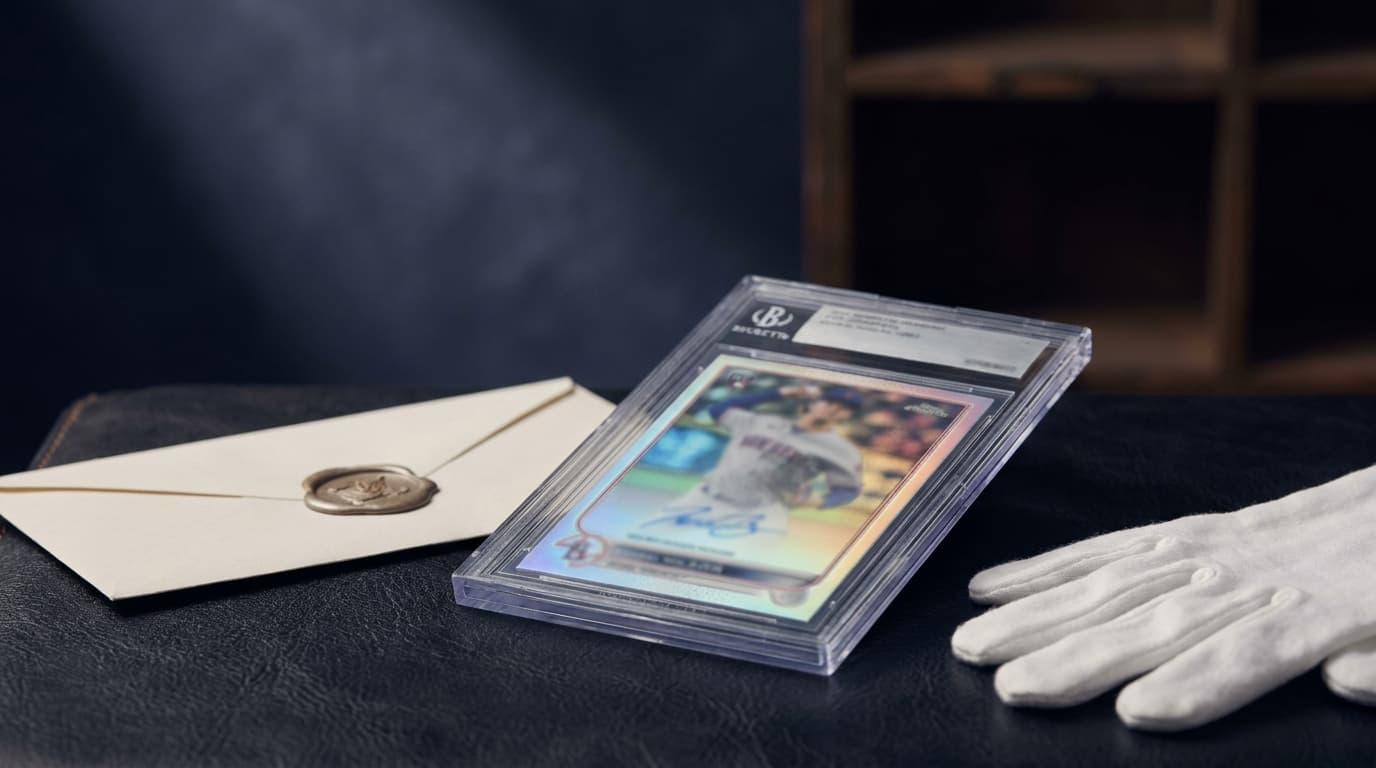
On July 14, 2026, Fanatics Collect announced that its Private Sales network had brokered a 2018 Bowman Chrome Shohei Ohtani Superfractor for $3,365,000 — the most expensive Ohtani card ever sold, and by most reckonings the third-highest price paid for any modern baseball card. There was no auction room, no public bidding, and no named buyer or seller. The number was announced after the fact, and the parties on both sides stayed anonymous (ESPN).
The card itself is a legitimate trophy: a one-of-one Superfractor from Ohtani's rookie season, the batting variation, graded BGS 9.5 Gem Mint, non-autographed and carrying no embedded memorabilia (Beckett serial 0010934430). It set several marks at once — most expensive Ohtani card, and the most expensive non-autographed Superfractor ever sold (Sports Illustrated; Beckett). It surpassed the prior Ohtani record of roughly $3,000,000, set by a signed 1-of-1 2025 Topps Chrome card with a game-worn golden MLB logo (ESPN).
But the record isn't really the story. The mechanism is.
Private brokerage, not auction, is where trophies change hands now
For most of the modern hobby's history, a seven-figure sale meant a public event: an auction house, a visible bidding record, a hammer price anyone could look up later. That is not how this Ohtani card traded. It moved through a curated private-sales desk — matched, negotiated, and settled without a public number ever printing until Fanatics chose to release one.
Treat this as a pattern, not an anecdote, because the very top of the market already shows the same shape. The overall modern record — Aaron Judge's 2013 Bowman Chrome Draft Superfractor Auto 1/1, which sold for $5.2 million in March 2026 in a BGS 9.5 grade — was also a Fanatics Collect private sale with undisclosed parties (ESPN). Both the number-one modern price and roughly the number-three modern price now sit behind the same curtain, brokered by the same platform.
The Judge card makes the transparency cost concrete. It had last sold publicly for $324,000 through PWCC Marketplace in 2022. Its next recorded sale was $5.2 million — a jump north of 16x, almost none of it visible on public record (ESPN). When a piece appreciates that much off-market, the community loses every intermediate data point that would explain how it got there.
How the machine is built
What makes this more than a run of coincidences is who is standing on every side of the transaction. Fanatics has assembled a vertically integrated stack that spans the entire life of a high-end card:
-
Manufacturing: Fanatics owns Topps, acquired in 2022 — the company that literally makes Bowman Chrome and its Superfractors (Card Capsule).
-
The auction house: Fanatics acquired PWCC in May 2023 and folded it into Fanatics Collect, with the PWCC brand effectively retired (Fanatics Inc.).
-
The marketplace: Fanatics Collect launched in 2024, alongside Fanatics Live commerce, vaulting, and a breaking service (Card Capsule).
-
The private desk: the Private Sales network, purpose-built for transactions of $10,000 and up, gives buyers access to "exclusive inventory before it hits the public market," matches premium pieces to verified serious buyers, handles the negotiation itself, and typically pays sellers within 48 hours (Fanatics Collect).
There is even another curated channel: Fanatics partnered with Sotheby's to launch a marketplace for trading cards worth $100,000 or more, again routing top-tier inventory through invitation and curation rather than open public results (Robb Report).
So the same entity mints the product, runs the auctions, operates the marketplace, and privately negotiates the trophy sales at the top. That is one funnel, not a market of independent participants.
What private sales erase
Public auction results are not just trivia — they are the comps. The reference points that price a card just below the record line come from the last time something comparable sold in the open. When a headline sale closes privately, with undisclosed parties and no bidding, those anchors simply do not get created.
This matters most to the people who will never touch a seven-figure card. If you are valuing a high-grade parallel, a numbered rookie, or a lesser 1-of-1 in the tens or low hundreds of thousands, you are pricing relative to the ceiling. When the ceiling stops printing public numbers, the whole scaffold below it gets shakier. You are left extrapolating from an announced figure you cannot independently verify, involving buyers and sellers you cannot identify, at a price the platform alone chose to disclose.
The conflict worth naming
Here is the tension in plain terms. The platform that manufactures the cardboard also sets auction dynamics and also privately negotiates the ceiling — and it collects fees across those functions. That gives it an unusual degree of control over whether a headline transaction ever becomes a public comp at all, and considerable influence over the narrative when it does.
None of that means any specific number is wrong. The Ohtani sale is corroborated across ESPN, Sports Illustrated, Sports Collectors Daily, and Beckett, and the card and grade are consistently described (Sports Collectors Daily). But corroboration of an announcement is not the same as an independently observable market. When one company controls both the transaction and its disclosure, information about what things are "really" worth becomes asymmetric — and the party holding the most information is also the one selling into the market.
Who benefits, and who pays
Private brokerage genuinely serves several parties. The platform earns fees on both sides and shapes the story around each record. Sellers get discretion and speed — paid, per Fanatics' own terms, typically within 48 hours (Fanatics Collect). Top buyers get privacy and first access to inventory before it goes public. Those are real, rational reasons the trophy tier is migrating off-market.
The cost lands on everyone else: the everyday collector and the mid-market, who lose the price transparency that public results used to provide for free. The convenience at the top is subsidized by opacity below it.
How to price against an opaque ceiling
If the very top of the market is going dark, adjust how you lean on it. A few practical, skeptical habits:
-
Treat announced private figures as marketing, not comps. A number with no bidding record and no named parties is a data point about what a platform wants published — not a verifiable clearing price. Do not build a valuation on it.
-
Anchor to the last genuinely public sale. Where a piece previously changed hands in the open — an auction with a visible result — that number is still your firmest evidence, even if it is years old. The Judge card's $324,000 public 2022 sale tells you more than its private $5.2M headline does about observable market behavior.
-
Use graded-population reports as the structural backbone. Pop counts tell you real supply. Scarcity you can verify beats a price you cannot.
-
Discount comps you cannot audit. If the only "evidence" for a valuation is a privately brokered, self-reported figure, size your confidence accordingly — and your offer.
An opaque ceiling is an asset for the platform that controls it — a clean record to market, released on its own terms. For everyone pricing against it, it is a blind spot. The $3.365 million Ohtani Superfractor is a real card and, quite possibly, a real price. What it is not is a public one — and in a hobby that has always run on the shared knowledge of what things actually sold for, that is the part worth watching.
Related reading
Sources
-
Unique Ohtani rookie card sells privately for record $3.365M — ESPN
-
2018 Bowman Chrome Baseball Shohei Ohtani Superfractor Sells for $3.3 Million — Sports Illustrated
-
Shohei Ohtani's 2018 Bowman Chrome Superfractor Sets Multiple Records — Beckett
-
Sell High-Value Trading Cards Online | Private Sales — Fanatics Collect
-
Fanatics Continues Push into Collecting Space, Acquires PWCC — Fanatics Inc.
-
How Fanatics' Acquisition of Topps Changed the Sports Card Hobby — Card Capsule
-
Aaron Judge 1-of-1 card sells for $5.2M, a modern-day record — ESPN
Note: This article contains AI-assisted content and has been reviewed in our editorial workflow.
DISCLAIMER: PureGrail articles are for informational and entertainment purposes only. Nothing on this site constitutes financial, investment, or legal advice. Collectibles are speculative assets and values can decrease significantly. Always conduct your own research before buying or selling. Past price performance does not indicate future results.