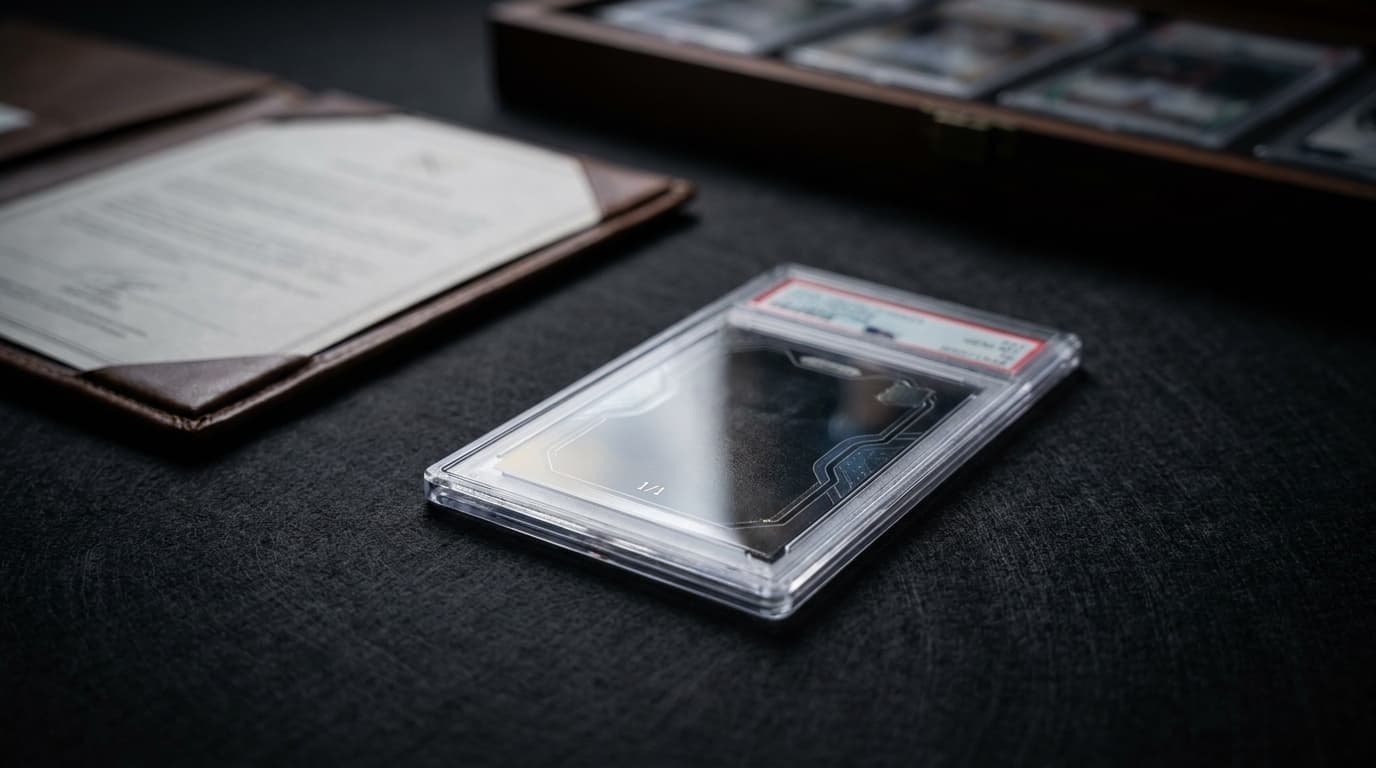
Around May 26, 2026, a single Victor Wembanyama rookie card reportedly sold for $5.11 million — and it did so with no bidder in the room, no public price ladder, and no auction house gavel. The card was a 2023-24 Panini Prizm Black, a one-of-one numbered parallel graded PSA 10 (Gem Mint), and the deal was brokered privately by Fanatics Collect. According to ESPN, it is now the most expensive non-autographed NBA card ever sold, ranking roughly fourth among all NBA cards and about eleventh across all sports cards — and it was the third $5M-plus sports card sale of 2026.
The timing was not incidental. The print landed while Wembanyama and the San Antonio Spurs were in the middle of a deep 2026 playoff run. For a market that runs on narrative as much as scarcity, that backdrop matters. But so does a colder read of what actually traded here: a private, off-market transaction between a broker and one anonymous buyer. That is a headline number. It is not the same thing as a liquid market price.
Why "non-auto record" is the real headline
The qualifier is doing heavy lifting. Every NBA card that has publicly sold for more than this Wemby is an autographed Logoman 1/1 — the game-worn patch cards that pair a one-of-one swatch with an on-card signature. Per HoopsHype's tally of the most expensive NBA card sales, that tier includes the Kobe Bryant–Michael Jordan Dual Logoman Auto ($12.93M), the Jordan–LeBron Dual Logoman Auto ($10M), and the Luka Doncic Logoman Auto ($4.7M).
Stack the Wemby against that group and the distinction sharpens: it sits inside the all-time NBA top five without a signature on it. In a hobby where the marquee lots almost always carry an autograph, an unsigned card clearing $5M is the anomaly worth explaining — and the explanation is structural, not sentimental.
The scarcity mechanic collectors should actually internalize
Here is the mechanic that makes this card the apex asset, and it is easy to miss if you only look at the price. There are no licensed autographed Wembanyama rookie cards. None. As Dexerto lays out, Panini held the NBA trading-card license during Wembanyama's 2023-24 rookie season, while his autograph rights are exclusive to Fanatics. The two never overlapped on a rookie product. So the signed-rookie category that normally sits atop a generational player's checklist simply does not exist for Wemby.
That absence reroutes demand. When you cannot buy a signed rookie at any price, the ceiling for the player's rookie year concentrates in the top non-auto 1/1 parallels — cards like the Prizm Black. Collectors chasing the definitive Wembanyama rookie have nowhere else to put apex money. The $5.11M isn't just a bet on the player; it's a bet on a checklist gap that can't be filled retroactively.
The Finals-narrative multiplier
Cards price off ceilings, and Wembanyama spent the spring of 2026 raising his. In his third year, the 22-year-old was the unanimous 2026 Defensive Player of the Year, finished third in MVP voting, and was named unanimous Western Conference Finals MVP. Per NBA.com, he put up 27.3 points, 10.9 rebounds, and 2.7 blocks across a seven-game series to eliminate the top-seeded Thunder and push San Antonio to its first NBA Finals since 2014 — the Tim Duncan era.
To size what that halo does, look at the prior mark. Wembanyama's previous rookie-card record was a 2023-24 Panini Prizm Nebula Choice 1/1 graded PSA 9, which sold for $860,100 at Goldin in February 2025 — a different top-tier 1/1 from the same product. The $5.11M print is roughly a 5.9x jump off that comp in about fifteen months. Some of that is a hotter high end across the entire card market; a lot of it is a generational defender dragging a mid-market team to the Finals in real time, with a top-pop 1/1 hitting the block right as the story peaked.
One correction the narrative needs: San Antonio did not win. The Spurs lost the Finals 4-1 to the New York Knicks, a series that included a Game 4 in which they blew a 29-point lead — the worst collapse in Finals history, as The Ringer documented. If you're comping Wemby cards, frame the run as a Finals appearance and a loss, not a title. That distinction may matter for where the narrative premium settles from here.
Why this print is hard to comp
This is the part serious buyers should sit with. A public auction gives you a price ladder — you can see the underbid, the pace of bidding, how many wallets were live near the top. This sale gives you none of that. It was a private transaction brokered by Fanatics Collect, with a single anonymous buyer (who cited security for staying nameless) and no published bid history to anchor value against.
The buyer's stated rationale reinforces the point. He told The Athletic, by way of Yahoo Sports, that Wembanyama's long-term ceiling was the primary reason he paid up. That is a conviction buy from one motivated collector — not a clearing price discovered by a room of competing bidders. Treat $5.11M as a single high-conviction data point, not a level the next comparable 1/1 will automatically hit.
The conditioning controversy sitting under the grade
There is also an asterisk the market hasn't fully resolved. A video from PSA's offices thanking "Kurt's Card Care" — a company that sells card cleaning and restoration products — raised alteration concerns around the card, as reported by both ESPN and Dexerto. The tension is straightforward: PSA's stated policy is to refuse grading on trimmed, cleaned, or restored cards — yet it assigned this one a 10. The owner denied any treatment connection.
The buyer's response tells you something about high-end behavior: he said he'd have bought the card regardless of the controversy. That's rational for a trophy-asset collector chasing a specific 1/1 with no substitute. It's a different calculus than the one facing everyone else in the Wemby market, where grade integrity and provenance questions can weigh more heavily on cards that do have comps and do trade in volume.
Does the apex lift the tiers below it?
The practical question for most holders isn't whether they own a Prizm Black 1/1 — almost no one does — it's whether a $5.11M ceiling re-rates base rookies, numbered parallels, and lower 1/1s. Be skeptical here. Apex 1/1s and broad-market cards trade on different demand curves. A single off-market trophy sale can dominate headlines without meaningfully moving the price of a numbered /99 or a base PSA 10, which live in liquid, comp-able markets where dozens of copies trade.
Sometimes a record does provide a psychological tailwind for a player's whole checklist. But a private, no-bid-history sale of a card with no substitute is exactly the kind of print that can stay siloed at the top. Don't assume the $5.11M number underwrites your lower-tier Wemby cardboard.
Practical takeaways for holders
-
Don't comp against the 1/1. An off-market apex sale with no bid ladder is a poor anchor for a card that actually trades. Comp your parallels against recent, public sales of the same card in the same grade.
-
Weigh the Finals loss into the narrative, not just the run. The halo here is a generational DPOY and WCF MVP who reached the Finals and lost 4-1. That's still a strong story — but it's an appearance, not a ring, and the narrative premium can move as the story evolves.
-
Separate structural scarcity from broad demand. The "no licensed auto rookie" gap is what makes the top non-auto 1/1 special. It does far less for a /149 or a base rookie, where supply is real and buyers have substitutes.
-
Keep grade and provenance questions in view. The conditioning controversy didn't stop a trophy buyer, but on comp-able cards, alteration and grade-integrity concerns tend to matter more, not less.
The cleanest way to read $5.11M: it's a genuine record and a genuine signal about how scarce the top of the Wembanyama rookie market is — driven by a licensing quirk that can't be undone. It is also a single private sale to one buyer during a peak-narrative window. Both things are true. The record is real. The market price is still being discovered.
Related reading
-
They Banned a $3,000 Card That Can't Be Reprinted: Candelabra of Tawnos Leaves Legacy
-
[39 Copies Per Buyer on a Common: The June 19 White Flare Buyout That Targeted the Cheap Cards on Purpose](/article/white-flare-buyout-cheap-cards-copies-per-buyer)
Sources
-
Victor Wembanyama card sells for $5.11 million in private sale — ESPN
-
Victor Wembanyama rookie card sells for record $5.11M after hobby controversy — Dexerto
-
Spurs' Victor Wembanyama named Western Conference Finals MVP — NBA.com
-
Victor Wembanyama Won't Forget the Spurs' Finals Loss — The Ringer
Note: This article contains AI-assisted content and has been reviewed in our editorial workflow.
DISCLAIMER: PureGrail articles are for informational and entertainment purposes only. Nothing on this site constitutes financial, investment, or legal advice. Collectibles are speculative assets and values can decrease significantly. Always conduct your own research before buying or selling. Past price performance does not indicate future results.