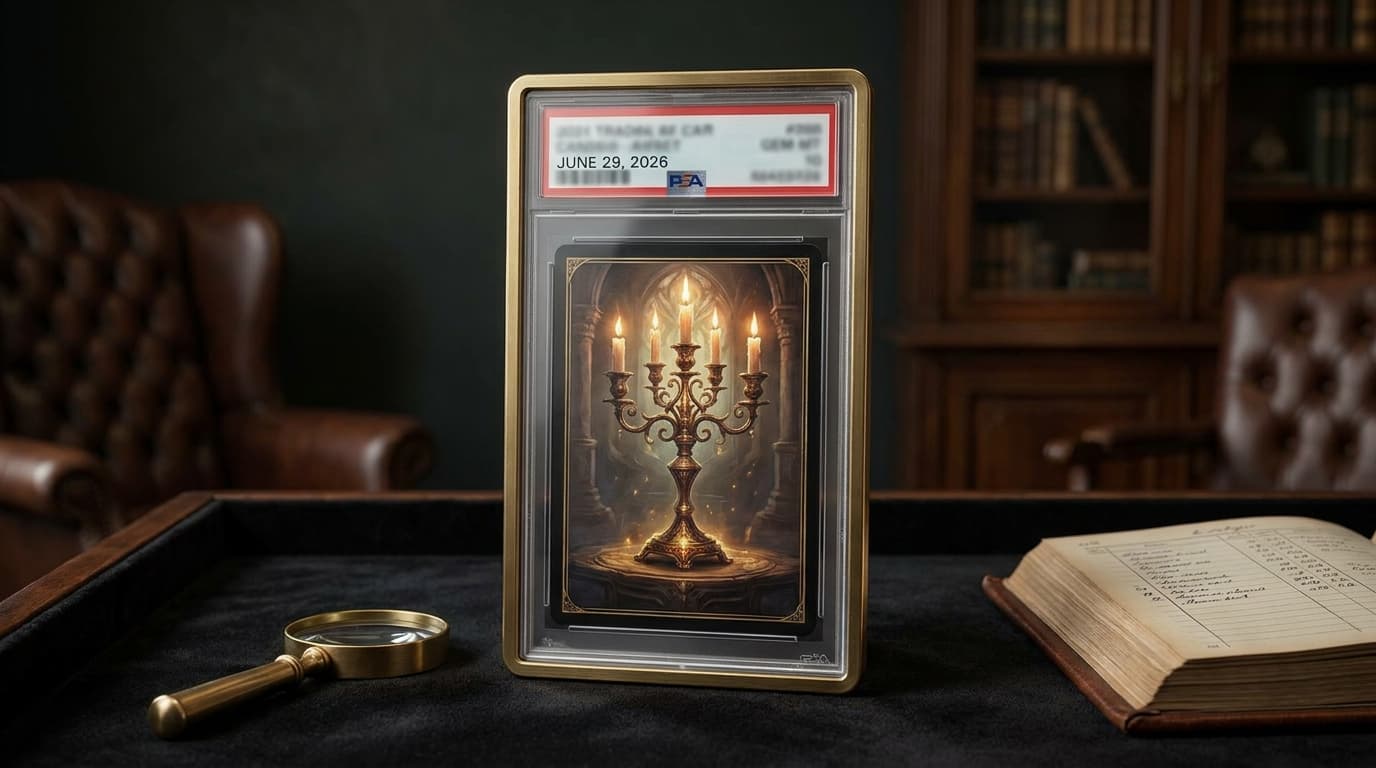
On June 29, 2026, Wizards of the Coast did something that rarely lines up so cleanly for collectors: it banned a roughly $3,000 card from one of its formats, and the card in question is one Wizards has formally promised it will never reprint. The Banned & Restricted announcement removed Candelabra of Tawnos from Legacy, effective immediately. Because Candelabra is a Reserved List card from Antiquities (1994), supply is permanently fixed. That leaves exactly one variable that can move its price: demand. And the ban just deleted a major source of it overnight.
This is a clean test case, not a hype headline. A high-value, never-reprinted card lost access to a competitive format that had been a real demand pillar. Whether that matters a lot, a little, or not at all is genuinely unsettled — and the early hours after an announcement are the most overreaction-prone window there is. Below is what actually happened, why the Reserved List changes the arithmetic, and what to watch before drawing conclusions.
What got banned, and why
The June 29 update touched eight cards across three formats. In Legacy, that was Candelabra of Tawnos. [Pauper lost Seeker of Skybreak](https://mtgrocks.com/mtg-june-2026-bans/), and Brawl saw six cards hit: Force of Will, Subtlety, Wash Away, Ugin's Labyrinth, Time Warp, and Temporal Manipulation. For collectors, the Legacy line is the one with price consequences.
The stated reasoning is specific. Colorless Tron's share of the Legacy metagame kept climbing while its win rate refused to drop — the combination Wizards typically treats as a problem rather than a phase. The competitive evidence cited was concrete: two copies of the deck reached the finals of the late-May Legacy Showcase Challenge, with another in the Top 8. Within that deck, Wizards identified Candelabra as the highest value-above-replacement card — the single piece doing the most work that no substitute could replicate — and therefore the one most likely to cause long-term format problems. So Candelabra, not a cheaper supporting piece, took the hit.
There's a historical rhyme here worth noting. Candelabra was on Legacy's original 1996 banned list, came off it in 1999, and now returns after roughly 27 years. The card untaps lands equal to the mana paid into it, which is the engine behind Colorless Tron's explosive mana — and, years earlier, the High Tide combo decks. It has always been a card that does something formats eventually decide is too much.
Why the Reserved List changes the math
Most ban discussions assume Wizards holds two levers: it can ban a card to cool demand, or reprint it to relieve supply pressure. For Candelabra, the second lever doesn't exist. The Reserved List is a standing pledge — currently covering 572 cards — that Wizards will never print these cards again in a tournament-legal form. The stated rationale is value preservation: no reprints means no supply shocks, which is the structural reason these cards hold and climb.
So the usual model collapses to one variable. Supply is frozen at whatever number of Antiquities copies survived since 1994. Price is therefore a pure function of demand. When a ban removes a chunk of demand for an ordinary card, the market can eventually be backfilled with reprints; here, it can't be backfilled at all, in either direction. That makes Candelabra unusually sensitive to exactly the kind of demand shift this ban represents — and it cuts both ways, which is why the outcome isn't obvious.
How a 1994 card got to ~$3,000
Candelabra didn't drift here. According to Wargamer's reporting, the card traded around $800 a year ago and sits roughly in the $2,500–$4,000 range as of June 2026 — a steep, sustained month-over-month climb, not a single spike. Two demand sources drove it: competitive Legacy play, where Colorless Tron made Candelabra a four-of staple, and Commander, specifically the cEDH (competitive Commander) crowd, where the card's mana acceleration also commands a premium.
That two-engine setup is the crux of the whole question. If you want to estimate how much the Legacy ban should move the price, you first have to estimate how much of that ~$3,000 was Legacy-specific demand versus Commander and collector demand that the ban leaves entirely intact.
The demand-sink argument
Think of each format as a "demand sink" — a place that absorbs copies and creates buyers. Legacy was one sink for Candelabra; Vintage and Commander are others. The ban drained the Legacy sink while leaving Vintage and Commander legality untouched. Candelabra is still fully playable in both, including cEDH.
The honest answer is that nobody has a precise split. Legacy is a smaller-population format than Commander by player count, which argues that Commander/cEDH demand could be the larger share of that price. But Legacy is also where the card was a maximized four-of in a top-tier deck, while in singleton Commander it's one copy per deck. Competitive four-of demand from a winning archetype can punch above its raw player numbers. Both things can be true, and that ambiguity is precisely why the price direction is contested rather than obvious.
The bull case: a price floor
The case for the price holding rests on the structure. Supply cannot grow. Commander is Magic's largest format and isn't going anywhere, and cEDH demand for fast colorless mana doesn't evaporate because Legacy changed. Cube builders and collectors who want an iconic Antiquities rare were never buying it to play Tron in the first place. Layered on top is Reserved List psychology: a meaningful slice of buyers treat these cards as scarce, never-reprinted assets, and that belief tends to put a floor under panic. If most of the recent run-up was Commander-and-collector driven, losing Legacy trims a branch, not the trunk.
The bear case: a real slump
The case for a genuine decline is just as coherent. A ban removes a competitive demand pillar permanently — Legacy buyers who needed four copies simply stop needing them, and some existing owners will list their playsets into the market at once. Trade commentary frames the outlook as authentically uncertain rather than safely bullish; Wargamer's coverage flagged that it will be "interesting to see if, and how much, it slumps." The most dangerous window is the first hours and days, when announcement-driven sellers and bargain-hunters collide and prices can gap well past where they settle. Early prints of a B&R reaction are noisy by nature, and reading them as the new normal is a classic mistake.
Precedent, and its limits
There's a base rate worth consulting. When the Premodern format banned Parallax Tide, demand shifted onto its combo partner Replenish — another Reserved List card — and Replenish spiked, with the cheapest near-mint copies climbing toward the $225–$299 range. The lesson isn't directional; it's that Reserved List prices react sharply to format and demand changes, because frozen supply means demand swings translate straight into price with nothing to absorb them.
The limits of the comparison matter, though. The Replenish case was a ban raising demand for a related card; the Candelabra case is a ban removing demand from the banned card itself. Same Reserved List sensitivity, opposite mechanism. The precedent tells you to expect volatility and a fast reaction — not which way Candelabra ultimately resolves.
Collector takeaways
If you own copies, are tempted to buy the dip, or are tempted to sell the news, the discipline is the same:
-
Watch sold listings, not asks. Asking prices in the first days reflect hope and panic, not the market. Track real completed-sale data on MTGGoldfish and MTGStocks for this specific Antiquities printing.
-
Expect early volatility, and discount it. The first hours are the worst time to draw a conclusion. Let the announcement-driven noise clear before deciding what the card is worth.
-
Separate a panic dip from a durable re-rating. A sharp drop that recovers as Commander and collector demand reassert is a very different event from a slow, sustained slide that confirms Legacy was a bigger share of the price than the bulls assumed. Only time and sold data distinguish them.
-
Don't assume the Reserved List guarantees anything. Frozen supply supports price; it doesn't mandate it. Demand still has to show up — and the ban just removed one place it used to.
The clean version: a never-reprintable card lost a real demand sink, and the structure that usually protects Reserved List prices is also what makes this one unusually exposed to exactly this kind of shock. The bull and bear cases are both internally consistent, which is the most honest thing you can say in the first 24 hours. Watch the sold listings and let the market, not the headline, settle the question.
Related reading
-
Fewer Than 150 Cosmic Foil Mind Stones: Is MTG's Infinity Stone Cycle a Thesis or a Scarcity Trap?
-
[Paige Bueckers Rookie Card Math: What WNBA Mid-Season Sales Actually Say About the 2025 Prizm Base](/article/paige-bueckers-2025-prizm-base-rookie-card-math-mid-season)
Sources
-
Banned and Restricted Announcement – June 29, 2026 (Wizards of the Coast)
-
MTG bans $3,000 Reserved List card from its strongest format (Wargamer)
-
Major MTG Ban Announcement Hits Eight Cards in Three Formats (MTGRocks)
-
Latest Banned & Restricted Announcement Removes Candelabra of Tawnos From Legacy (Star City Games)
-
Candelabra of Tawnos, Antiquities Price History (MTGGoldfish)
-
The MTG Reserved List: History and Complete Listing (Draftsim)
-
MTG Premodern Ban Causes Reserved List Card to Hit $225 (MTGRocks)
Note: This article contains AI-assisted content and has been reviewed in our editorial workflow.
DISCLAIMER: PureGrail articles are for informational and entertainment purposes only. Nothing on this site constitutes financial, investment, or legal advice. Collectibles are speculative assets and values can decrease significantly. Always conduct your own research before buying or selling. Past price performance does not indicate future results.