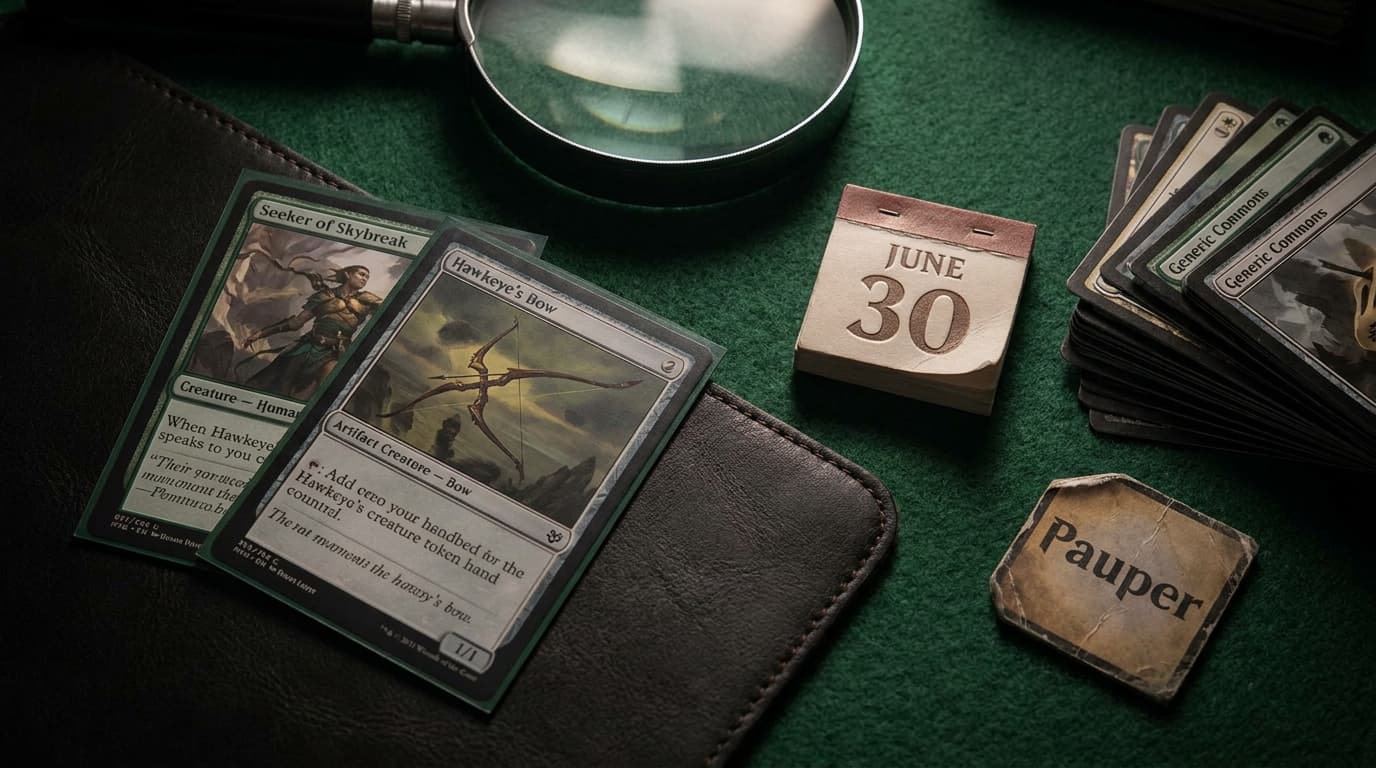
A 29-year-old common that traded near bulk for most of its life is suddenly one of the loudest tickers in Magic finance. Seeker of Skybreak, an Elf printed back in 1997's Tempest, climbed as much as 534% in a matter of days — not because anything changed about the card, but because a new one-mana Equipment from the Marvel Super Heroes set turns it into a two-card infinite combo that's fully legal in Pauper. The catch: the entire move rests on a single regulatory event. Wizards of the Coast's next Pauper banlist update lands June 30, 2026, and the combo is squarely on the watchlist. This is the textbook shape of a buy-the-rumor spike with a hard, dated downside catalyst — so it's worth walking through carefully before anyone treats a $1 common like a growth stock.
What actually happened: the Seeker + Bow loop
The trigger is a card called Hawkeye's Bow, a one-mana common Equipment from Marvel Super Heroes. Its relevant text: whenever the equipped creature taps, it deals 1 damage to each opponent. On its own, that's a slow drip. The problem is what you equip it to.
Seeker of Skybreak is a common Elf with an activated ability that lets it untap itself. Pair the two and you get a closed loop with no natural stopping point: equip the Bow to Seeker, tap Seeker (the Bow pings each opponent for 1), then use Seeker's ability to untap itself, and repeat. Each iteration is another point of damage, so the loop is effectively infinite — lethal as early as turn three, with some lines reportedly faster on the play. Because both pieces are commons, the whole thing is Pauper-legal the moment the set goes live (Wargamer).
Marvel Super Heroes hits tabletop on June 26, 2026, and per Wizards' own collecting feature, the main MSH set is legal in all constructed formats — Pauper included (Wizards of the Coast). That legality date is the clock everyone is trading against.
The price data, read skeptically
The headline number — 534% — is real, but it's baseline-sensitive, and that distinction matters more than the percentage itself. According to MTGRocks, that figure is measured off the cheapest reprint — a 7th Edition copy that moved from roughly $0.94 near-mint to about $5.96 including shipping. Seeker has multiple printings at different price points, and the 534% is calculated against the lowest one. It's the most dramatic way to express the move, not necessarily what a buyer actually pays for a specific copy.
The original 1997 Tempest printing tells a related but distinct story. Per MTGStocks, the Tempest copy is up about 579% over the month (roughly +$5.67) and 296% over the week (roughly +$4.97), with a market average near $6.65, a current price around $6.81, and an all-time high around $9.96 — which is where the "up to ~$10 at some shops" framing comes from.
So there are two different numbers doing two different jobs. The 534% reprint-baseline figure is the attention-grabbing headline. The ~579% Tempest move is the harder data on the scarce original. The gap between them is the story: a 29-year-old print run has thin supply, so a percentage move on the original exaggerates easily, while the reprinted copies cap the practical ceiling because they're more available. A buyer chasing the headline percentage on a cheap reprint is paying for the same combo a Tempest buyer is, but the two are not the same asset.
Why combo-driven commons spike like this
The mechanics of this kind of spike are predictable, and recognizing the pattern is more useful than the specific card. A few forces stack:
-
Single-card dependency. The entire thesis is one interaction. There's no diversified demand pulling the card — it's combo or nothing. That makes the demand fragile in a way a staple's isn't.
-
Thin float on an old print run. Tempest is 29 years old. There simply aren't many original copies in active circulation, so even modest speculative buying moves the average price hard. Low float equals high volatility in both directions.
-
Speculative pile-on. Once a percentage figure starts circulating, buying begets buying. Some of that demand is players building the deck; a lot of it is speculators front-running a perceived shortage.
-
Reprint exposure. Wizards reprints commons easily. If WotC wants to defuse a price spike — or just supply demand for a playable card — a reprint floods the market and the scarcity premium evaporates.
None of this is unique to Seeker. It's the standard anatomy of a combo-common spike, and it's why these moves are better understood as event-driven trades than as collectible appreciation.
The ban-risk math
Here's the part that makes this specifically dangerous. WotC's Gavin Verhey addressed the combo on Good Morning Magic, saying it "has all the hallmarks of something that's going to be a problem" — but the Pauper Format Panel chose not to pre-ban it, reasoning that Pauper is flush with cheap, efficient creature removal and Seeker has low toughness, so the combo may simply die to a one-mana removal spell before it goes off (MTGRocks).
That "wait and see" stance sets up a hard calendar. The next Pauper banlist announcement is June 30, 2026. If the panel acts then, the speculative thesis collapses essentially overnight — a banned card has no competitive demand to support the spike, and what's left is a 1997 common with a brief news cycle behind it. If June 30 passes without action, the next ban window isn't until August 10, 2026 — a gap commentators have flagged as "concerningly long" if the combo proves oppressive (Wargamer).
So the position is genuinely binary. June 30 is a coin-flip date that can either validate the demand (no ban → roughly six weeks of competitive life before the next checkpoint) or erase it. The speculative window is, realistically, about two weeks long.
The verdict for collectors and speculators
The asymmetry here favors caution. Consider what the position actually is:
-
Buy-the-rumor downside. Much of the move has already happened. Buying after a 500%+ run means paying near the top for a card whose upside depends on a non-ban and whose downside depends on a ban — with the deciding event days away.
-
Ban risk. Verhey's own language signals the panel sees a likely problem. "Not pre-banning" is not "won't ban" — it's "we'll watch the metagame first." June 30 is the readout.
-
Reprint risk. Even setting bans aside, WotC can reprint a common into oblivion. A playable, in-demand common is exactly the kind of card that gets stuffed into a future set or supplemental product.
-
Removal risk to the combo itself. The panel's stated reason for restraint — abundant cheap Pauper removal — is also a reason the deck may underperform, which would soften organic demand regardless of any ban.
Stack those and you have a position with multiple independent ways to lose and essentially one way to win (no ban, no reprint, combo proves strong enough to sustain play demand). That's not a hold; it's a short-dated bet on a single regulatory decision.
Practical takeaways
-
Treat combo spikes as event-driven trades, not investments. The thesis has an expiry date — June 30 — and a card whose value lives or dies on a banlist announcement is a trade with a deadline, not a collectible you tuck away.
-
Size accordingly. If you're speculating on commons like this, position size should reflect that you can lose most of the premium on a single announcement. Don't allocate to a binary event what you'd only risk on a diversified hold.
-
Watch the banlist calendar, not the hype. The June 30 and August 10 dates are the real catalysts. The percentage figures are a lagging story; the calendar is the forward-looking one.
-
Mind the baseline. A 534% figure off a $0.94 reprint and a ~579% figure off a scarce $6+ Tempest copy are not interchangeable. Know which printing you're actually buying and what its realistic ceiling is.
-
Account for reprint risk on any playable common. Scarcity premiums on cheap, useful cards are some of the easiest for the publisher to erase.
Seeker of Skybreak is a clean case study in how modern Magic finance works: a real interaction, a real price move, and a real downside catalyst all compressed into a two-week window. The combo is legitimate and the spike is documented. But the move is built on one fragile dependency, the percentage is inflated by an old print run's thin supply and a cheap-reprint baseline, and the whole thesis points at a single date on WotC's calendar. For anyone tempted to chase it, the honest framing isn't "a 1997 common is up 534%" — it's "a binary bet is resolving on June 30, and most of the easy money has already moved."
Related reading
-
[MTG Marvel Super Heroes, 12 Days Out: The Disputed $2 Collector Booster 'Hike' and What Pre-Sale Premiums Actually Say](/article/mtg-marvel-super-heroes-12-days-out-collector-booster-price-presale-premiums)
-
[The Mega Greninja Halo: How a Chaos Rising Chase Card Is Quietly Reviving 2016 Greninja BREAK — and Whether the Vintage Bump Holds](/article/mega-greninja-halo-chaos-rising-2016-greninja-break-vintage-bump)
-
[Pitch Black Pre-Sale, 32 Days Out: Does the Fifth Mega Evolution Set Still Command a Premium After $13K of Master-Set Fatigue?](/article/pitch-black-presale-fifth-mega-evolution-set-premium-13k-fatigue)
Sources
-
29-Year-Old Elf Spikes 534% in Price Thanks to New Two-Card Combo (MTGRocks)
-
MTG Designer Shuts Down Pre-Banning Concerning New Combo (MTGRocks)
-
Seeker of Skybreak • Tempest (TMP) #254 — Price History (MTGStocks)
Note: This article contains AI-assisted content and has been reviewed in our editorial workflow.
DISCLAIMER: PureGrail articles are for informational and entertainment purposes only. Nothing on this site constitutes financial, investment, or legal advice. Collectibles are speculative assets and values can decrease significantly. Always conduct your own research before buying or selling. Past price performance does not indicate future results.