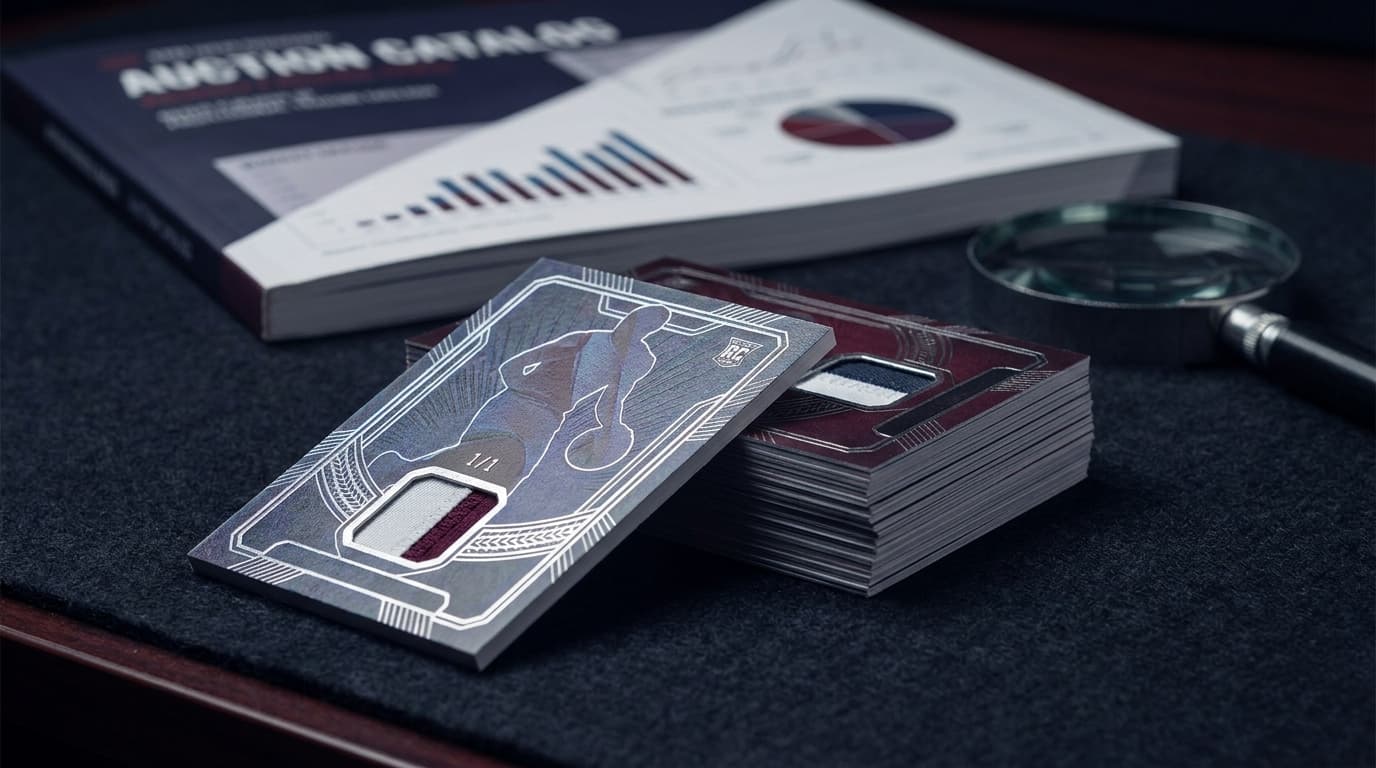
The number that got everyone's attention is real: WNBA card searches on Whatnot jumped 1,670% in 2025, on top of an 870% rise in 2024 — growth roughly three times faster than NBA cards on the same platform. The headline sale is real too. In July 2025, a signed Caitlin Clark 2024 Panini Flawless WNBA Platinum Rookie Logowoman Patch Auto 1/1 sold for $660,000 at Fanatics Collect's Premier Auction, the most ever paid for a women's-sports card — nearly doubling her prior $366,000 record, with an on-card inscription reading '769 pts and counting.'
Those are the kind of figures that pull capital into a category. They are also the kind of figures that should make a serious collector ask the uncomfortable question first: is this a league taking off, or is it one athlete's gravity dressed up as a market? The honest answer is that it's some of both — and the mix matters enormously for how you should size any position.
What the data actually says
Start with the verified numbers, because the WNBA card story has already accumulated some folklore. According to Whatnot's own 2026 trends report and trade coverage from cllct, the platform's WNBA figures for 2025 break down like this:
-
Search volume: up 1,670%, following +870% the prior year — about 3x the growth rate of NBA cards.
-
Signed WNBA items: up roughly 1,000%.
-
WNBA jerseys: up about 290%.
-
Per-player search growth: Paige Bueckers +530%, Cameron Brink +330%, Aliyah Boston +260%, A'ja Wilson +240%.
-
Geography: Atlanta was the national hot-bed, with WNBA card purchase growth of +7,300%.
One number you may see floating around deserves a flag. A widely repeated claim holds that WNBA secondary transaction volume rose "roughly 400%." We could not find that figure in Whatnot's published 2026 trends report or in cllct's coverage, and Whatnot's own volume-adjacent numbers are the ones above — signed items +1,000% and jerseys +290%. Until someone can source it, treat the 400% as unverified and don't let it anchor a buy decision. This is exactly the kind of stray statistic that gets laundered into consensus during a hot run.
It's also worth keeping the container in view. Whatnot crossed $6 billion-plus in total 2025 sales, more than double its 2024 figure. The WNBA surge happened inside a marketplace that was itself roughly doubling — so some of the raw growth is a rising tide. Whatnot, for its part, framed the WNBA as "a sustained collecting category rather than a one-year trend," which is a claim, not yet a proof. The rest of this piece is about testing it.
The concentration case
Here is the part of the story the bulls tend to skate past. The category's dollar velocity is heavily anchored to a single player's rookie cardboard.
PSA has graded more than 100,000 Caitlin Clark cards since 2024. The next-closest WNBA names are Bueckers at roughly 11,200 and Angel Reese at about 9,300 — an order-of-magnitude gap. That's not a rounding difference; it's a structural feature of the market. When one player accounts for ten times the graded population of the next name down, the category's liquidity, comps, and sentiment are disproportionately exposed to how that one player is trending.
The demand data points the same way. Over a recent 30-day window, Market Movers ranked Clark the #3 most-purchased basketball player overall — behind only Victor Wembanyama and Michael Jordan, and ahead of essentially every active NBA star. That is a remarkable thing for a young WNBA guard, and it's precisely why the concentration risk is not hypothetical. A meaningful share of the category's transaction dollars rides on Clark's rookie cards specifically.
So if you're buying "the WNBA card category" as a passive thesis, understand what you're actually long: to a first approximation, you're long Caitlin Clark, with a diversified sleeve attached.
The depth case
That diversified sleeve, though, is getting real — and this is the strongest evidence for the "sustained category" argument. A year ago, Market Movers' basketball top 80 contained just 4 WNBA players. Over a recent 30-day window that rose to 9, including 3 in the top 20 and 2 in the top 10. These aren't token appearances propped up by a single whale sale:
-
Cameron Brink — roughly 2,600 sales, 10th overall.
-
Angel Reese — about 2,000 sales, 16th overall, ahead of Jayson Tatum and Tyrese Haliburton.
-
Paige Bueckers — 500-plus sales, with a $30,000-plus sale recorded before her cards had even hit licensed product.
Add Aliyah Boston and A'ja Wilson to the collected roster and the picture is a category broadening at the top, not just deepening around one name. Reese outselling established NBA All-Stars in raw transaction count is a genuine signal that collector attention is distributing. The froth is loudest around the 1/1 auctions, but the mid-market — the four-figure sales across half a dozen players — is where you'd look to confirm durable demand, and it's filling in.
The correct read is nuanced: the roster is broadening and the category is still Clark-weighted. Both are true at once. Nine names in the top 80 is real progress from four; 100,000 graded Clark cards against ~10,000 for the next name is real concentration. Don't let either fact cancel the other in your head.
The natural experiment
We rarely get a clean test of a concentration thesis. In 2025 the WNBA handed us one. Clark missed 7 of 8 Fever games that were broadcast on Ion, and those specific broadcasts fell 6% year over year to 627,000 viewers. That's the concentration risk showing up on the tape: pull the marquee player, and the properties most directly tied to her take a measurable hit.
But — and this is the decisive detail — the leaguewide metrics decoupled from her availability. Even with Clark sidelined for much of the season, 2025 was the WNBA's most-watched regular season since 1998, averaging 969,000 viewers (+3% YoY). Total attendance hit 3.15 million (+34% YoY), roughly 11,148 per game. The postseason averaged 1.2 million viewers (+5%). The player-specific number dipped; the league-level numbers set multi-decade highs in the same breath.
The lesson for a collector is a clean one: player risk is not league risk. A Clark injury or slump is a direct, first-order hit to her cards and a second-order hit to category sentiment and liquidity. It is not, on this evidence, an existential threat to the WNBA's underlying growth. Those are two different exposures, and they should be priced differently.
Structural growth versus sentiment growth
It helps to split the category's tailwinds into two buckets: structural (league-level, slow-moving, hard to reverse) and sentiment (froth, fast-moving, easy to reverse).
On the structural side, the WNBA is physically expanding. The Golden State Valkyries debuted in 2025 as the first expansion team since 2008 and helped drive a 44-game schedule. In 2026, the Portland Fire's debut drew a sellout 19,335 at Moda Center — a record for a WNBA expansion-team opener, eclipsing the Valkyries' 18,064. More teams means more games, more rosters, more licensed product allocation, and more local collector bases. Rising viewership and attendance compound that. None of this depends on any single athlete, and none of it unwinds if one player has a down year.
On the sentiment side sits the 1/1 auction market — the $660,000 Logowoman, the record-chasing headlines, the live-break adrenaline (that card was pulled during a live Whatnot break). That market is thrilling and it generates the numbers that draw in tourists, but it is thin, comp-starved, and the first thing to cool when the narrative wobbles. A single record sale is a data point, not a comp; there is by definition no second $660,000 Clark Logowoman to check it against.
The mistake to avoid is treating sentiment growth as if it were structural. Expansion crowds and 1998-high ratings are load-bearing. A one-of-one auction record is a spotlight, not a foundation.
A collector's verdict
Put it together and you get a usable framework. Before any WNBA card purchase, decide which bet you're actually making:
-
A bet on the league. Broad rookie classes, second- and third-name stars, sealed product, and cards priced off distribution rather than scarcity. This exposure is structurally supported — expansion, viewership, and product allocation are all pushing the right way. It's lower-beta and more forgiving of a single player's fortunes.
-
A bet on one athlete. Clark rookies, marquee 1/1s, and cards whose value is inseparable from a specific name's trajectory. This is high-beta and concentration-exposed. The upside is obvious and has been spectacular; the downside is that you own a lottery ticket on one person's health, form, and continued cultural pull.
Neither is wrong. But size them differently. The single-athlete bet should be money you can watch swing hard, entered with clear eyes about grading-population inflation quietly diluting supply beneath you. The league bet can carry more weight because its thesis survives a bad month for any one player — as 2025 demonstrated in real time.
Risk box
-
Clark injury or slump. The direct hit lands on her cards, with a secondary drag on category sentiment and liquidity. The 2025 Ion data (-6% on Clark-less Fever broadcasts) is the closest thing to a live stress test we have.
-
Thin 1/1 comps. Record sales like the $660,000 Logowoman are singular by construction. One print does not establish a market; treat marquee-auction prices as headlines, not valuations.
-
Grading-population inflation. 100,000-plus graded Clark cards and rising is a supply story working against long-run scarcity for all but the truly rare parallels and autos.
-
Expansion as a supply headwind. More teams and larger print runs are bullish for the league and for participation, but they add cardboard to the market — good for depth, a potential drag on per-card scarcity value.
-
Narrative reversal. The category grew inside a marketplace (Whatnot) that itself doubled. Some of the tailwind is platform-wide enthusiasm that could ebb independently of anything WNBA-specific.
Bottom line
The WNBA card category is broadening, and the structural case for it — expansion, record attendance, a 1998-high in viewership, a deepening roster of collected players — is genuine and improving. It is also still Clark-weighted to a degree that a passive "buy the category" thesis quietly understates. A Clark shock would hit her cards hardest, category sentiment and liquidity next, and the league's underlying growth barely at all. Know which of those you're buying, and let that decide how much.
Related reading
Sources
-
WNBA cards grew three times faster than NBA on Whatnot in 2025 — cllct
-
2026 & Whatnot: How Live Shopping is Redefining Retail (Whatnot 2026 trends report)
-
Signed 1-of-1 Caitlin Clark rookie card sells for $660,000 — ESPN
-
Caitlin Clark sets new record for most expensive card for female athlete — cllct
-
[WNBA card market has evolved into more than just Caitlin Clark — cllct](https://www.cllct.com/sports-collectibles/sports-cards/wnba-card-market-has-evolved-into-more-than-just-caitlin-clark)
-
WNBA 2025 season in numbers: Did Caitlin Clark's absence impact engagement? — SportsPro
-
Portland Fire Ignite Record-Breaking Crowd in WNBA Expansion Debut — Just Women's Sports
-
WNBA Cards Takeover: The Caitlin Clark Effect and 2026's Fastest-Growing Category — Athlon Sports
Note: This article contains AI-assisted content and has been reviewed in our editorial workflow.
DISCLAIMER: PureGrail articles are for informational and entertainment purposes only. Nothing on this site constitutes financial, investment, or legal advice. Collectibles are speculative assets and values can decrease significantly. Always conduct your own research before buying or selling. Past price performance does not indicate future results.