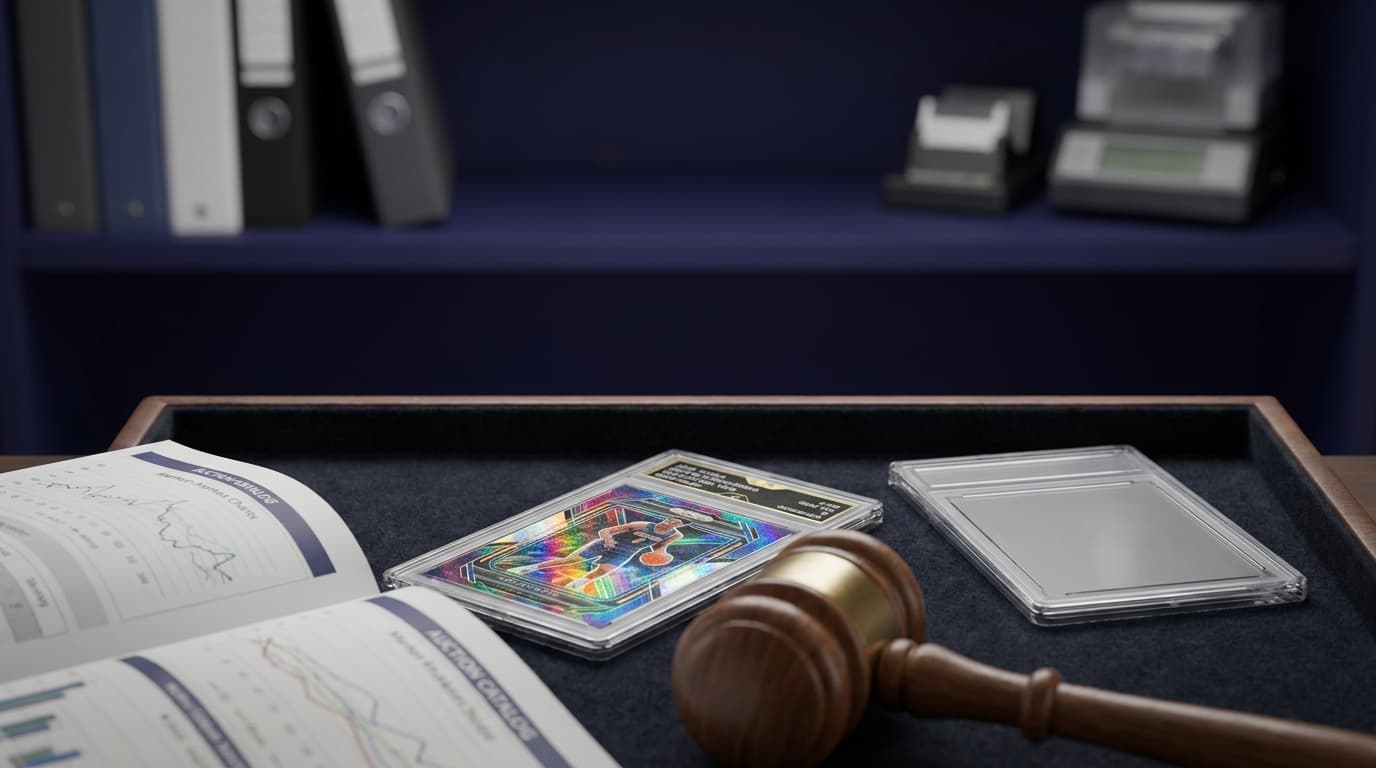
On June 22, 2026, a 2018 Panini Prizm Choice Nebula Jalen Brunson rookie — a true 1/1 — sold for $312,000 at Fanatics Collect. To frame the trajectory: that same card last changed hands for $96,600 in November 2024, and back in 2019 a copy of Brunson's rookie went for roughly $300 on eBay. (ESPN) It is a genuinely staggering number, and it is exactly the kind of headline that pulls money into a market at the worst possible moment.
One correction worth making up front, because the timing is the whole point of this article: that sale did not happen "the morning after Game 5." The Knicks clinched on June 13. The Nebula crossed the block on June 22 — roughly nine days into the spike, not at the buzzer. That gap matters, because championship card runs are not a single explosion. They are a curve with a peak and a long downslope, and most collectors meet the curve on the way up while telling themselves it only goes one direction.
This is not a victory-lap piece. It is a sell-discipline piece. The trophy is real; the multiplier on these cards is the trap.
What the Knicks actually did — and why this is the maximum-multiplier scenario
New York beat the San Antonio Spurs 4-1 in the 2026 NBA Finals, closing the series with a 94-90 Game 5 win on June 13. It was the franchise's first championship since 1973 and the third in its history. Jalen Brunson scored 45 points in the clincher and was named unanimous Finals MVP. (NBA.com)
For card valuations, that combination is about as combustible as it gets. A 53-year title drought in the largest media market in the country, a homegrown-feeling face-of-the-franchise lead guard, and a unanimous Finals MVP all stack onto the same player at the same time. Championship plus MVP plus market size plus narrative scarcity is the maximum-multiplier setup. The problem with maximum multipliers is that they are, by definition, already extended — there is not much narrative left to add, and a lot of room to give back.
Anatomy of a championship spike
Championship spikes tend to run in two distinct windows. The first is the peak window — the frenzy where eyeballs, FOMO, and fresh title coverage compress weeks of buying into days. Trade coverage of this exact run put that window at roughly the next 10 to 14 days before compression sets in. (Yahoo Sports) The second is the mean-reversion window, where attention dilutes, motivated sellers show up, and prices settle back toward a new — usually higher, but far lower than the peak — floor.
The cleanest recent precedent the trade press points to is Nikola Jokic: after his title, his cards retraced roughly 40% within about 30 days. (Yahoo Sports) That is the anchor I'd weigh most heavily.
My own working model is slightly more aggressive than the trade-press framing: I treat the peak as a roughly 7-to-10-day event and the bulk of the mean reversion as a ~30-to-45-day process. I want to be explicit that this is a model, not a law of physics. The verifiable anchors are the "10-14 days are the peak" warning and the Jokic ~40%/30-day retracement; my 45-day fuse is a reading of those data points, not an established universal rule. Treat it as a planning assumption, not a guarantee.
Case study: the Brunson Silver Prizm PSA 10
The card to watch as a barometer is the Brunson PSA 10 Panini Prizm Silver rookie. Its pre-title baseline sat around $300; within weeks of the championship it pushed past $2,000 — a roughly 6-to-7x move. (Yahoo Sports)
Here is where the durable-re-rate-versus-pop distinction earns its keep. A title-winning, unanimous-MVP lead guard in New York is a legitimately better long-term hold than he was on June 12. His floor should reset higher. But "higher floor" and "$2,000" are not the same claim. My read is that the Silver is a momentum peak, and a more reasonable late-summer settle is somewhere near ~$1,000. Note what that still represents: roughly a 3x-plus durable re-rate over the old $300 floor. You do not need to call the exact top to recognize that the last double — $1,000 to $2,000 — is the sentiment portion, and the sentiment portion is the part that compresses.
Brunson's data depth supports the idea that the core re-rate is real even as the peak is frothy: there were 14 Brunson sales of $30,000-plus in June alone, four of them above $99,000 (all since June 19), and he posted 131.9% month-over-month hobby-value growth — the highest of any tracked athlete that month. (ESPN) That is genuine bid depth at the top of the market. The question is never whether Brunson cards are worth more now. It is whether this price, on this day, in this window, is the one you want to be holding into the offseason.
Liquidity traps: when the multiplier has no floor under it
The role-player spikes are where the sell-discipline thesis stops being abstract. Two examples from this run:
-
OG Anunoby — his ungraded 2017-18 Blue Prizm (/199) rookie went from roughly $10-$11.50 to $70-$99, about a 7x move, driven largely by a single Game 4 putback ("The Tip"). (Sports Illustrated)
-
Tyler Kolek — his PSA 10 2024 Mosaic Black 1/1 ran from $1,200 in March to $15,000 on June 20, roughly 12.5x, despite minimal Finals minutes. (Sports Illustrated)
These are momentum and narrative moves, not fundamental re-rates. A 12.5x on a deep-bench player off a championship narrative is the textbook liquidity trap: the print on the screen is real, but the bid depth underneath it is thin. When the catalyst (the title glow, the one viral play) fades, there may simply be no second buyer near the last price. If you are holding one of these into strength, strength is the time to sell — not after the offseason news cycle has moved on.
The durable re-rate test
The practical way to separate a real floor reset from a sentiment pop is to ask four questions of any card that just spiked:
-
Is the player a fundamental driver or a narrative passenger? Brunson (title + unanimous MVP) is a driver. Kolek, on minimal minutes, is a passenger.
-
Is there sustained sales depth, or one print? Fourteen $30k-plus Brunson sales in a month is depth. A single 1/1 record on a role player is a print.
-
Does population scarcity actually constrain supply, or is the "scarcity" just temporary attention?
-
Did the move ride a single catalyst? One play, one game, one headline that the offseason will bury.
A card that re-rates on fundamentals plus depth can hold much of its gain. A card that pops on a single catalyst and thin volume is the one to sell into the window.
The counter-view, for balance
Not every voice in this market is saying sell. At least one outlet flagged Mikal Bridges and OG Anunoby as "undervalued" rather than overheated. (Yahoo Sports) It's worth representing fairly: a bull case on a quality two-way starter on a championship team is not crazy, and role players who become long-term franchise fixtures can hold re-rates better than a pure-momentum read suggests. The distinction I'd draw is between the legitimate version of that thesis — a starter with a durable role and reasonable entry price — and the wishful version, which is buying a 7x-off-one-play spike and calling it value. The bull case can be real; the price you pay for it still decides whether you're right.
The sell-discipline playbook
Trade coverage of this run named explicit sell candidates, and they line up with the framework above. (Yahoo Sports)
Lean toward selling into strength:
-
Brunson PSA 10 Prizm Silvers — the momentum peak, where the last double is sentiment.
-
Karl-Anthony Towns graded rookies above PSA 8. Towns lagged badly: his PSA 10 2015 Blue Prizm rookie moved only from ~$320 to $355-$528, still below its December 2024 highs of $800-$875. (Sports Illustrated) Poor Finals performance capped his multiplier — these are spikes that didn't even fully spike, which is a reason to take the bump, not chase it.
-
Topps NOW singles flipped above MSRP — print-on-demand commemoratives with little long-term scarcity.
-
The pure role-player momentum plays (Kolek, Anunoby spikes) where bid depth is thinnest.
More reasonable to hold: core Brunson assets you bought below the new floor and intend to keep through the durable re-rate — recognizing you may still ride them down from the peak before they settle. As one mid-tier reference point, a Brunson PSA 9 2018 Prizm Blue (/199) rookie moved from $351 on April 26 to $1,626 on June 22, about 4.6x. (ESPN) Whether that holds depends on which side of the re-rate test it lands on after the noise clears.
The compression catalyst: the NBA Draft and the broader offseason news cycle. Championship attention is a finite resource, and the offseason actively competes for it. Every draft headline, free-agency rumor, and summer-league storyline pulls eyeballs off the title and onto the next thing — which is precisely the mechanism that accelerates the post-title compression.
The multiplier is on the clock
The Knicks winning a title for the first time in 53 years is a real, durable change in the value of Jalen Brunson's cards. A $2,000 Silver Prizm and a 12.5x role-player 1/1 are not. The whole skill of this moment is holding both ideas at once: the re-rate is genuine, and the peak is a selling opportunity, not a new baseline.
If the trade-press 10-to-14-day peak and the Jokic ~40%/30-day precedent are even roughly right, the part of these prices that's pure championship adrenaline is sitting on a short fuse — and the offseason is holding the match. Disciplined exits beat hold-and-hope when the catalyst is already behind you. Decide now which of your cards re-rated and which just popped, and act on the difference while the window is still open.
Related reading
-
[The Mega Greninja Halo: How a Chaos Rising Chase Card Is Quietly Reviving 2016 Greninja BREAK — and Whether the Vintage Bump Holds](/article/mega-greninja-halo-chaos-rising-2016-greninja-break-vintage-bump)
-
[Topps Series 2 2026 Lands: Paul Skenes Sophomore Base Math and Why Series 2 Rookies Are Outrunning Series 1 for the First Time in a Decade](/article/topps-series-2-2026-skenes-sophomore-base-series-1-spread)
Sources
-
Recap: Knicks win the 2026 NBA championship, defeating Spurs in five games — NBA.com
-
Jalen Brunson rookie card commands $312,000 price at auction after Knicks' Finals win — ESPN
Note: This article contains AI-assisted content and has been reviewed in our editorial workflow.
DISCLAIMER: PureGrail articles are for informational and entertainment purposes only. Nothing on this site constitutes financial, investment, or legal advice. Collectibles are speculative assets and values can decrease significantly. Always conduct your own research before buying or selling. Past price performance does not indicate future results.