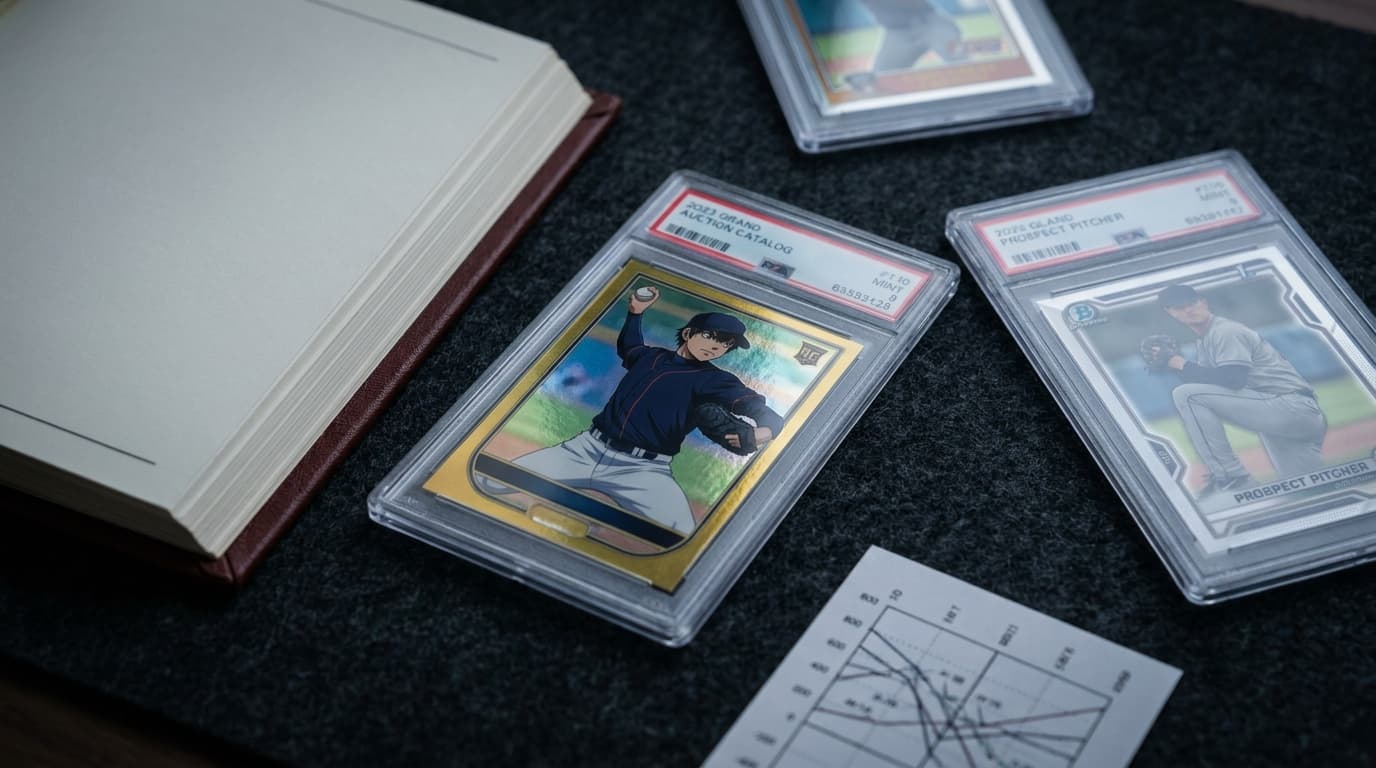
On June 21, 2026, a single baseball card changed hands for $45,600. The card was a 2026 Bowman Anime Superfractor 1/1 rookie of Milwaukee Brewers right-hander Jacob Misiorowski, and the sale — reported by Yahoo Sports and executed on Fanatics Collect — landed as the second-highest Misiorowski sale on record. The only number ahead of it is a 2022 Bowman Chrome DP Superfractor prospect autograph 1/1 (PSA 10) that sold for $52,800.
Here is the part worth sitting with before you nod along: the buyer priced a five-figure card off roughly half a season of major-league pitching. At the time of the sale, Misiorowski's professional track record as a big-league starter amounted to about 93 innings. That is the entire evidentiary base under a $45,600 bet. This piece is about what that money is actually buying — and about a specific risk the market keeps underweighting when it pays up for a pitcher.
The performance case: what the buyer is paying for
To be clear, the number is not irrational on its face. The performance underneath it has been genuinely elite. At the time of the June sale, Misiorowski was around 8-3 with a 1.45 ERA, a 0.75 WHIP, and 138 strikeouts across 93 innings — a strikeout rate north of 13 per nine. By later in the 2026 season, per his ESPN game log and Baseball-Reference record, he had extended that to roughly 9-4 with a 1.47 ERA, a 0.78 WHIP, and 156 strikeouts through 17 starts and about 104 innings, leading qualified MLB pitchers in ERA, WHIP, and strikeouts.
(One housekeeping note for anyone reconciling figures across sources: the sale-date line reads 8-3, 1.45; the later-season line reads 9-4, 1.47. Both are correct as of their respective dates. We'll keep figures tagged to when they were true.)
The résumé also carries the kind of highlight-reel milestones that move hobby demand. Per the milestones consolidated on his Wikipedia page, the 24-year-old set a pitch-tracking-era record for a starter with a 105.5 mph fastball on June 26, 2026 (thrown to Pete Crow-Armstrong), ran a scoreless streak of roughly 29.1 innings, and was named an All-Star in each of his first two MLB seasons. Layer on the card itself — the Anime insert design blends a Japanese-animation aesthetic with a 1955 Bowman-style TV-set frame, per Fanatics' description — and you have novelty and scarcity stacked on top of an ace-level statistical profile. That is the bull case, and it is not a weak one.
The skeptical math
Now the other side. Ninety-three to 104 innings is a thin track record on which to anchor a top-of-market price. Pitchers regress. Leagues adjust. And Misiorowski's specific profile — max-effort delivery, triple-digit velocity, a fastball that touched 105.5 mph — is the exact archetype most associated with elevated arm-injury risk. The harder a starter throws and the more effort it takes to get there, the fatter the tail on the distribution of outcomes.
The market treats that velocity as pure upside. It is also a risk flag. A card priced to a 1.45 ERA is implicitly priced to durability, and durability is the one thing a 24-year-old flamethrower with barely 100 big-league innings has not yet demonstrated. You are not paying for what he has done; you are paying for a projection that assumes the arm holds. That assumption is doing enormous, unpriced work.
The pitcher-card discount nobody prices in
This is the core of the thesis, and it applies well beyond the single 1/1. At the very top of the market, a buyer paying $45,600 for a true one-of-one is at least buying irreplaceable scarcity. The bigger mispricing sits below the 1/1 line — in the parallel ladder that most collectors actually buy into.
Sports Card Investor tracks the full ladder on his 2022 Bowman Draft Chrome auto: Refractor /499, Purple /250, Aqua Lava /199, Blue /150, Green /99, Black /75, Sparkle /71, Gold /50, Orange /25, Red /5, down through Black Wave /1 and the Superfractor /1. Prices compress fast as you move off the top. His base Refractor /499 raw sold for $1,425 on 6/30/2026, with a PSA 10 example at $3,170 on 6/28/2026 — and earlier 2026 sales in the $440–$625 range. The gradient tells the story: the non-1/1 tiers sit far below the headline number and move quickly with sentiment.
The problem is that buyers stacking into these tiers on a hot streak are, in effect, buying the same arm-injury tail as the 1/1 buyer — but they rarely discount for it. A $1,425 Refractor and a $3,170 PSA 10 both live or die on the same elbow and shoulder. When a max-effort pitcher's performance is peaking mid-season, demand across the entire ladder inflates at once. That is exactly when the injury/regression tail is least reflected in the price, because the recent evidence all points up. The discount that should exist for holding a speculative pitching asset — the haircut for the surgery scenario — quietly disappears from the market right when it should be widest.
Comps that bound the range
To sanity-check the outcomes, it helps to bracket them. On the ceiling, there is Paul Skenes. His 2023 Bowman Chrome Draft Prospect Auto Superfractor 1/1 (PSA 7) sold for $123,220 at Goldin on September 30, 2024, up from $80,520 that June, with the non-auto PSA 10 Superfractor reaching $63,000 in August 2024. That is roughly what a best-case, elite-young-arm 1/1 can command when the market fully buys in. It is the aspirational number a Misiorowski bull is implicitly reaching toward.
The floor is uglier and less discussed. Pitching prospects are among the most volatile segments in the hobby. As All Vintage Cards lays out, arm injuries are common and values can collapse quickly once a surgery enters the picture. The canonical cautionary tale, catalogued among the biggest baseball prospect busts, is Mark Prior — a dominant young arm whose value evaporated. The point is not that Misiorowski is Prior. It is that the same profile — young, overpowering, high-effort — has produced both outcomes historically, and the market pays the Skenes ceiling far more readily than it hedges the Prior floor.
Historical hit rate
Zoom out to the pattern rather than the player. A mid-season, peak-performance prospect buy is close to a definition of buying the top: you are transacting at the moment recent data is most flattering and least complete. For a position player, regression is the main risk. For a max-effort pitcher, regression shares the tail with injury — two independent ways to give the price back. History says a meaningful share of these blowoff-top pitcher buys do not hold, precisely because the event that reprices them (a UCL tear, a shoulder issue, a velocity dip) tends to arrive without warning and reprices hard. The cards that hold are the ones where durability eventually gets demonstrated. That evidence, by definition, does not yet exist at 93 innings.
Bottom line
A mid-season heater can justify a top-of-market 1/1 — but only for a buyer who has honestly haircut the pitcher tail and still likes the number, and who is buying genuine one-of-one scarcity rather than a parallel priced as if it were scarce. Misiorowski's 2026 has been, statistically, as good as a starting-pitcher season gets: MLB-best ERA, WHIP, and strikeouts, a velocity record, back-to-back All-Star nods. None of that is in dispute.
What is in dispute is whether $45,600 — or the compressed prices down the /499-to-/1 ladder — reflect the possibility that the arm behind the numbers is one delivery away from a different story. A disciplined buyer prices both the Skenes ceiling and the Prior floor, weights the floor more heavily for a 105-mph max-effort arm than the market currently does, and pays accordingly. The performance is real. The discount nobody prices in is the reason to pay less for it than the tape says you should.
Related reading
Sources
-
2022 Bowman Chrome DP Superfractor Jacob Misiorowski Prospect Auto 1/1 PSA 10 — Fanatics Collect
-
Jacob Misiorowski 2022 Bowman Draft Chrome Refractor /499 Price Guide — Sports Card Investor
-
Boom or Bust? The Pros & Cons of Investing in Baseball Prospect Cards — All Vintage Cards
Note: This article contains AI-assisted content and has been reviewed in our editorial workflow.
DISCLAIMER: PureGrail articles are for informational and entertainment purposes only. Nothing on this site constitutes financial, investment, or legal advice. Collectibles are speculative assets and values can decrease significantly. Always conduct your own research before buying or selling. Past price performance does not indicate future results.