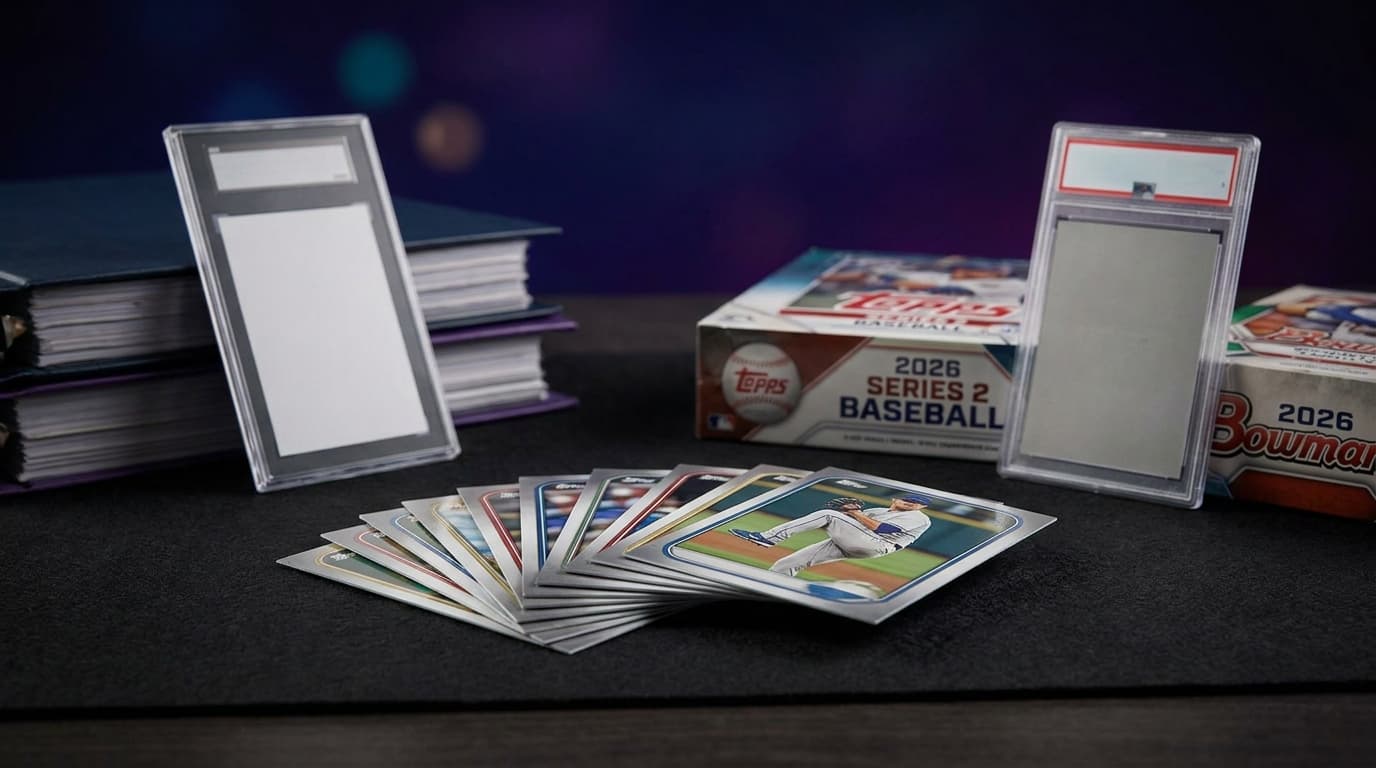
The strangest thing about 2026 Topps Series 2, hitting hobby shelves on June 10, isn't the product itself — it's the price action around it. Series 2 is supposed to trade at a discount to Series 1. Series 1 catches the marquee rookie debut photography, Series 2 mops up the back half of the checklist, and the hobby boxes price accordingly. That spread has compressed this year, and the reasons are not entirely about Paul Skenes.
The Product, on Paper
The configuration is unchanged from recent flagship years. The 350-card base set picks up at #351 and runs through #700, a continuation of Series 1. Hobby boxes hold 20 packs of 12 cards with one guaranteed auto or relic per box. Jumbo boxes step up to 10 packs of 40 cards with one auto and one relic each. The insert lineup includes the K Zone die-cut SP, which features Skenes alongside the standard Series 2 inserts and parallels.
Skenes is also on the multi-generational hobby box cover, sharing the treatment with Willie Mays, Sandy Koufax, and Vladimir Guerrero Jr. It's a deliberate anchor — Topps is leaning on the cover and the K Zone insert to carry box-rip interest, because the base card itself is a sophomore base, not a debut.
The Spread That Shouldn't Exist
Here is the data point that frames everything else. 2026 Topps Series 1 hobby is trading around $125 on the secondary market — basically flat to where 2025 Series 1 settled. Meanwhile, 2026 Bowman hobby has run to roughly $310 against a $239.99 presale and $259.99 release-day MSRP, with jumbos sitting near $540. The entire flagship complex is being pulled up by Bowman heat, and Series 2 is launching into that updraft.
Series 1 vs Series 2 spreads have historically widened in Series 1's favor because that's where the debut RC photography lands. In 2026 the spread has compressed, and the question worth asking is whether what's compressing it is real demand for Series 2's rookie checklist depth — or inventory rotation off the Bowman wave.
Skenes, the Anchor — and the Fundamentals
The bull case starts with Skenes. He won the 2025 NL Cy Young with a 1.97 ERA — the first sub-2.00 ERA from a starter since Justin Verlander's 1.75 in 2022. That kind of season-two underwriting is what gets a player onto a generational cover and a die-cut insert.
The fundamentals through early June are less helpful. Skenes sits at 3-1 with a 3.27 ERA and a 0.91 WHIP — still good, but down from the baseline the card was priced against. He gave up five earned runs while recording only two outs on Opening Day against the Mets on March 26, and entering June he was on a four-start streak of allowing three or more earned runs after seven of his first nine outings held opponents to one run or fewer.
None of that breaks the card. But it does mean the velocity argument has to lean on the K Zone insert and the cover-anchor branding, not on a base card that prints in volume.
The Sophomore Base Discount, Historically
Year-two flagship base cards have a fairly consistent discount curve, and the shape of the discount depends on where the true RC actually lives.
Ronald Acuña Jr.'s true rookie card is the 2018 Topps Series 2 SSP — roughly one per case, with the Bat Down variation rarer than Bat Up. His 2019 sophomore base trades at a steep discount to that SSP because the SSP scarcity is doing the heavy lifting, not the photograph. Bobby Witt Jr.'s flagship RC is 2022 Topps #US100 in Update, with a #660 SP variation in the Series 2 base run; his 2023 sophomore base sits well below either. Juan Soto's structure is similar — he debuted in 2018, so 2019 Topps flagship is a sophomore base, while the marquee RCs sit in 2018 Bowman and Update.
The takeaway for Skenes: his 2026 Series 2 base will land at a meaningful discount to his 2024 Topps RC regardless of how the sophomore season finishes. The K Zone insert is where the upside compression lives, not the base.
Per-Box Pull Math at Current Levels
At $125 for a 20-pack hobby box, you are paying $6.25 per pack for 12 cards and one guaranteed auto-or-relic. That's 240 base-eligible cards against a 350-card half-set — you will not complete the run from a single hobby box, and the single hit is split across either an auto or a relic, not both.
Jumbo boxes at $250–$275 secondary deliver 400 cards across 10 packs with one auto and one relic guaranteed. The per-card cost drops materially, the hit count doubles, and a single jumbo rip puts a one-box base complete in realistic range. For collectors targeting Skenes base plus the K Zone insert plus checklist depth from the call-up wave, the jumbo math is closer to what serious set-builders actually want.
Why the Checklist Isn't the Usual Series 2 Leftovers
Series 2 usually catches the rookies who didn't make Series 1's photo cutoff, which means the checklist often reads as B-list. 2026 is different for two reasons.
First, the in-season call-up wave is unusually deep. [Konnor Griffin debuted as the Pirates' #1 overall prospect](https://athlonsports.com/collectibles/collectibles-mlb-prospect-call-ups-2026-rookie-cards), with Colt Emerson and Payton Tolle joining the rookie ranks early enough to make the Series 2 print window. The rookie cards moving fastest on the secondary line up with what Baseball America has flagged as the Series 2 names worth hunting.
Second, the class as a whole is unusually strong. Baseball America's top-20 MLB rookies for 2026 has 13 of those 20 ranked as top-25 overall prospects — tying 2016 for the strongest rookie class of the past 15 years. Series 2 catches more of that wave than usual because the print window lands after a meaningful slice of those debuts.
Roki Sasaki, whose true flagship Topps RC was 2025, opened 2026 in the Dodgers' rotation with a weak April and a better May. If he appears in the Series 2 base, treat it as a secondary driver. The Sasaki RC chase already cleared in 2025.
Who's Actually Buying the Jumbos?
This is the part of the demand picture that doesn't get talked about enough. Industry trend coverage for 2026 reports a collector shift toward singles and away from group breaks. That matters because jumbo box demand from breakers and case hoarders is not the same signal as end-user singles demand.
If breakers are buying jumbos to feed streams and end-users are buying singles off those streams, the jumbo price is being held up by inventory rotation, not by terminal demand. If end-users are buying jumbos directly to rip for personal collection, the price has a more durable floor. The trend signal points closer to the first picture than the second, which is the structural reason to be skeptical of the $250+ jumbo level holding through July.
Mean-Reversion vs Persistence
Two scenarios for how the spread resolves over the next four to six weeks.
Mean-reversion: Skenes' ERA continues to bleed and the K Zone insert anchor softens. Bowman cools as the initial release scarcity premium fades. Series 2 supply lands and the Series 1 vs Series 2 spread snaps back to its normal Series-1-premium shape. Hobby drifts toward $100–$110, jumbos toward $220–$240.
Persistence: Skenes regains his 2025 form, the call-up wave keeps accelerating into July, Bowman holds the $300+ hobby level, and Series 2 stays close to or above Series 1 on a per-box basis. Jumbos sustain $250+ on real end-user demand rather than rotation.
The case for mean-reversion is stronger on fundamentals. The case for persistence depends on the rookie class continuing to deliver names — which, given the depth of the underlying class, isn't a stretch.
Reader Takeaway
Practical framework for the next four to six weeks:
-
Jumbo boxes: Hold if you already own. Don't chase at $260+ unless you specifically want the auto-plus-relic guarantee and the set-build math. Watch for Bowman cooling as a signal to wait.
-
Hobby boxes: The $125 level is the marginal trade. Not cheap, but not bid up the way Bowman is. Reasonable rip price if you want checklist exposure without overpaying for the configuration.
-
Skenes raw base: Sophomore base. Wait for the post-release supply bulge before paying any premium. The Acuña, Witt, and Soto comps all point to a discount that takes a few weeks to settle.
-
Skenes K Zone insert: This is the actual chase card from the Skenes side of the checklist. SP die-cut tied to the cover treatment — graded population is what will matter, so factor grading turnaround into your entry timing.
-
Rookie singles from the call-up wave: Griffin, Emerson, Tolle. These move on news. Decide whether you're buying the player or the print run before clicking buy.
The thing to watch isn't Series 2 itself. It's what Bowman does in July, and what Skenes' ERA looks like at the All-Star break. The spread closes — or doesn't — on those two variables, not on the Series 2 product mechanics.
Related reading
Sources
-
2026 Topps Series 2 Baseball Checklist & Set Info (Checklist Insider)
-
2026 Topps Series 2: Rookies & Prospect Cards (Baseball America)
-
Ronald Acuña Jr. Rookie Cards Checklist (Cardboard Connection)
-
Bobby Witt Jr. 2022 Topps #660 SP Variation (Sports Card Investor)
Note: This article contains AI-assisted content and has been reviewed in our editorial workflow.
DISCLAIMER: PureGrail articles are for informational and entertainment purposes only. Nothing on this site constitutes financial, investment, or legal advice. Collectibles are speculative assets and values can decrease significantly. Always conduct your own research before buying or selling. Past price performance does not indicate future results.