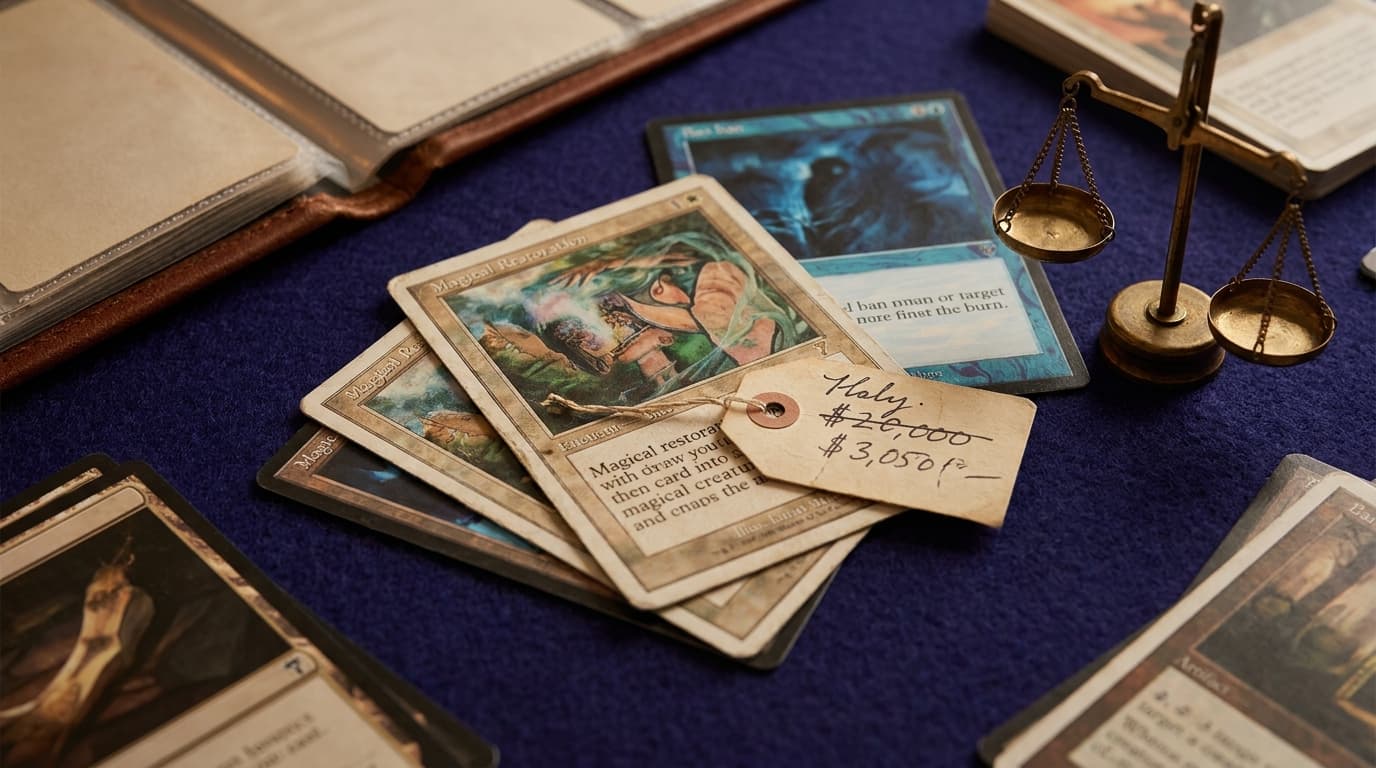
When a Reserved List card jumps in price, the reflex among experienced collectors is to look for a buyout — a coordinated sweep of available copies designed to manufacture scarcity and flip the card into a thin market. That pattern is real, it is common, and it is something seasoned hobbyists have learned to fade. So when Replenish, an enchantment from 1999's Urza's Destiny, recorded a $225 sale by March 2026 after sitting around $120 at the end of December 2025, the obvious question is whether someone simply bought the card up.
The evidence says no. There is no single squeeze here. What moved Replenish was the slower, broader, stickier force of tournament demand — a format gaining players, a ban reshaping its metagame, and a card that can never be reprinted landing at the center of the best deck. That distinction matters, because format-driven appreciation on fixed supply tends to behave differently from a buyout. Understanding why is the point of this article.
What changed in eight months
The catalyst was access. Premodern — a 60-card constructed format built from cards printed between Fourth Edition and Scourge — had existed for years as a paper-only, community-run format. That changed on December 8, 2025, when Premodern debuted on Magic Online as the first format featured in MTGO's new "Contraption" format-lab. According to that announcement, among 60-card formats Premodern generates the most player requests.
Going digital does two things to a paper format. It lowers the barrier to play — no need to assemble a physical deck of decades-old cards to test a list — and it lends legitimacy, signaling that the format has an official home and a future. The result over the following months was more players and more events, which is the raw material demand is built from. None of that is a buyout. It is a population increase.
The ban that reshaped the metagame
The second catalyst was a banlist update — the format's first since July 2023. On January 18, 2026, Premodern's Martin Berlin announced that Parallax Tide would be banned, effective on Magic Online on January 20. The decision was covered across the trade press, including Star City Games.
The rationale is worth understanding because it explains the downstream price action. Parallax Tide functioned as a one-sided Armageddon — a mass land phase-out that crippled an opponent's mana while leaving its controller intact. Per the data cited with the ban, roughly 30% of top-8 slots in 65-plus player events were occupied by decks built around the card: Stiflenought, Replenish, and Tide Control variants. When a single card warps that much of a competitive field, removing it resets the metagame.
Crucially, Parallax Tide was the worst predator of GW/Selesnya Enchantress. Banning it removed Enchantress's hardest matchup and left the archetype sitting at the top of the post-ban metagame.
Why Replenish specifically
This is where supply meets demand. Replenish is a four-of staple in the dominant post-ban Enchantress deck — meaning a competitive player doesn't want one copy, they want four. The card is the engine that makes the deck explosive, and there is no substitute that does the same job.
Now layer in the supply side. Replenish is on the Reserved List as an Urza's Destiny printing, which means Wizards of the Coast has committed to never reprinting it. Supply is permanently fixed at whatever was opened in 1999. Most format staples can absorb a demand surge because a reprint eventually relieves the pressure; Replenish cannot. When demand rises against a hard cap, price is the only release valve.
That combination — a four-of requirement in the best deck, sitting on supply that physically cannot expand — is the mechanical reason a $120 card became a $225 card without anyone needing to corner the market.
The price record
The trajectory is documented. Replenish sat near $120 at the end of December 2025. By March 2026 a copy sold for $225, and near-mint listings have carried asking prices as high as $299. Played copies are commonly cited at nearly $175, which puts the working market in roughly a $175–$225 band depending on condition.
The more telling data point is not the headline price but the listing count. TCGplayer supply is described as extremely thin — only a handful of near-mint copies available at any given time. In a buyout, thin supply is the manufactured product of the buyout itself, and it tends to refill as the buyer's appetite is satisfied and others list into the spike. Here, the thinness reflects a structural reality: there were never many copies to begin with, and players who acquire them are putting them into decks rather than back onto the market.
The index lens
If this were a single-card pump, you would expect Replenish to move alone. It didn't. The Premodern Price Index — an aggregate of format-played cards snapshotted daily from MTGJSON — was up 22.2% over the trailing 90 days as of June 20, 2026. That is breadth, and breadth is the fingerprint of format demand rather than a targeted squeeze.
The sympathetic movers tell the same story. Cursed Scroll, a format staple, climbed to over $100 near-mint by June 2026, up from roughly $40–$75 earlier in the year. MTGStocks and Draftsim document a wider basket: Phyrexian Dreadnought moved from around $180 to $250, Gaea's Cradle sits near $1,800 near-mint (up roughly $75 in 30 days), and fringe Tireless Tribe pieces like Glory have spiked several hundred percent off low bases — Draftsim's coverage cites moves as large as 1,269%. When an entire format's card pool re-rates together, the demand is coming from the format, not from one buyer working one card.
Buyout vs. player squeeze: how to tell them apart
For collectors trying to read whether a spike is worth respecting or worth fading, the Replenish episode is a useful template. Four signals separate format-driven demand from a buyout:
- Velocity. Buyouts are fast and spiky — a near-vertical move over days. Replenish's path from roughly $120 to the $175–$225 band played out over months, tracking the format's growth and the post-ban metagame settling.
- Breadth. A buyout hits one card. Format demand lifts a basket — here, the index up 22.2% over 90 days alongside Cursed Scroll, Dreadnought, Cradle, and Tireless Tribe cards all moving in sympathy.
- Who is buying. Buyout copies sit in dealer and speculator inventory waiting to be re-sold. These copies are going into decks, which is why the listings stay thin instead of refilling.
- Durability. Buyout scarcity is artificial and tends to unwind when the buyer stops. Demand resting on tournament playability persists as long as the deck stays good.
This is why coverage across the trade press has consistently framed the Premodern move as player- and competition-driven rather than speculative — and why that framing should change how you weigh it. Collectors fade buyouts because the floor is fake. A floor built on four-of demand in the best deck of a growing format is a different kind of floor.
The open question
None of this guarantees the price holds. The honest framing is that format-driven appreciation on Reserved List supply should hold its level differently than a hype spike — slower to rise, but with more underneath it — yet the thesis has clear failure points worth naming.
The most direct is another banlist update. The current price rests on Enchantress being the dominant deck and Replenish being its irreplaceable four-of; a future ban that weakens the archetype, or a metagame shift that demotes it, would pull demand out from under the card. A second risk is the format simply cooling — the MTGO novelty fading and event counts receding toward their paper-only baseline. A third, more structural concern is whether the demand at these levels is genuinely all players, or whether speculators have begun front-running the format's growth, in which case some of the move carries the fragility of any speculative position.
The Reserved List guarantees the supply side will never flex. What it does not guarantee is that demand stays where it is. For now, the cleanest read on Replenish is that its move is real in the sense that matters most to a skeptic — it is anchored to playability rather than to a squeeze — while remaining exactly as durable as the format and the metagame that created it. Watch the banlist, watch the event counts, and watch whether the listings stay thin. Those are the variables that will tell you whether $225 was a level or a peak.
Sources
- Premodern Debuts in Contraption – Magic Online's Format Lab (MTGO)
- Ban List Update 2026 – Premodern Magic (Martin Berlin)
- Parallax Tide Banned In Premodern – Star City Games
- MTG Premodern Ban Causes Reserved List Card to Hit $225 – MTGRocks
- Premodern's Price Awakening – MTGStocks
- MTG Singles Price Spikes June 2026: Biggest Market Movers – The Cardboard Chronicles
- Rising MTG Format Causes Multiple Spikes Up to 1269% – Draftsim
- MTG Premodern Enchantress decklists – MTGDecks
Note: This article contains AI-assisted content and has been reviewed in our editorial workflow.
DISCLAIMER: PureGrail articles are for informational and entertainment purposes only. Nothing on this site constitutes financial, investment, or legal advice. Collectibles are speculative assets and values can decrease significantly. Always conduct your own research before buying or selling. Past price performance does not indicate future results.