For roughly thirty years, the Pokémon Trading Card Game ran on a predictable rhythm: a set would launch in Japan first, and the English and other localized versions would follow two to three months later. That lag was more than a scheduling quirk. It was the structural foundation of an entire trade — the Japan-first arbitrage — in which importers bought sealed Japanese product and sold it into a Western market that had no localized equivalent yet.
On September 16, 2026, that window closes. The Pokémon Company has confirmed that Pokémon TCG: 30th Celebration will release simultaneously worldwide — explicitly described as "the first to have a simultaneous global release." The set was revealed on June 1, 2026. For the first time, there is no head start to exploit.
This piece does two things. First, it quantifies what actually lived inside that 2–3 month gap using real sealed-box price data. Second, it asks the harder question: how much of recent anniversary-flipping profit came from regional timing that this release eliminates, versus genuine card scarcity that a synchronized launch does nothing to change.
What lived in the Japan-first gap
The historical cadence is well documented: Japanese sets shipped roughly every 8–12 weeks, ahead of their English counterparts, with the localized release trailing by about 60 days (Samurai Sword). That offset is precisely the asset the import trade monetized.
The mechanics were simple. Pre-order pricing is peak fear-of-missing-out pricing. For English sealed product, boxes typically fall 10–20% within two to four weeks of launch as supply catches up to hype — for example, Phantasmal Flames boxes moved from $313 to $265, a 15.3% drop in under two weeks.
Japanese product follows a similar decay but on its own earlier clock: pre-order prices tend to hold, then decline about a month into the launch, then slide a further 5–10% — a combined peak-to-trough pullback of roughly 25%. The MEGA Dream ex set, for instance, sold about 18.3% cheaper the day after launch than at pre-order, before tariffs. The arbitrage trade harvested the difference between an early Japanese availability window and a still-empty Western shelf.
What a synchronized launch removes — and what it doesn't
A same-day global drop kills the regional-timing edge outright. There is no import scarcity if every region is supplied at once, and no pre-localization vacuum to sell into if the localized product already exists on day one. Trade coverage frames the simultaneous release as a deliberate move to eliminate that 2–3 month import window, and notes Japan is separately debuting an identity-verification purchase system alongside the set as an additional anti-scalper measure.
But timing arbitrage and card scarcity are not the same thing, and conflating them is where flippers get burned. A synchronized launch leaves untouched: language and SKU collectibility (a Japanese print and an English print remain distinct collectibles), and genuine chase-card scarcity driven by pull rates rather than geography. Removing the calendar gap removes one source of edge. It does not flatten a set's internal rarity structure.
The pull-rate rework: a guaranteed hit in every pack
30th Celebration is mechanically unusual, and that reshapes per-pack expected value from the floor up. According to the official announcement and corroborating trade reporting from VGC and PokéBeach:
-
Six cards per pack instead of the usual composition, and every card is foil — including Basic Energy.
-
A guaranteed Pikachu in every booster, drawn from 30 unique Pikachu cards, each illustrated by a different artist. Revealed artists include Atsuko Nishida — the original Pikachu designer — alongside Yuu Nishida and OKACHEKE.
-
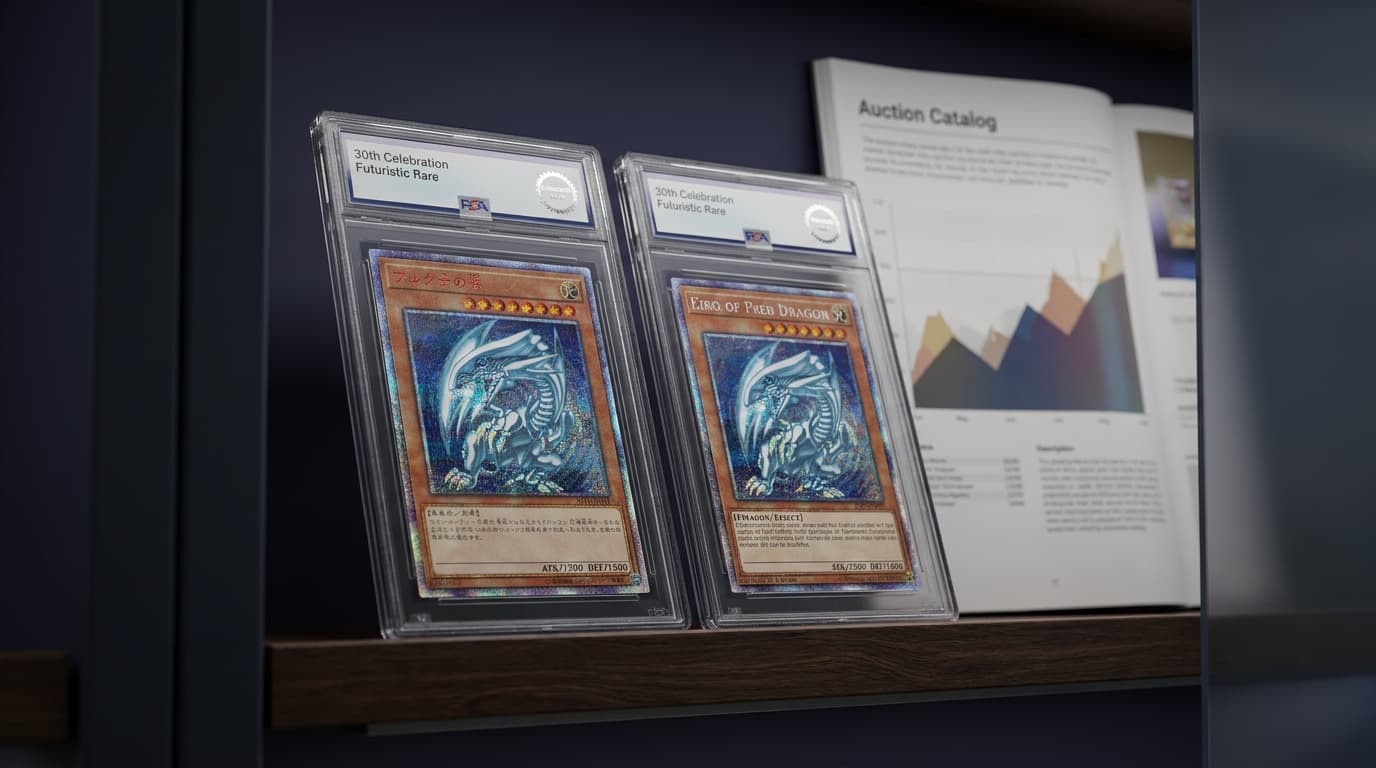
A new rarity, "Futuristic Rare," with neon, striking art described as "evocative of hope toward an unknown future," by Japanese artist YOSHIROTTEN. Mewtwo and Mew are the first two.
-
Around 30 reprinted classics, including a Base Set Charizard and Pikachu & Zekrom-GX. Note: these reprints are not Standard-legal.
The trade and aggregator reporting puts the set at roughly 150-plus cards, though that is not an official Pokémon Company count and should be treated as provisional.
The structural effect is a raised floor and a contested ceiling. A guaranteed 1-of-30 Pikachu plus all-foil contents means every pack has a tangible "hit" — there is no true blank. That tends to support the perceived value of opening product. But it also means the floor cards are, by design, not scarce: if everyone's pack contains a foil Pikachu, the bulk Pikachu cards have wide supply. The ceiling lives elsewhere — specific sought-after Pikachu artists, the Futuristic Rare chase cards, and graded high-grade copies of marquee pulls.
Compress or amplify? The case on both sides
With the timing arbitrage gone, the open question is what happens to day-one premiums. There is a credible argument in each direction.
The case for compression
No import scarcity exists when all regions are stocked simultaneously. There is no Western availability vacuum, so the price spike that used to come from being early disappears. And the base rate is unforgiving: sealed premiums normally fade 10–20% within weeks of launch as supply normalizes. If product is broadly available everywhere at once, that normalization could arrive faster, not slower.
The case for amplification
The opposite reading is that a synchronized launch concentrates global demand into a single moment. Instead of demand being spread across a Japanese window and a later English window, every region competes for the same day-one allocation. That matters because supply may be constrained: per Wargamer, The Pokémon Company's new manufacturing facility reportedly isn't online until 2027, and while the 25th-anniversary strategy leaned heavily on overprinting, current demand may outstrip available spare capacity. A single synchronized demand spike against constrained print capacity is the classic recipe for an amplified, if potentially short-lived, premium.
The honest answer is that these forces partly offset, and the outcome likely splits by product: sealed boxes, if well supplied, are vulnerable to the usual post-launch fade, while the genuinely scarce chase singles are where any durable premium concentrates.
Decomposing the flip profit: timing vs. scarcity
Here is the analytical core. Recent anniversary and set-launch flipping profit was a blend of two distinct sources:
-
Regional-timing arbitrage — money made purely from being early, buying Japanese sealed product and selling into a Western pre-release vacuum. 30th Celebration eliminates this source entirely.
-
Card scarcity — money made from genuinely hard-to-pull cards whose value derives from pull rates and condition, not geography. This source persists regardless of launch timing.
The practical implication: a flipper whose edge was mostly (1) loses that edge on this set. A collector or dealer whose returns came from (2) — identifying and grading the right chase cards — is largely unaffected by the synchronized launch. Separating which bucket your historical returns came from is the single most useful exercise before committing capital to a same-day global drop.
Where the edge moves — and a base-rate warning
If the timing arbitrage is gone, the remaining edges are the ones tied to real scarcity and access:
-
Pre-allocation and access. With no import window, getting volume at MSRP through distribution relationships becomes more valuable than being geographically early.
-
Graded singles over sealed. The durable scarcity in this set lives in specific cards — particular Pikachu artists and the Futuristic Rare tier (Mew, Mewtwo) — and in high grades, not in boxes that may be well supplied.
-
Selectivity within the chase pool. Not all 30 Pikachu cards will hold value equally; artist desirability and grade will sort them.
And the cautionary base rate that should temper any of this: scarcity and hype do not guarantee appreciation. Inferno X crashed 25.9% from launch and never recovered. A guaranteed foil in every pack and a shiny new rarity tier are strong marketing, but they are not a price floor. The structural story here — first same-day global launch, novel pack composition, constrained print capacity — is genuinely new. How it prices is not yet known, and anyone telling you otherwise is selling something.
Bottom line
September 16, 2026 ends the Japan-first cadence that defined three decades of Pokémon TCG releases and the import trade built on it. The regional-timing arbitrage simply ceases to exist for this set. What remains is the part that always actually mattered: genuine card scarcity, condition, and access. Whether day-one premiums compress or amplify will turn on how well the global drop is supplied against a single synchronized demand spike — with a manufacturing capacity question hanging over the answer. Treat the timing edge as gone, scrutinize where your past profits really came from, and let the base rates, not the hype, set your expectations.
Related reading
-
[The Mega Greninja Halo: How a Chaos Rising Chase Card Is Quietly Reviving 2016 Greninja BREAK — and Whether the Vintage Bump Holds](/article/mega-greninja-halo-chaos-rising-2016-greninja-break-vintage-bump)
Sources
-
Get Ready for Pokémon TCG: 30th Celebration — Pokemon.com (official)
-
Pokémon reveals 30th Celebration TCG set, with a foil Pikachu in every pack — VGC
-
"30th Celebration" TCG Set Officially Revealed for Worldwide September Release — PokéBeach
-
Pokémon must defend its 30th Celebration set from scalpers — Wargamer
-
Pokémon TCG Japanese Set Release Dates 2026 — Full Schedule — Samurai Sword
Note: This article contains AI-assisted content and has been reviewed in our editorial workflow.
DISCLAIMER: PureGrail articles are for informational and entertainment purposes only. Nothing on this site constitutes financial, investment, or legal advice. Collectibles are speculative assets and values can decrease significantly. Always conduct your own research before buying or selling. Past price performance does not indicate future results.