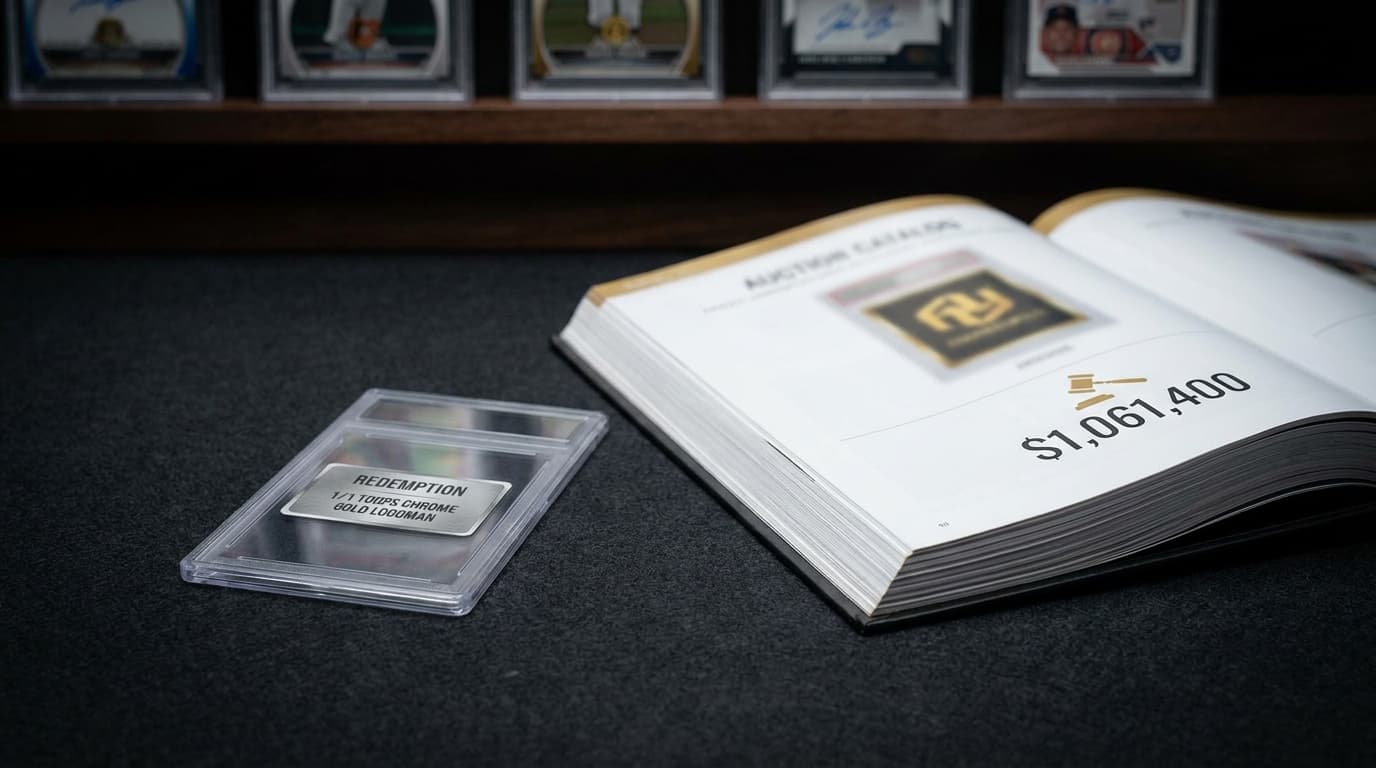
On June 6, 2026, a Shai Gilgeous-Alexander card sold for $1,061,400 at Goldin - the first SGA card ever to clear seven figures, and a public record for the player. It hammered at $870,000 before buyer's premium and drew 42 bids on its way there. It headlined a record-setting auction.
It is also a card that does not physically exist yet.
The lot was a 2025-26 Topps Chrome Gold Logoman Autographed Relics #GLM-1, numbered 1/1. But what changed hands was not the card. It was an unused redemption - a voucher Topps issues when the finished card isn't ready to be packed out. The buyer owns an IOU that Topps will, at some point, exchange for the real thing. That distinction is the entire story, and it's worth understanding before anyone treats a pull like this as an investment.
What actually sold
According to the trade reporting from Sports Collectors Daily and Auction Report, the winning bidder bought a redemption that will later be exchanged for a 2025-26 Topps Chrome Gold Logoman card carrying SGA's on-card signature and a game-worn gold NBA Logoman patch. The spec is the apex of the set: a single copy, numbered 1/1, of the most coveted parallel in the product.
The price roughly doubled SGA's prior record - a 2019-20 Panini Flawless Logoman Autographs 1/1 that sold through Goldin in March 2026 for $577,306. Sports Illustrated independently confirmed the sale and SGA's entry into the so-called million-dollar club.
For context on the room it sold into: the auction's second-highest lot was a 2018 Topps Chrome Sapphire Edition Rookie Autographs Red Shohei Ohtani graded PSA 10, which brought $530,700. The SGA redemption beat it by more than half a million dollars - on an item the seller could not put in a slab and hand over.
How the Gold Logoman program works
The Topps Gold NBA Logoman program is built around league patches - the embroidered NBA logo on a player's jersey - worn by award winners (MVP, Rookie of the Year, Defensive Player of the Year) and then cut and inserted into low-numbered, often autographed cards. Because there is one physical patch per relevant jersey, the chase cards sit at tiny print runs, and the 1/1 is by definition the only one. That scarcity is real, not manufactured numbering for its own sake; it's what makes a Logoman 1/1 the top of the pyramid in a given player's modern catalog.
It also explains why these cards so often ship as redemptions. Cutting and authenticating a game-worn league patch, securing an on-card autograph, and assembling the final card is slow work that frequently isn't finished by the time product hits shelves. So Topps packs out a voucher instead.
Why now, and why this number
The demand engine here is SGA's career peak. Per CBS Sports, he won back-to-back NBA MVP awards, becoming the 14th player to do so. Per his consolidated record, the 2024-25 season also brought a scoring title (32.7 points per game on 51.9% shooting), Finals MVP, and a championship, with the Thunder finishing 68-14. He became the fourth player in NBA history to win MVP, Finals MVP, and the scoring title in the same season.
That's the bull case in one breath. It's also the warning. A record price set at the exact moment a player has stacked every available honor is, by construction, a purchase made at or near the top of the hype curve. Nothing about SGA's play is in question. The question is whether a number set at peak narrative is the number you'd pay in three or five years - and whether the thing you're buying even arrives intact by then.
The redemption risk anatomy
This is where a buyer earns or loses the premium. A redemption is a promise with a clock on it, and the clock has teeth.
Fulfillment can take a long time. Topps' own redemption guidance tells collectors to allow up to 15 weeks for standard redemptions. High-end cards - exactly the category a 1/1 game-worn Logoman autograph falls into - routinely run past a year. During that window the buyer holds capital in an item they cannot grade, sell with certainty, or even inspect.
There is a remedy, but it's a substitution, not a guarantee of the card. Under the Topps Redemption and Authenticity Protection Program, if a redemption goes unfulfilled for more than six months with no prior substitution offered, the collector may request a replacement worth 200% of Topps' determined market value, or equivalent Topps.com credit. Read that carefully: for a one-of-one with a seven-figure sale behind it, "Topps' determined market value" and "what the market just paid" are not obviously the same number, and a credit is not a card. The remedy protects you from getting nothing; it does not guarantee you get the specific asset you bid on.
And there's a window that can close on you. As Cardlines documents, the online defect-claim portal can lock once the 12-month window expires - a genuine problem when a high-end card arrives late. A card that ships at month 13 or later can arrive after the buyer's recourse for a defect has already timed out.
Condition and grading risk you can't see yet
Layer one more unknown on top of the timeline. With an ordinary high-value card, you can see the centering, the patch placement, the autograph, the corners. You're buying a known object, often already graded. With a redemption, you're paying a 1/1 premium for a card whose physical quality is undetermined until it ships.
Centering can be off. The patch can land poorly within the window. An autograph can be light, smeared, or placed awkwardly. And because the eventual card will almost certainly be graded, a low grade can meaningfully cut value - on an asset where there is no second copy to average against. A buyer paying a million-plus is, in effect, pre-paying for a grade they haven't seen and can't influence.
Is an IOU an asset?
That's the larger question this sale forces. Vintage cards are durable, inspectable, and have decades of price history. A modern 1/1 redemption is the opposite on two of those three counts: it's young, and at the moment of sale it is not even an inspectable object. The market just demonstrated it will pay seven figures on confidence alone - confidence in the player, in Topps' fulfillment, and in the durability of the eventual card's value. That's a lot of confidence priced into a voucher.
It's a real signal about how liquid and how aggressive the top of the modern market has become. It is not, on its own, proof that the IOU is a sound store of value. Those are different claims, and the auction result only settles the first one.
How to price the risk before calling it an investment
If you're tempted to treat a modern chase pull or redemption as an investment rather than a collectible you simply want to own, the discipline is to discount, not to dream:
-
Discount for fulfillment lag. Capital tied up for a year-plus in an un-sellable, un-gradeable voucher has a real opportunity cost. Price it in.
-
Discount for condition variance. You are buying an unseen grade. The downside from poor centering, patch placement, or a weak autograph is yours alone on a 1/1.
-
Discount for single-player concentration. The entire thesis rests on one athlete at his peak. Injury, decline, or simply the market re-rating peak-hype prices all cut the same way.
-
Know the remedy's limits. The 200%-of-determined-value or credit backstop protects you from a total loss, not from a gap between Topps' valuation and the open market - and the 12-month claim window can lapse before a late card even arrives.
None of this means the sale was foolish, or that SGA's market is soft. It means the headline number and the underlying asset are not the same thing. A million dollars bought a promise. Whether that promise becomes a million-dollar card - and stays one - is the part that hasn't happened yet.
Related reading
-
[The Mega Greninja Halo: How a Chaos Rising Chase Card Is Quietly Reviving 2016 Greninja BREAK — and Whether the Vintage Bump Holds](/article/mega-greninja-halo-chaos-rising-2016-greninja-break-vintage-bump)
-
[Pitch Black Pre-Sale, 32 Days Out: Does the Fifth Mega Evolution Set Still Command a Premium After $13K of Master-Set Fatigue?](/article/pitch-black-presale-fifth-mega-evolution-set-premium-13k-fatigue)
Sources
-
SGA 1/1 Gold Logoman Redemption Card Sells for Over $1 Million - Sports Collectors Daily
-
Shai Gilgeous-Alexander Joins Million-Dollar Club With New Record Sale - Sports Illustrated
-
Topps Redemption and Authenticity Protection Program (official)
-
The Ultimate Guide to the Topps Redemption Grade Guarantee - Cardlines
-
Shai Gilgeous-Alexander named MVP: 14th player to win back-to-back - CBS Sports
Note: This article contains AI-assisted content and has been reviewed in our editorial workflow.
DISCLAIMER: PureGrail articles are for informational and entertainment purposes only. Nothing on this site constitutes financial, investment, or legal advice. Collectibles are speculative assets and values can decrease significantly. Always conduct your own research before buying or selling. Past price performance does not indicate future results.