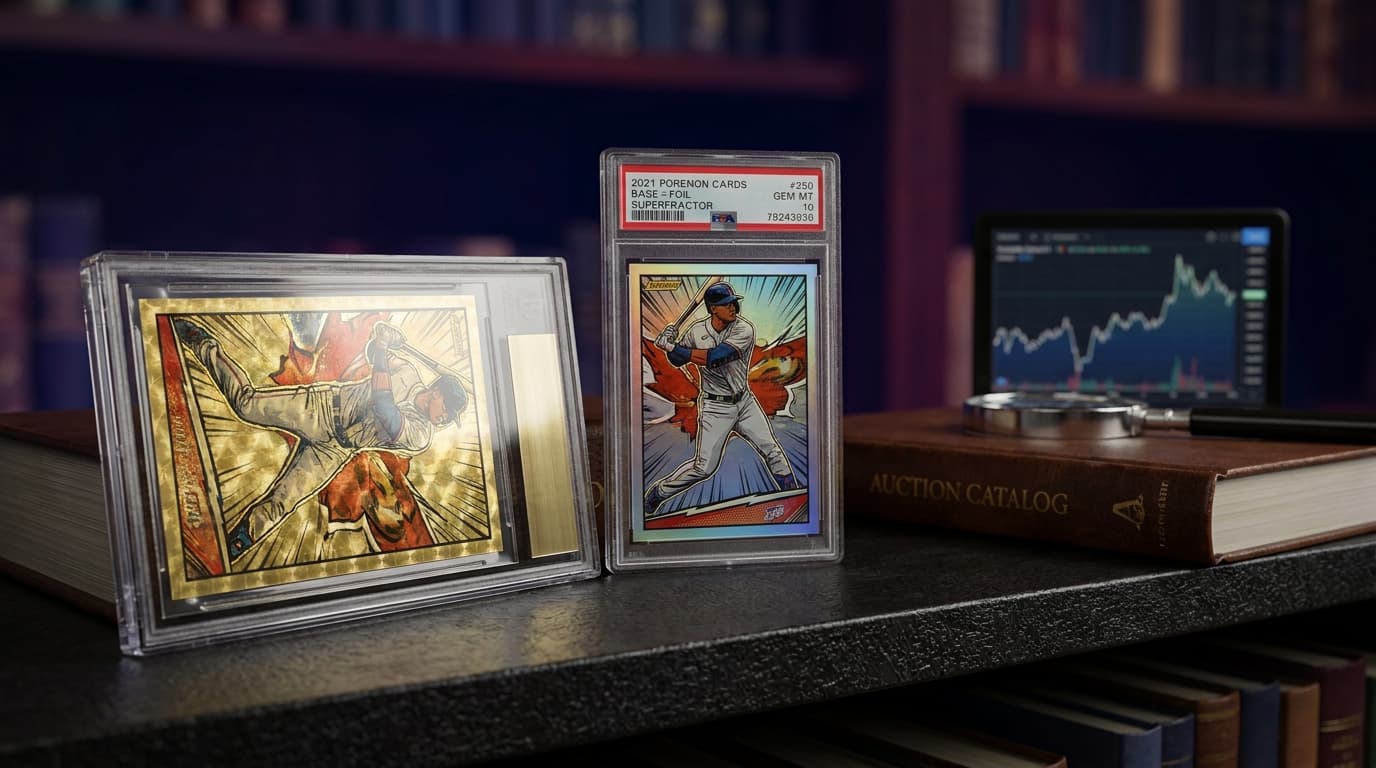
Two sales frame the entire debate around Topps' comic-styled Alter Ego Super Heroes inserts. In late January 2026, a 1/1 Shohei Ohtani 'Sho Time' Superfractor (#AE-9), graded CGC Authentic, closed at $105,000 at Fanatics Collect—reported as the highest public price ever paid for an Ohtani insert and the fourth-highest CGC-certified sports card ever sold on that platform. Then, on July 12, 2026, a PSA 9 base Ohtani Alter Ego sold for $17,632.95, leading a Collector Investor Auctions (CIA) sale in which Ohtani accounted for four of the top six lots.
A five-figure sale for a base insert is the part that should make serious collectors sit up. It raises a fair question the hobby hasn't answered yet: are art-driven inserts a durable new premium class, or are we watching the early innings of the next chase-card craze that cools once the novelty fades? Below, we lay out what the card actually is, what's verifiable about its value ladder, and the strongest cases for and against durability.
What 'Alter Ego' actually is
Alter Ego Super Heroes debuted in 2025 Topps Chrome Update Series Baseball as a 10-card insert set featuring original comic-book-styled art of stars, illustrated by Michael Blaskewicz. Per Topps' own product write-up and trade coverage, the base insert falls at roughly 1:4,074 hobby packs (about 1:203.7 boxes, or 1:17 cases), with the 1/1 Superfractor at 1:389,424 hobby packs. Those are steep odds by any measure.
The important distinction from a typical color parallel is that the demand driver here is the art itself, not the refractor tint. Buyers are chasing the illustrated concept—the superhero reimagining of a player—rather than a numbered rainbow. That's what makes the category feel novel, and it's also precisely what ties its fate to novelty rather than to scarcity alone.
The value ladder—with a real caveat
Here is where discipline matters. The only two odds tiers Topps and trade coverage publicly disclose are the base (1:4,074) and the 1/1 Superfractor (1:389,424). No source publicly lists per-tier odds or print runs for the intermediate numbered parallels (the usual /5, /10, /25, /50, /99 ladder).
That's a meaningful gap. Any confident 'base-to-Superfractor ladder' you see quoted is being reconstructed from secondary-market sales, not from a published odds sheet. Treat the middle of that ladder as estimated, not confirmed—and be skeptical of anyone pricing a /25 or /50 as though its scarcity were officially documented. Only the two endpoints are verified.
The bull case: a durable category
The case that Alter Ego is a real premium class rests on three structural points:
-
Supply is capped at print. Unlike the on-demand art programs of the past, these are fixed-odds short prints seeded into packs. Once print concludes, the population doesn't keep expanding. That's a genuine structural difference from earlier art crazes (more on that below).
-
Cross-sport franchising. Topps has already extended the concept to Topps Chrome Update Basketball, with a 10-card set including Victor Wembanyama, Cooper Flagg, and Kon Knueppel, at similar ~1:4,000 base odds. That's a signal Topps intends to build Alter Ego into a repeatable, brandable format rather than a one-off.
-
Premium art as a repeatable format. If the illustrated-insert concept has staying power across sports and seasons, it can behave like a recognizable sub-brand—the way certain long-running insert lines have.
Bear case #1: concentration risk
The clearest present-day risk is how narrowly the value is distributed. Market Movers data cited by Yahoo Sports puts the average raw (ungraded) Alter Ego at roughly $5,042 for Ohtani versus ~$3,452 for Judge. On a 10-name checklist, that means category value leans heavily on one or two superstars—and, by extension, on one or two season narratives.
A card whose price is bound to a single player's ongoing story is exposed to that player's health, performance, and headlines. When the top two names carry the set, the 'category' is really a bet on those names. That's not automatically disqualifying, but it's a very different risk profile than a broadly distributed set, and buyers should price it as such.
Bear case #2: the art-craze precedent
The cautionary history is Topps Project 2020. Its aggregate StockX price index fell roughly 63% in a single week—from $916 on May 30, 2020 to $341 on June 6, 2020—with individual cards down 50–70%. That collapse was driven by ballooning print runs (the Trout at 34,950 copies; the Griffey at 99,177).
Here's the honest nuance, and it cuts in Alter Ego's favor: Project 2020 and Project70 were high-print, on-demand programs whose supply expanded as demand rose, which is what mechanically crushed prices. Alter Ego inserts are fixed-odds short prints where scarcity is capped at print. So the specific failure mode that broke Project 2020—oversupply—does not apply here in the same way.
What does carry over is the softer half of that story: novelty fatigue. Project 2020's crash was part oversupply, part the market simply moving on from an art fad. Alter Ego is insulated against the first factor but not the second. If collector enthusiasm for illustrated inserts cools, capped supply won't save prices that were set by novelty-driven demand.
Buyer's synthesis
Sorting the two bear cases: for Alter Ego, the dominant risk is demand and novelty, not oversupply. That reframes what a buyer should actually watch:
-
The Ohtani season narrative. Because the category leans on him, his story is effectively the category's story.
-
Whether the non-Ohtani names hold. If value stays glued to one or two players and the rest of the checklist stays soft, that's evidence of a star-dependent chase, not a broad premium class.
-
Basketball-set sell-through. The cross-sport extension is the real-time test of the 'durable, franchisable format' thesis. If the basketball Alter Egos find durable demand, the bull case strengthens; if they fade after the initial rip, that's a tell.
On sizing: an insert whose price is concentrated on a single star, and whose intermediate scarcity tiers aren't even publicly documented, argues for modest, eyes-open exposure rather than conviction positioning. The capped supply is a genuine point in its favor over the Project 2020 comparison—but capped supply protects you from a supply glut, not from the market deciding it's bored.
Verification and limitations
In the interest of not overstating what's known:
-
Confirmed: both anchor comps (the $105,000 1/1 Superfractor at Fanatics Collect, January 2026; the $17,632.95 PSA 9 base at CIA, July 12, 2026), and the two disclosed odds tiers (base 1:4,074; 1/1 Superfractor 1:389,424).
-
Estimated / not confirmed: the intermediate numbered-parallel odds and print runs (no public odds sheet), and a reported prior 'record' of about $6,999 for any other Alter Ego card before the Superfractor—treat that figure as directional only, since it wasn't corroborated in the primary auction-house pages.
Related reading
-
[1,670% Search Growth, One Name Holding It Up: Is the WNBA Card Category a Boom or a Caitlin Clark Concentration Bet?](/article/wnba-cards-boom-or-caitlin-clark-concentration-bet)
Sources
-
Shohei Ohtani Super Heroes Leads CIA Auctions at $17,633 (July 12, 2026) — Auction Report
-
Ohtani Magic: 'Sho Time' Alter Ego Tops Six Figures — Sports Collectors Digest
-
Topps' 'Alter Ego' Inserts Poised to Be the Hobby's Next Big Chase Cards — Yahoo Sports
-
[Topps Chrome Update Basketball Alter Ego Inserts Are Worth the Chase — Yahoo Sports](https://sports.yahoo.com/articles/topps-chrome-basketball-alter-ego-174500685.html)
-
Chase 2025 Topps Chrome Baseball Update Series Alter Ego Cards — Topps Ripped
-
Shohei Ohtani Topps Chrome SuperFractor Alter Ego 1/1 Sets Record — Sports Illustrated
Note: This article contains AI-assisted content and has been reviewed in our editorial workflow.
DISCLAIMER: PureGrail articles are for informational and entertainment purposes only. Nothing on this site constitutes financial, investment, or legal advice. Collectibles are speculative assets and values can decrease significantly. Always conduct your own research before buying or selling. Past price performance does not indicate future results.