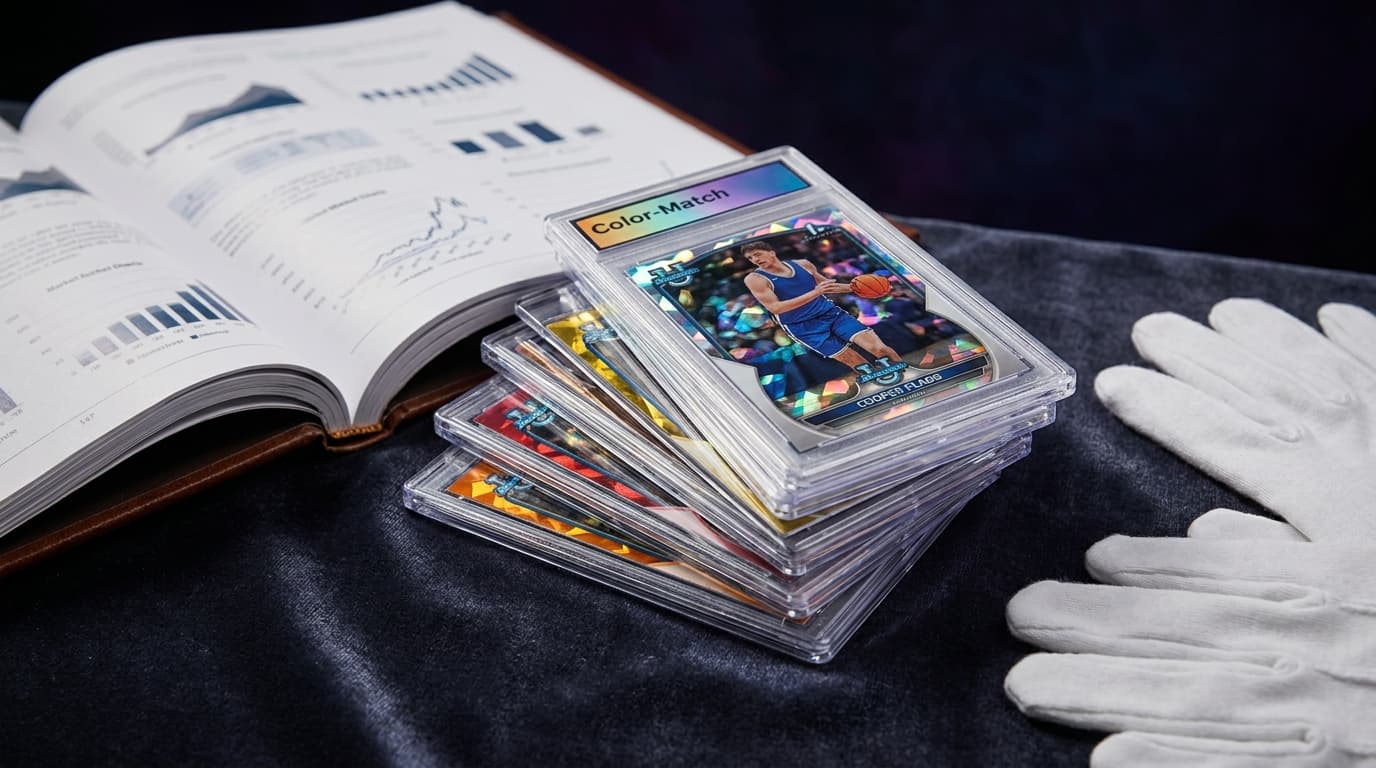
For a locked-in consensus #1, the moment the market actually reprices is not Draft night. It is the Lottery. That is the cleanest argument you can make about the 14-day window between the 2025 NBA Draft Lottery on May 12, 2025 and the 2025 NBA Draft on June 25-26, 2025 — and it is the lens this piece uses to look at Cooper Flagg's Bowman U Chrome parallel ladder.
Dallas drawing the #1 pick at roughly 1.8% odds was an outlier outcome. It resolved the single largest piece of uncertainty hanging over Flagg's pre-rookie market — landing spot — and it did so in a way that nobody had priced in. Everything after that, including Draft night itself, is a smaller-magnitude catalyst on top of a card market that has already absorbed the news.
Methodology: what we are actually measuring
Before any numbers, the rules of the road. This is the structure to apply when you pull your own comps:
-
SKUs tracked. Bowman U Chrome Flagg base; Refractor (unnumbered or /199 depending on configuration); numbered color Refractors stepping through /99, /50, /25, /10; on-card Autograph; and Color-Match parallels — the parallels whose color matches the team or jersey of the eventual landing spot. The full ladder tops out at the Superfractor 1/1, which is not a comp-able SKU in any meaningful sample.
-
Data sources. eBay sold/completed listings as the raw layer, 130point as the verification layer, and [Card Ladder](https://www.cardladder.com/) for index-level cross-check, especially when reconstructing comparable windows from prior draft cycles.
-
Exclusions. Best Offer accepted with hidden price, obvious shill or relisted sales, and any cross-condition comparisons (you do not blend raw and PSA 10 prints into the same series).
-
Sample threshold. Minimum five sold comps per SKU per side of the window. If you do not have five, you do not have a trend — you have an anecdote, and it should be reported as one.
Base Bowman U Chrome: the liquidity floor
Base Bowman U Chrome of a consensus #1 is the most liquid pre-rookie SKU available, which is why it is the right anchor for the whole exercise. Volume typically rises into Draft week as casual buyers come back into the market, while average sale price for raw copies tends to be range-bound — base is mostly a volume story, not a price story.
The work to do at write-time: separate raw sold comps from PSA 10 sold comps, count transactions per day across the 14-day window, and watch whether the sale count is climbing while price is flat. That combination — flat price, rising volume — is the signature of a market where the headline name is doing the work and the SKU is acting like a commodity.
Refractors and numbered parallels: where the compression shows up
This is the section where the Lottery-is-the-real-event thesis lives or dies. The premium parallel ladder — Refractor, then numbered color Refractors at /99, /50, /25, /10 — trades at a multiple over base. That multiple is, in effect, the market's price for two things stacked together: scarcity and uncertainty.
Scarcity does not change in a 14-day window. Print runs are fixed. What changes is the uncertainty piece. Once the Lottery resolves landing spot, the uncertainty premium that was sitting in every premium parallel begins to bleed out. The historical pattern across prior cycles — Wembanyama in 2023, Banchero in 2022, Cade Cunningham in 2021, Zion Williamson in 2019 — is that premium multiples over base compress in the Lottery-to-Draft window for consensus #1s. The headline base price can stay flat or even drift up, while the /50 or /25 multiple shrinks.
The metric to report is not the raw price of the /25, it is the ratio of /25 sold price to base sold price across the window. If that ratio is contracting, the compression thesis is intact. If it is widening, something else is in the market — usually a small-sample sale at the low end of the ladder dragging the average.
Color-Match: the parallel that the Lottery rewrites
Color-Match is the most interesting SKU in the Flagg ladder for this specific window, because its value is conditional on landing spot in a way base and standard Refractors are not. Pre-Lottery, a blue Color-Match parallel of Flagg trades on speculation — any team with blue in its uniform is a live possibility. Post-Lottery, with Dallas confirmed as the destination, the "correct" color of Color-Match is the one that maps to Mavericks blue. Everything else is, mechanically, a non-matching color again.
That creates a bifurcation: the matching color should bid up, non-matching colors should reprice down. Quantifying the split is the cleanest piece of evidence for the broader Lottery-repricing thesis. It is also where small samples bite hardest — there is one matching color, and its sold-comp count is going to be low. Treat any single-sale signal here as anecdotal, and lean on 130point to confirm direction before you call a trend.
Autos: thin liquidity, careful reporting
On-card Auto sold-comp count for any specific Flagg Bowman U Chrome configuration is going to be the lowest of any tier covered here. That is true for every consensus #1 in the comp set. The honest way to report this section is to (1) state your sample size explicitly, (2) cite 130point alongside eBay sold for cross-check, and (3) flag any /10-or-below auto sales as anecdotes, not trend points. A single buyer overpaying for one numbered auto can move the "average" in a way that looks like a market move and is not.
Historical overlay: does Flagg's curve match the template?
The reason consensus #1 cycles are useful as a comp set is that the structure of the catalyst path is the same: Lottery resolves landing spot, Draft confirms what is already known, Summer League introduces new on-court information. Wembanyama in 2023 and Banchero in 2022 are the most directly relevant comparables because both were Bowman U / Bowman Chrome Prospects-era cards with similar parallel ladders. In both cases, the 14-day Lottery-to-Draft window showed the same pattern: premium parallel multiples compressed, base held or drifted, Color-Match bifurcated.
If Flagg's curve matches that template, you have a confirmation. If it diverges, you have a question to investigate — usually either an unusually thin sample, a Topps print-run disclosure that changed the scarcity math, or a non-card-market factor (an injury report, a team-fit narrative shift) doing something the historical cycles did not have to deal with. Sports Collectors Daily and Beckett are useful for picking up that kind of context at the hobby-news level.
The skeptical read: why premiums fade fastest post-Lottery
The structural reason premiums compress in this window is simple and uncomfortable: the Lottery is where the uncertainty premium is paid out, and Draft night, for a locked-in #1, does not add much new information. The buyer who pays a multiple on a /25 pre-Lottery is partly paying for the chance that Flagg lands in a marquee market. Once the Lottery resolves that question — either positively or negatively — the buyer at T+14 is no longer pricing the same option. They are pricing a card whose landing spot is known.
That is not a hype-cycle observation. It is a mechanical one. And it is the reason the "sell into Draft night" instinct often arrives a week or two too late for premium parallels of consensus #1s. The peak of the spread, on the historical evidence, tends to sit closer to the Lottery itself.
Practical framework: sell into Draft, or hold through Summer League
Two windows, two different risk profiles:
-
Sell into Draft (T+0 to T+14 from Lottery). Historically the cleanest exit for premium parallels where the uncertainty premium is the main thing you are holding. The buyer pool is at peak attention, volume is up, and the structural reason to hold (landing-spot reveal) has already happened.
-
Hold through Summer League. The next catalyst after Draft night is NBA Summer League in Las Vegas, July 10-20, 2025. This is where on-court information enters the market for the first time. The hold-through trade is fundamentally a bet that Flagg's Summer League tape adds positive information that the Lottery and Draft did not. That is a different bet — it is a player-quality bet, not a landing-spot bet — and the SKU mix that benefits from it is different. Base and lower-tier parallels generally participate more in a Summer League re-rate than premium numbered parallels do.
Neither window is right or wrong. They are pricing different things.
Risk disclosures
Several things will move this analysis independently of demand and should be reported alongside any price observation:
-
Grading-pop changes. PSA population for Bowman University cards is still climbing in absolute terms. A pop-report shift can move PSA 10 premiums independently of raw market sentiment.
-
Print-run disclosures. Topps/Fanatics occasionally release print-run information after the fact. If a numbered parallel's effective scarcity changes, the multiple should change with it. Confirm parallel naming and any official print-run notes against Topps' Bowman U Chrome product line and Beckett's product coverage.
-
Short history. NIL-era college Chrome products have a shorter price history than NBA rookie Chrome products. Comparables are real but the dataset is thinner than it looks, and any single Draft-cycle reading should be weighted accordingly.
-
Small-sample SKUs. Anything at /10 or below — and most autographs in any configuration — is anecdotal in a 14-day window. Report sample size every time.
What to actually do with this
Pull the comps. Five-minimum per SKU per side of the window. Calculate the ratio of premium parallel sold price to base sold price on the Lottery date and on T+14. If that ratio has contracted, the consensus-#1 template is intact and Flagg's card market is behaving the way Wembanyama's and Banchero's did. If it has not, the next question is which of the risk-disclosure items above is doing the work — and that is where the real reporting begins.
Related reading
-
Cooper Flagg Card Math, Revisited: Which Duke Bowman Chrome U Premiums Actually Survived Draft Night
Sources
Note: This article contains AI-assisted content and has been reviewed in our editorial workflow.
DISCLAIMER: PureGrail articles are for informational and entertainment purposes only. Nothing on this site constitutes financial, investment, or legal advice. Collectibles are speculative assets and values can decrease significantly. Always conduct your own research before buying or selling. Past price performance does not indicate future results.