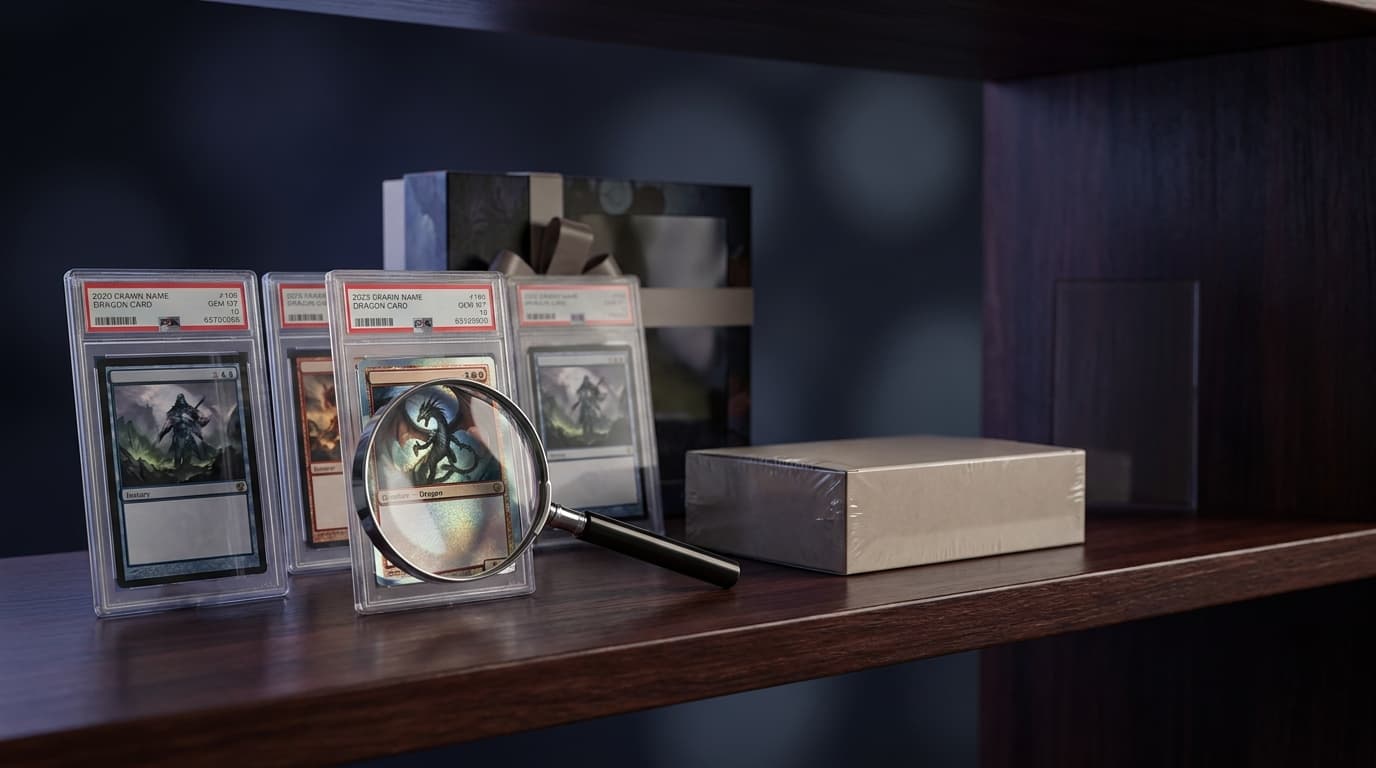
The headline writes itself: Collector Booster boxes for The Hobbit were showing sold-out at several major retailers during the summer preorder window, more than two months before the set's worldwide release. For a Universes Beyond product this early, that reads as either genuine scarcity or the familiar preorder theater that precedes a mass ship. The buyer-facing question is narrower and more useful: is this early Collector and Gift Bundle scarcity load-bearing, or is it allocation optics running ahead of an August 14 date when product floods every big-box in the country?
The answer is not the blanket "it always reprints" skepticism that usually wins these arguments. It's more specific, and it hinges on a policy detail that reframes the whole debate.
What is actually true today
The Hobbit is a Universes Beyond set built on Tolkien's book, and — unlike some crossover product — it is Standard-legal. It releases worldwide on August 14, 2026, with prerelease events running August 7–13 and the set arriving on MTG Arena and Magic Online on August 11 (Playgroup.gg set guide). Those are the fixed dates buyers should anchor to.
The product lineup and MSRPs come straight from Wizards' own preview (Collecting The Hobbit): Play Boosters are $6.99 for 14 cards plus a token, and a Play Booster box holds 30 boosters plus one foil Box Topper. Collector Boosters are $37.99 for 15 cards, with 12 packs to a Collector box. The Gift Bundle carries a later, staggered date — September 4, 2026 — which is itself a data point worth sitting with. A product that ships three weeks after the main set is, by definition, a drip release.
One caution on the numbers floating around retail listings. Figures like a $209.70 Play box or a $499.99 Collector box are retailer or marketplace asks, not MSRP, and we could not verify those exact prices. Comparable listings seen in summer 2026 ran roughly $220 for a Play box and $499–$549 for a Collector box, frequently flagged "sold out." Treat any of these as a specific store's asking price at a moment in time, not a fixed market price.
The correction that reframes the piece
Here is the detail that breaks the lazy skeptic take. Per Wizards Play Network policy, Collector Boosters and specialty Bundles are typically single, one-time print runs that are not expected to restock. It is Play Boosters, Commander decks, and Starter Kits that get reprinted to demand (WPN product availability policy).
That single fact scrambles the intuition. "The Collector box sold out" is a more credible scarcity signal than "aggressively reprinted" framing implies, because the aggressive reprinting mostly applies to Play product. The August 14 flood is real — but it's a flood of Play Boosters and reprintable product, not necessarily of Collector boxes. So the skepticism has to be aimed correctly: be skeptical of scarcity on the products Wizards openly reprints, and take capped Collector and Bundle scarcity more seriously.
Reading the print-run signals
Sort every "sold out" banner you see into one of two bins:
-
Reprinted-to-demand product (Play Boosters, Commander decks, Starter Kits). A sold-out flag here is weak. If demand exists, Wizards makes more. Waiting rarely costs you.
-
Single-run product (Collector Boosters, specialty Bundles). A sold-out flag here is stronger, because policy says no meaningful restock is planned.
Then layer in the softer optics. A staggered release date — the Gift Bundle's September 4 slot — is a drip mechanism, not proof of a hard cap. Per-customer purchase limits are allocation behavior: Wizards' recent UB Spider-Man Collector box carried a 1-per-customer limit at specialty stores (Stomping Ground TCG), which spreads thin supply across more buyers and manufactures the look of scarcity even when the total print run is unremarkable. Allocation language — "limited stock," "sold out," "1 per household" — is the pattern to read, not the conclusion.
The availability picture during summer 2026 was fragmented in exactly this way: Collector boxes were preorderable on the likes of Amazon, GameStop, and Best Buy while simultaneously showing sold-out at TCG specialty stores (GameStop listing, Amazon Play box listing). A product that is sold out at a small allocation-limited store and in stock at a national retailer is not scarce; it is unevenly distributed.
Precedent 1 — LOTR: the tiers diverged hard
The most instructive precedent is The Lord of the Rings: Tales of Middle-earth (2023), and it's the case people most often cite wrong. The regular Collector Booster box preordered around $439.99. Because LTR went on to become the best-selling Magic set ever and was heavily reprinted, that regular sealed product softened after release, trading near or under its preorder price. Preordering the regular box at its ceiling was, in hindsight, a poor entry point.
What actually spiked was a different tier entirely: the limited Special Edition Collector Boosters, home of the 1-of-1 serialized The One Ring, where singles and packs reached roughly $1,000 (MTGRocks). When someone says "LOTR went up," ask which product. The commodity tier and the chase tier diverged, and conflating them is how buyers talk themselves into overpaying for the wrong box.
Precedent 2 — Fallout: scarcity that was real
The counter to a blanket "it always reprints" is Universes Beyond Fallout. Its Collector Boosters had their print run cut by Wizards, with allocations reduced and no meaningful restock afterward (MTGRocks). That is proof UB Collector scarcity can be genuine — not manufactured optics, but an actual supply constraint on a single-run product. Fallout is the case that keeps the skeptic honest in the other direction.
Which The Hobbit treatments actually hold
If scarcity is going to matter, it will matter at the chase tier, and The Hobbit weights its chase treatments toward Collector Boosters. The headline is a gleaming gold Smaug the Magnificent capped at roughly 500 copies, available only in Collector Boosters. Beyond it: borderless Middle-earth classic art cards, five Dwarvish-language cards, ten book-cover cards, twenty-five Dragon hoard frame cards, and Surge foils (Collecting The Hobbit).
Note what "holds" and what doesn't. A ~500-copy serialized Smaug is genuinely capped and can't be reprinted into oblivion — that scarcity is structural. Bulk foils and the more common Booster Fun frames are printed in volume and behave like commodities. The trap is paying a chase-tier premium for a sealed box whose expected value is dominated by product that will be plentiful. Buying the Collector box at the preorder ceiling is usually the worst entry point precisely because you're paying up for a lottery ticket while the LOTR regular-box precedent says the sealed price tends to soften post-release.
The buyer's checklist
Signals that can justify preordering now:
-
The product is a single-run Collector Booster or specialty Bundle, per WPN policy — not a reprinted-to-demand Play product.
-
You want the sealed box for a rip, a gift, or a prerelease, and the experience is the point rather than the resale.
-
There is credible evidence of an actual print cut, Fallout-style — not just a sold-out banner at one allocation-limited store.
Signals to wait for the post-release trough:
-
The "sold out" is on Play Boosters, Commander decks, or Starter Kits — Wizards reprints these to demand.
-
You're buying for value or singles exposure. Chasing a specific card is almost always cheaper on the singles market after release than gambling on sealed at the preorder ceiling; the LOTR regular box is the cautionary tale.
-
The scarcity is a staggered date (the Gift Bundle's September 4 slot) or a per-customer limit — those are drip and allocation optics, not a hard cap.
When to ignore a sold-out banner entirely: when the same product is in stock at a national big-box while showing sold-out at a small store. That's distribution unevenness, and August 14 is when the picture clears.
The honest read on The Hobbit: the Collector-side scarcity is more credible than reflexive skepticism allows, because policy says that product is single-run — but the credible scarcity concentrates in a handful of genuinely capped chase cards, not in the sealed box as a whole. Buy the box for the rip. Buy the card you want as a single, after the flood. And treat a preorder sold-out flag as a question, not an answer.
Related reading
-
Fewer Than 150 Cosmic Foil Mind Stones: Is MTG's Infinity Stone Cycle a Thesis or a Scarcity Trap?
-
The Last Grader Nobody Owns: Is Routing to CGC a Principle or a Priced-In Resale Hedge?
Sources
-
Collecting Magic: The Gathering — The Hobbit: A First Look (Wizards, official contents/MSRPs and chase treatments)
-
WPN — Product availability duration and reprint viability by product line (single-run vs. reprinted-to-demand policy)
-
The Hobbit MTG Release Date & Set Guide (Playgroup.gg) (release timeline)
-
MTG The Hobbit Play Booster Box (Amazon listing) (retail pricing/availability)
-
MTG The Hobbit Collector Booster Box (GameStop listing) (big-box availability)
-
LOTR MTG Booster Hits $1,000 Per Pack After Price Spike (MTGRocks) (Special Edition vs. regular tier)
-
MTG Supply Issues Could Be Worse Than Players Feared (MTGRocks) (Fallout print-run cut)
-
[MTG Universes Beyond Spider-Man Collector Booster Box (Stomping Ground TCG)](https://www.stompinggroundstcg.com/products/magic-the-gathering-universes-beyond-spider-man-collector-booster-box) (per-customer limits / allocation behavior)
Note: This article contains AI-assisted content and has been reviewed in our editorial workflow.
DISCLAIMER: PureGrail articles are for informational and entertainment purposes only. Nothing on this site constitutes financial, investment, or legal advice. Collectibles are speculative assets and values can decrease significantly. Always conduct your own research before buying or selling. Past price performance does not indicate future results.