Note: This article contains AI-assisted content and has been reviewed in our editorial workflow.
Before getting into the numbers, a correction on the framing the secondary-market discourse has been carrying for the last few weeks. Magic: The Gathering—Universes Beyond: FINAL FANTASY (set code FIN) released on June 13, 2025, not 2026 as some early write-ups had it. That matters because the cleanest read on this set is now a roughly two-week-old secondary-market record, and the data on that record does not support the popular 'pre-order premiums are compressing' thesis. If anything, FIN is the rare modern Magic release where the market overshot pre-order pricing, and kept going.
This piece walks through what the first two weeks of trading actually showed, which singles are holding for real Commander reasons, which are pure collector chase pieces, and how to read the Universes Beyond (UB) 'fatigue' discourse against sell-through that tells a very different story.
Sealed product: $455 implied retail to ~$999 on TCGplayer in roughly two weeks
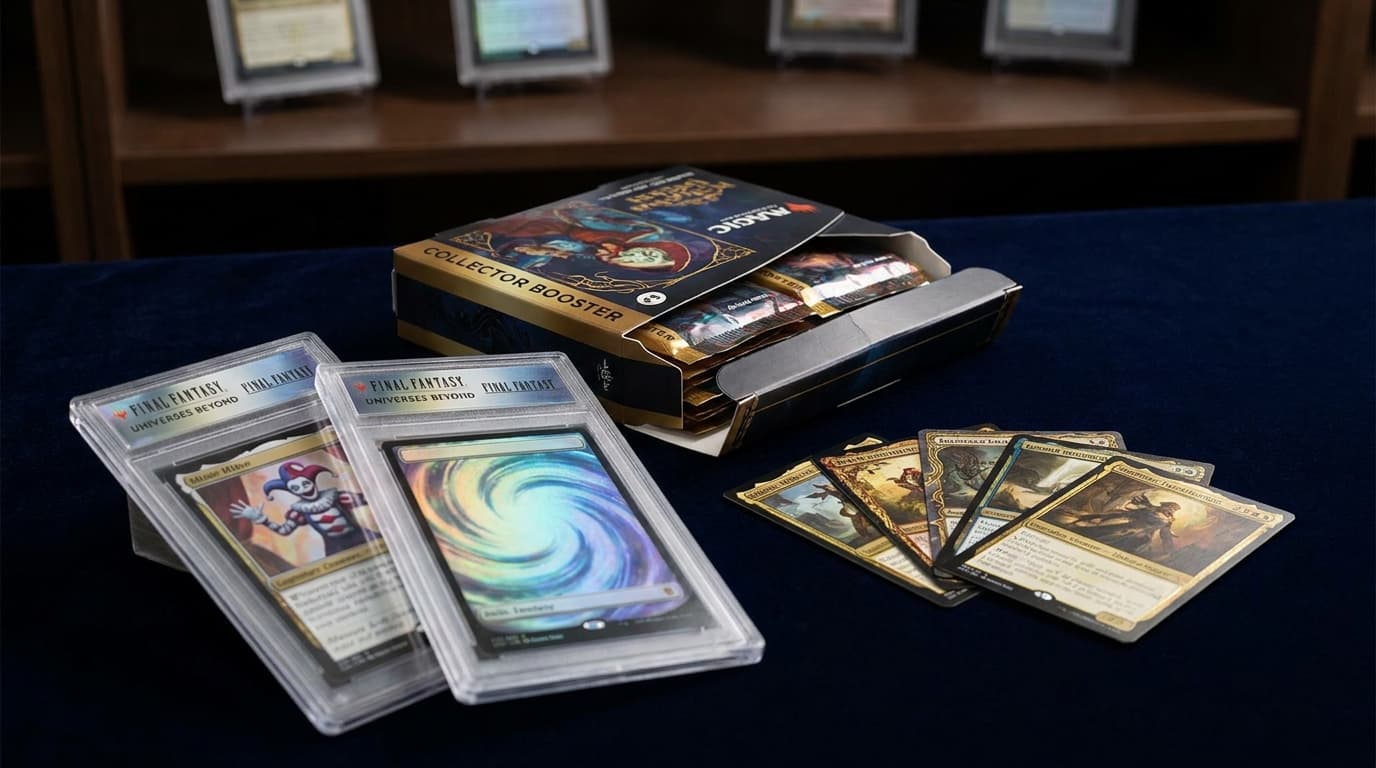
Collector Booster MSRP for FIN was $37.99 per pack, with twelve packs per display — call that ~$455 of implied retail in a sealed box. Within roughly two weeks of release, the Collector Booster box was clearing at about $999 on TCGplayer, and pushed toward $1,200 shortly after, according to MTGRocks' reporting on demand and Draftsim's independent tracking. That is more than a doubling of the MSRP-derived launch price inside the first month of trading.
The relevant comp is The Lord of the Rings: Tales of Middle-earth, the prior UB tentpole. LOTR Collector Boxes launched closer to $400 in mid-2023 and climbed steadily over roughly two years to the ~$1,000+ range by 2025, per MTGStocks' LOTR check-in. FIN, in other words, accomplished in two weeks roughly what LOTR took two years to do. Whatever else is true about the set, 'pre-order softness' is not the story.
The Standard-legal variable
One reason the LOTR comparison breaks down past the box level is that FIN is the first Universes Beyond tentpole to be Standard-legal. LOTR was Modern- and Commander-legal only. Wizards has since confirmed that all future UB tentpoles will be Standard-legal going forward, which materially changes the demand profile for individual cards — playable singles now pull from Standard, Pioneer, Modern, and Commander pools simultaneously rather than just the eternal-format crowd. MTGStocks' UB finance write-up goes into more detail on what that does to single-card economics.
For a collector trying to compare these two sets on a like-for-like basis, the Standard-legal asterisk is the most important caveat. FIN's box trajectory is not just 'LOTR but faster' — it is a different demand structure.
Chase cards that are holding for Commander reasons
Several FIN singles are anchored by actual format demand, not just artwork. The cleanest evidence is regulatory: Vivi Ornitier, the Izzet looper from FIN, warped Standard hard enough to get itself banned — a Wizards action does not get more decisive than that. EDHREC's Commander-focused price breakdown goes through the rest of the format-relevant list, and TCGplayer's marketplace-derived chase-card list captures the early secondary pricing on each.
-
Vivi Ornitier — Standard-banned for format warping. The ban is unambiguous evidence of demand from competitive players, though it also caps near-term price upside in the format that drove the initial spike.
-
Tifa, Martial Artist — a mono-green landfall doubler that slots cleanly into existing EDH archetypes. EDHREC flags this as one of the more Commander-stable holds in the set.
-
Yuna, Grand Summoner — enchantress recursion with a build-around payoff. Real EDH demand, not just IP demand.
-
Cloud, Midgar Mercenary — the headline commander treatment, with the additional tailwind of being the face card of the Cloud vs. Sephiroth starter pair.
The practical read for collectors: these singles have a floor under them that is independent of how the artwork ages. If FIN's format relevance survives the next ban announcement, this is the group to focus on for Commander-stable holds.
Pure collector chase pieces — and the 1% math behind them
A second tier of FIN cards is moving for reasons that have nothing to do with format play. These are the borderless and surge-foil treatments, the Japanese-exclusive printings, and the cards whose base versions are functionally bulk. Per ScreenRant's expensive-cards roundup and the TCGplayer chase-card list above:
-
Traveling Chocobo — Borderless Japanese Exclusive Foil at roughly $3,371; English-language variants in the $700–$900 range. No format home of consequence; the price is structural scarcity plus IP demand.
-
Cloud, Ex-SOLDIER Borderless Surge Foil — around $600, while the base printing of Cloud sits at roughly $4. The ~150x gap between the two is doing all the work here.
-
Sephiroth, Fabled SOLDIER Borderless Surge Foil — about $476.
-
Kefka, Court Mage Borderless Surge Foil — about $150.
The pull-rate math is what keeps this tier insulated from gameplay shifts. Surge Foil Borderless Character pulls run roughly 1% of Collector Booster slots. At Collector Booster MSRP of $37.99, that is a ~$3,800 expected cost to pull any one specified Surge Foil — which sets a hard ceiling on how cheaply the market can supply them, regardless of how the cards play. A future ban, errata, or rotation does not move this curve. A future print of the same treatment would, but Wizards has historically avoided reprinting borderless surge variants at the same scarcity.
The Gogo buyout — speculation pressure, not soft demand
The single cleanest counter-example to the 'compression' thesis is the late-June 2025 Gogo, Mysterious Mime buyout. Per the TCGplayer seller blog's July 8 price-trend write-up, the card more than doubled in market price in under two weeks following a June 28 buyout. That is the opposite of a market settling down. It is speculative pressure on top of broad-based demand — the kind of move that only happens when there is enough thin supply and enough liquid buyers to absorb the run-up.
For a serious collector, the Gogo episode is more useful as a tell than as a buying opportunity. It says the FIN secondary market right now is reactive enough that single Reddit threads or YouTube specs can move prints meaningfully. That cuts both ways, and the appropriate posture is skepticism rather than chase.
The 'UB fatigue' narrative versus the sell-through
Mark Rosewater, Magic's lead designer, has publicly acknowledged the Universes Beyond fatigue discourse — 'we have to be careful,' per the quote captured in Dexerto's coverage. Wizards has also confirmed, per Wargamer's reporting, that the forward cadence will settle at roughly half UB and half in-universe, returning to a 3-and-3 split after the 4-UB/3-in-universe 2026 schedule.
The temptation is to read that as confirmation that UB demand is softening. The sell-through data argues the opposite. Per WotC commentary, FIN became the best-selling MTG set in history, and the current top three by sell-through is now FIN, LOTR, and Avatar: The Last Airbender — all UB. Store-level player surveys show mixed sentiment, but mixed sentiment and soft top-line are not the same thing. The honest read is that the fatigue discourse and the commercial reception are running on separate tracks. UB volume may eventually fatigue the market; marquee-IP UB tentpoles have not.
For a collector, those are two different bets. Caring about UB cadence is reasonable if you are speculating on filler-set UB releases. It is not the dominant variable for a set like FIN.
Practical takeaways
-
Sealed FIN is not a 'wait for the dip' product right now. The dip people were expecting did not arrive, and the LOTR comp suggests the floor under Collector Boxes is structural rather than hype-driven. That does not make today's $999–$1,200 a buy; it just means the framing of 'wait six months for pre-order compression' is the wrong frame.
-
For Commander-stable holds, the bias is toward the format-relevant commanders — Tifa, Yuna, and the EDH-archetype payoffs — over the recently-banned cards, whose near-term ceilings have moved. Watch the next ban announcement.
-
Pure collector chase pieces (Traveling Chocobo Japanese exclusive, Borderless Surge Foils of marquee characters) are priced off pull-rate scarcity, not gameplay. They are insulated from format shifts but exposed to reprint risk — which on these specific treatments has historically been low, but is not zero.
-
Treat single-card buyouts like the Gogo episode as signal, not as buy triggers. A market that runs 100%+ in two weeks on a buyout is one that can also reverse on a soft week, especially if a future Standard ban changes the demand profile.
-
Do not collapse 'UB fatigue' into 'FIN demand softening.' They are different conversations, and the sell-through has been clear about which one the market is voting on.
The two-week record on FIN is, in the end, a mild rebuke to the idea that Magic's modern release cadence is exhausting its buyer base. The buyers showed up, the boxes more than doubled, and the chase-card stack split cleanly between cards that play and cards that display. Whether that holds at the six-month mark — particularly through whatever the next ban announcement does to the format-relevant tier — is the question worth tracking next.
Related reading
Sources
-
Magic: The Gathering—FINAL FANTASY official product page — Wizards of the Coast
-
Universes Beyond: FINAL FANTASY (FIN) — All Cards and Prices — EchoMTG
-
Unprecedented Demand Causes Final Fantasy Booster Box to Hit $1200 — MTGRocks
-
Final Fantasy Collector Boxes Push Towards an Absurd $1,000 Mark — Draftsim
-
Checking In With Lord of the Rings: Tales of Middle-earth — MTGStocks
-
The 16 Cards Everybody Wants from MTG—FINAL FANTASY — TCGplayer
-
Price Trends: Magic: The Gathering Cards Climbing in Price (07/08/2025) — TCGplayer Seller blog
-
MTG's Lead Designer addresses Universes Beyond fatigue — Dexerto
-
10 Most Expensive Final Fantasy x Magic: The Gathering Cards — ScreenRant
-
MTG x Final Fantasy: Specs for Cloud and Tifa's deck: Limit Break — MTGPrice Blog
DISCLAIMER: PureGrail articles are for informational and entertainment purposes only. Nothing on this site constitutes financial, investment, or legal advice. Collectibles are speculative assets and values can decrease significantly. Always conduct your own research before buying or selling. Past price performance does not indicate future results.