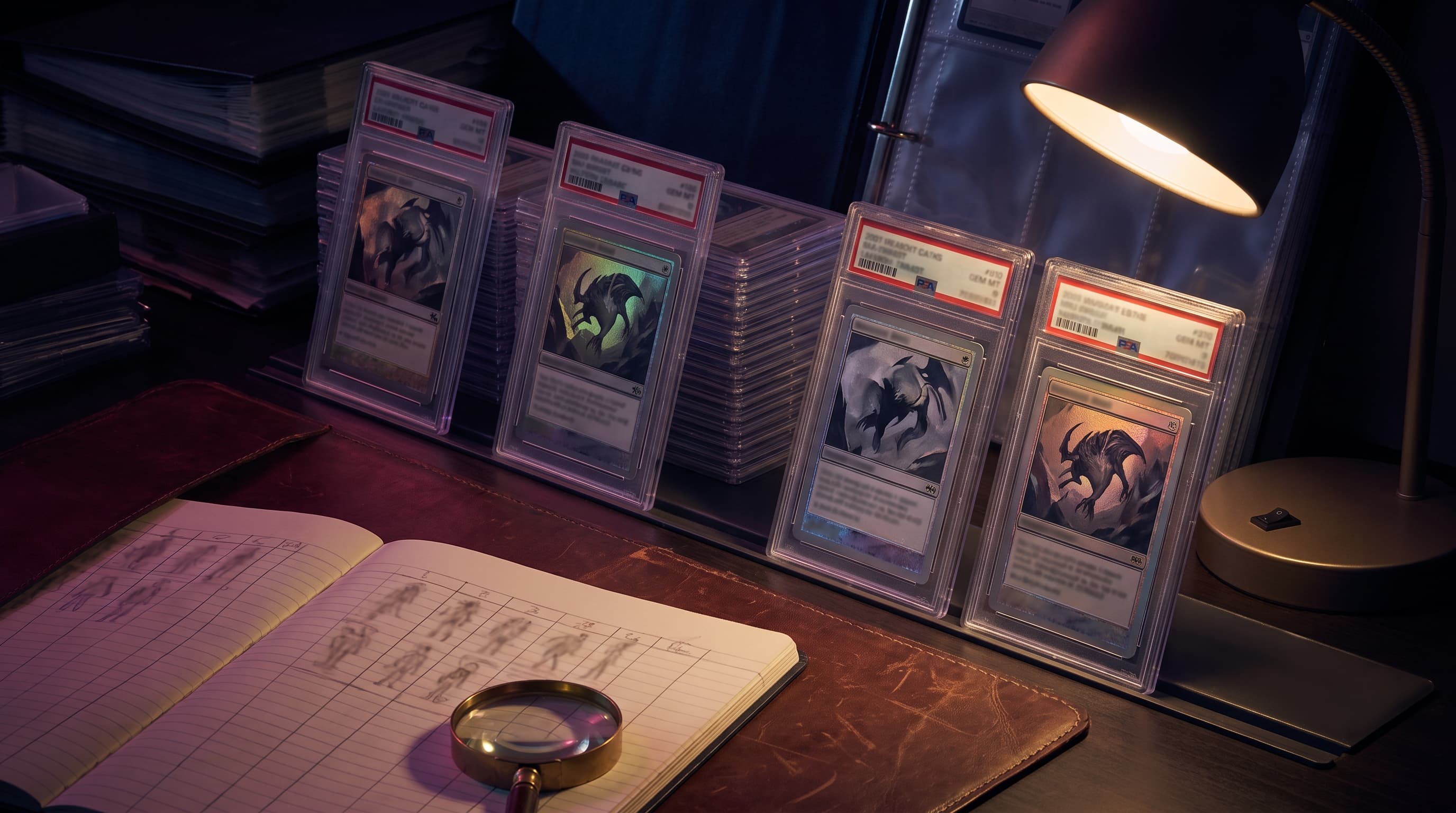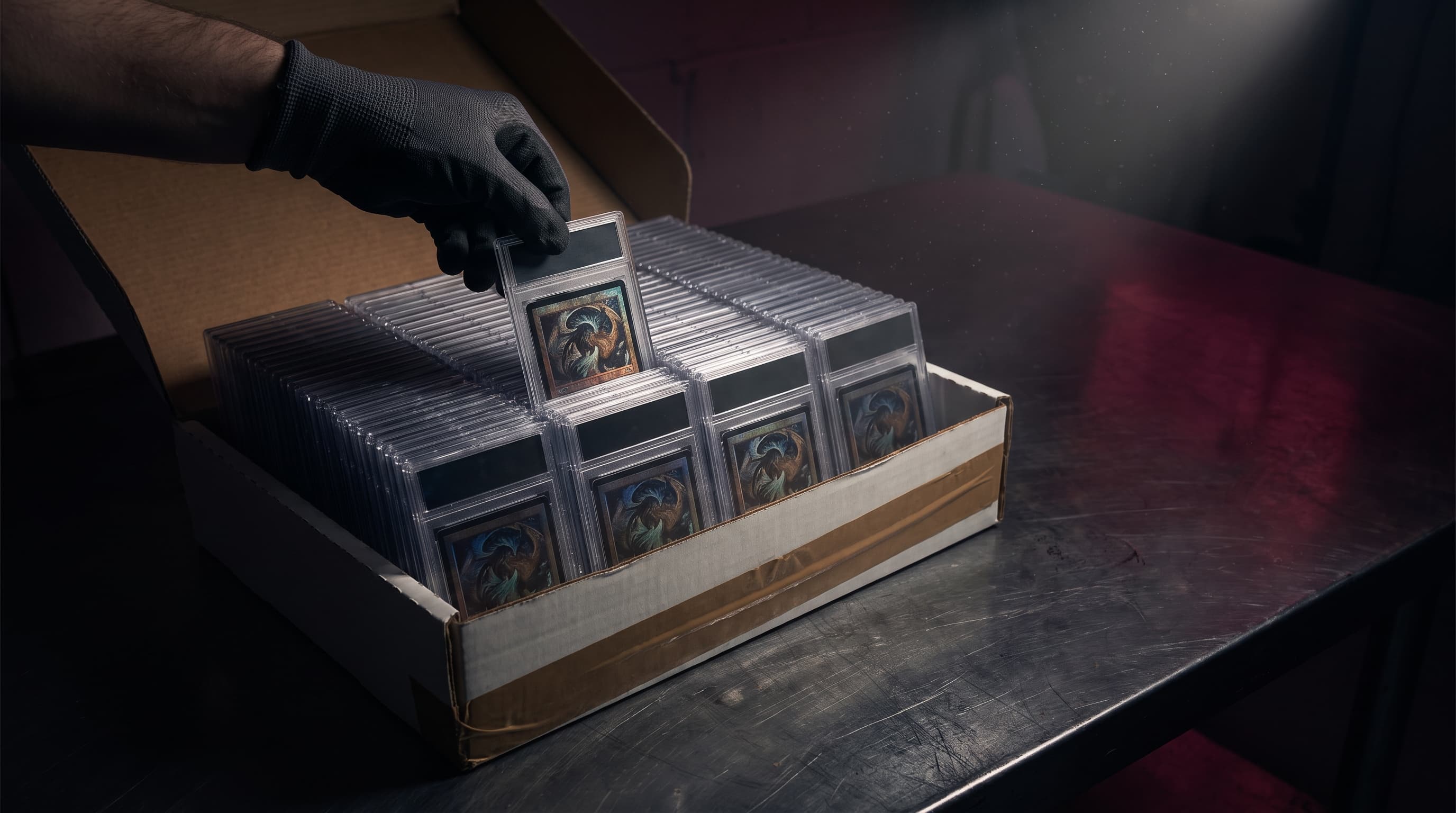
The 2026-27 Young Guns checklist in Upper Deck Series 1 Hockey runs from #201 to #249 (49 rookies). Card #250 is an Anton Frondell/Porter Martone checklist card. Hobby boxes average six Young Guns. PSA's Value tiers are still paused, so the strongest grading cases are Frondell #201, James Hagens #206 and Martone #209. For most of the other rookies, holding or selling raw makes more sense.
Series 1 is scheduled to hit hobby shelves on October 7, 2026, with retail tins and blasters following on October 21, according to Cardlines and Checklist Insider. This is the first flagship release since grading got more expensive per card, which changes the usual habit of sending every rookie off to be slabbed. Below, the checklist is sorted into three groups using roster status, draft position and grading cost. We did not use price predictions, and there is no reliable sold data yet for these cards. After that comes a method for checking the decision against your own comps.
The set at a glance
-
Base set: 250 cards. Young Guns are #201-249, and #250 is the Frondell/Martone checklist card (Checklist Insider).
-
Hobby box: 12 packs of 12 cards, 12 boxes per case, about six Young Guns per box on average.
-
Retail and other formats: tins have 8 packs plus 1 Dazzlers bonus pack. Blasters have 4 packs. Starter kits have 1 pack plus 1 exclusive insert. Every pack has 12 cards.
-
Presale price: on September 24, Cardlines reported hobby boxes "currently around $140 per hobby box." That is a presale figure, and release-week prices can move either way.
With 49 Young Guns and roughly six per box, no single box is likely to give you a particular rookie. If you are chasing one player, buying that player's single usually makes more sense than buying boxes to find it.
What changed in grading this year
PSA paused its four Value tiers (Value Bulk, Value, Value Plus and Value Max) effective June 2, 2026, citing "a 10 million card submission backlog," ICv2 reported. PSA's stated goal was to cut the backlog to 5 million cards, which ICv2 said would take about four months. Before the pause, those tiers cost $24.99, $32.99, $49.99 and $64.99 per card, according to HEAVY via Yahoo Sports.
In September, reports from HEAVY and Cardlines said the Value tiers all remain paused. PSA's cheapest open option is now the Standard tier:
-
$59.99 per card, opened September 14, 2026
-
Estimated turnaround of 90-100 business days, which is roughly 18 to 20 weeks before holidays
-
$1,000 maximum insured value
-
No Collectors Club membership required
There is also a catch. Cardlines reports PSA said "Standard submissions will be processed after existing Value and Bulk orders already in the system." Cardlines writer Jesse Haynes wrote that he "will not be sending cards to PSA through Standard." Above Standard, HEAVY lists Priority (formerly Regular) at $79.99, Express at $199 (up from $149) and Premier (formerly Walk-Through) at $599.
CGC is the cheaper option. Its official announcement sets US card Bulk at $17 per card and Economy at $20 per card for online submission forms completed on or after March 24, 2026.
What this means: grading only pays off when the graded copy sells for enough more than the raw copy to cover the fee, shipping, insurance and selling costs. If the per-card fee is $59.99 instead of $24.99, the price gap has to be much wider. For many base rookies, that gap will never be big enough.
Group 1: The strongest grading cases
Anton Frondell #201 (Blackhawks), James Hagens #206 (Bruins), Porter Martone #209 (Flyers)
All three were top-seven picks in the 2025 NHL Draft. Frondell went 3rd to Chicago, Martone 6th to Philadelphia and Hagens 7th to Boston, per the 2025 draft table. All three are on their team's official opening-night roster: Chicago, Philadelphia and Boston.
Martone already has NHL games played. After a season at Michigan State, he signed a three-year entry-level contract with the Flyers on March 29, 2026. He then put up 10 points (4 goals, 6 assists) in 9 regular-season games and 5 points in 10 playoff games, per his Wikipedia entry. SI's preview cites the same figures.
Of all the rookies on the checklist, these three have the best chance of justifying the PSA Standard fee or a CGC tier. That still applies only to clean copies. Check centering, edges, corners and surface under good light before you pay to submit. A card going in with visible flaws is a weak bet no matter whose name is on it. Being in this group says nothing about the grade a card will get.
Group 2: Hold raw and watch
Cole Hutson #223 (Capitals), Ilya Protas #218 (Capitals), Alex Bump #207 (Flyers)
All three are on opening-night rosters, but demand for their cards is less certain than for Group 1. Washington drafted Hutson 43rd overall in 2024. He scored 32 points in 35 games at Boston University, signed his entry-level contract on March 15, 2026, and then had 10 points (3 goals, 7 assists) in 14 NHL games, per Wikipedia. The Capitals' roster release says Hutson and Protas, both 20, "enter their first full NHL seasons in 2026-27." SI calls Protas "the reigning AHL Rookie of the Year." Bump made the Flyers' opening-night roster alongside Martone.
For these cards, start by keeping your best copies raw. Keep them sleeved and toploaded, then watch ice time and sold comps over the first weeks of the season. If the gap between raw and graded sales becomes wide enough to cover a grading fee, submit then. You lose little by waiting, and you avoid locking $59.99 per card into a queue that runs for months.
Group 3: Fine to sell raw
Oliver Bonk #240 (Flyers), Hunter McDonald (Flyers), Sacha Boisvert #243 (Blackhawks)
According to the team releases, Bonk and McDonald are not on the Flyers' opening-night roster, and Boisvert is not on the Blackhawks'. That is not a judgment of their careers. It does mean that release-week buyers will probably care less about their base Young Guns than about the rookies who are playing NHL games now. A fee of $17 to $59.99 per card is hard to earn back on cards like these. Selling raw into release-week demand is usually the cleaner move. That is our judgment of the tradeoff, not a forecast of where these players or their cards end up.
The rest of the checklist. Other notable Young Guns include Cole O'Hara #202 (NSH), Konsta Helenius #210 (BUF), Felix Unger Sorum #213 (CAR), Victor Eklund #220 (NYI, 16th overall in 2025), David Reinbacher #222 (MTL), Brayden Yager #242 (WPG), Lenni Hameenaho #244 (NJD) and Carter Yakemchuk #249 (OTT). Before you sort any of them, check that team's own opening-night roster release on NHL.com and place the player in Group 2 or Group 3 based on what it says.
Numbered parallels are a separate decision
Everything above applies to base Young Guns. Cardlines lists these Young Guns parallels: Outburst Silver (1:60 hobby packs), Clear Cut (1:144 hobby packs), Deluxe /250, UD Exclusives /100, Outburst Red /25, High Gloss /10 and Outburst Gold 1-of-1. At 12 packs per box, the stated odds work out to about one Outburst Silver every five hobby boxes and about one Clear Cut every 12 boxes (one case), on average.
For low-numbered parallels like the Exclusives /100, Red /25, High Gloss /10 or the Gold 1-of-1, scarcity can justify grading even for a Group 2 or Group 3 player, because so few copies exist. Run the same break-even check with comps for that specific parallel, not the base card. If a card is likely to be worth more than $1,000, keep in mind that PSA Standard's insured value is capped at that amount.
How to run the numbers yourself
PureGrail's card grading break-even tool compares the extra net proceeds from grading a card with what you would net by selling it raw. You enter your own costs. The tool does not predict grades, current prices or investment returns. Your inputs:
-
Raw sold comp: recent completed sales of raw copies, not asking prices.
-
Graded sold comp: completed sales at the grade you realistically expect, from the grader you plan to use.
-
Grading fee: for example $59.99 for PSA Standard, or $17 or $20 for CGC Bulk or Economy.
-
Shipping and insurance: both ways.
-
Marketplace fees: on both the raw sale and the graded sale.
-
Time cost: how much the 90-100 business-day wait is worth to you, given that demand for a rookie can change during that time.
A hypothetical example, with made-up numbers that do not reflect any real Young Guns card: say a raw copy sells for $50 and a PSA-graded copy for $120. Assume a 13% marketplace fee and $10 in shipping and insurance. Selling raw nets $43.50. Grading at PSA Standard nets $120 minus $15.60 in fees, minus $59.99, minus $10, which is $34.41. In this case, grading leaves you about $9 worse off before you even count the wait. If the card comes back a grade lower than you hoped, it gets worse. Rerun the same card with CGC's fee and CGC sold comps before you decide. The cheaper fee helps, but only if CGC slabs of that card actually sell for enough.
Pre-submission checklist
-
Wait for release week to settle, then pull sold comps. Asking prices and presale listings are not comps.
-
Recheck roster status right before you submit. Opening-night rosters are a starting point, not a guarantee.
-
Treat PSA Standard's 90-100 business-day estimate as a real cost. Remember that Standard orders are processed after existing Value and Bulk orders.
-
Inspect every card under good light before paying a fee. Only submit copies with clean centering, edges, corners and surface.
-
Decide on numbered parallels separately, using comps for that parallel.
Related reading
-
Your Grading Bill Is Not Your Biggest Cost: The True Cost of Grading Cards
-
How to Avoid the 2026 Allen and Ginter Hobby Box Presale Markup on Release Day
Sources
-
Cardlines: 2026-27 Upper Deck Series 1 Hockey Review & Checklist (Sept 24, 2026)
-
Checklist Insider: 2026-27 Upper Deck Series 1 Hockey Checklist, Set Details, Boxes
-
NHL.com: Flyers Announce 2026-27 Opening Night Active Roster
-
NHL.com: Bruins Announce Opening Day Roster for 2026-27 Season
-
ICv2: PSA Will Temporarily Shut Down Value Grading Tiers (May 29, 2026)
-
Cardlines: PSA Standard Grading Tier: Is The $59.99 Service Worth It? (Sept 24, 2026)
Note: This article contains AI-assisted content and has been reviewed in our editorial workflow.
DISCLAIMER: PureGrail articles are for informational and entertainment purposes only. Nothing on this site constitutes financial, investment, or legal advice. Collectibles are speculative assets and values can decrease significantly. Always conduct your own research before buying or selling. Past price performance does not indicate future results.