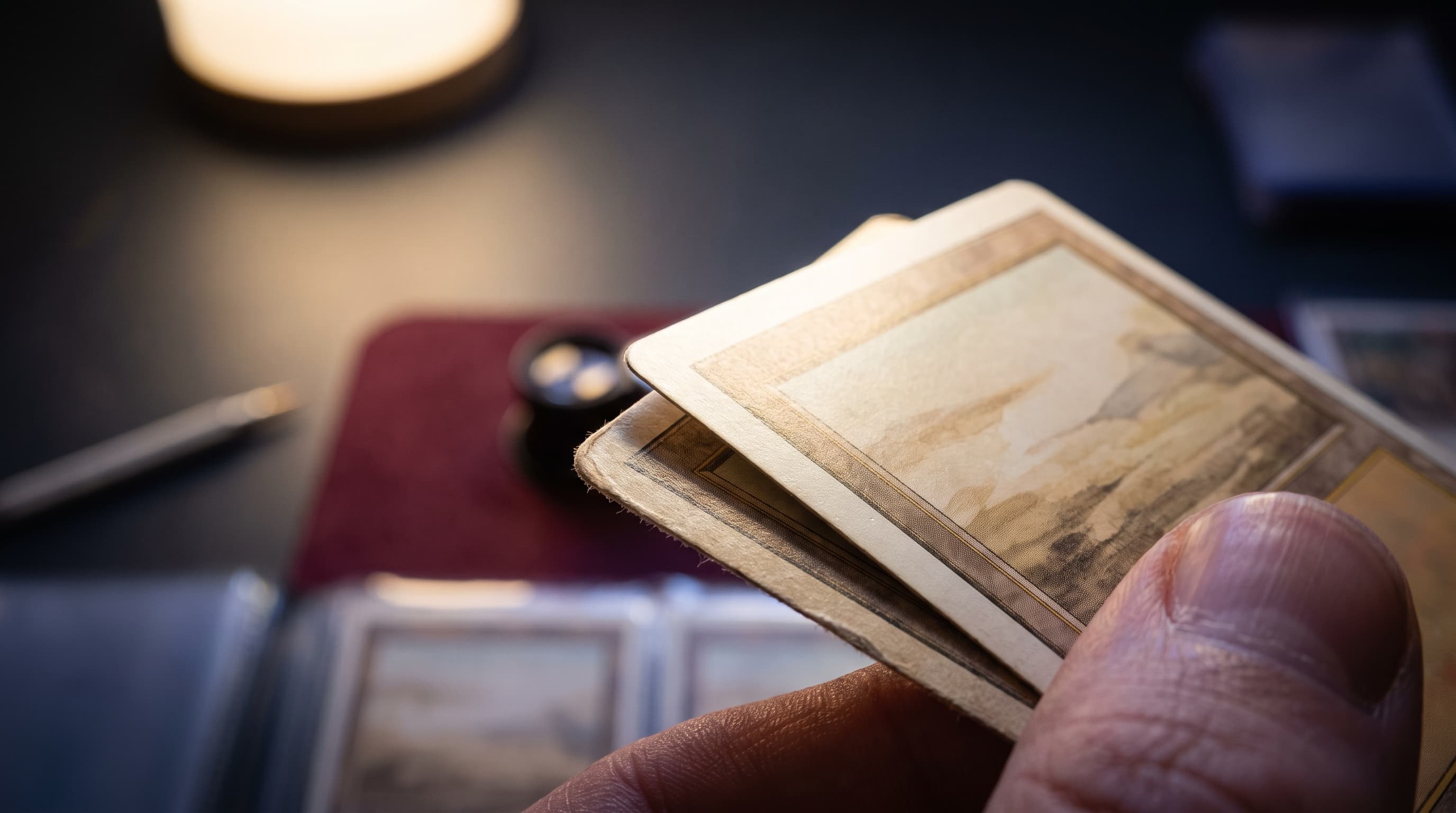
If you want to know how to tell if a card is trimmed or pressed, start by lowering your expectations. No single test settles it. A ruler misses trims because vintage cards left the factory in varying sizes. A blacklight finds added paint, glue or coatings, but not a clean trim. The best checks compare the card with itself and with a known-good common from the same set. This checklist is for buying raw vintage at a card show or from a private seller, where nobody has screened the card for you. Passing every check lowers your risk. It does not prove the card is clean.
What do PSA and SGC call a trimmed or pressed card?
PSA will not give a number grade to a card that shows evidence of trimming, recoloring, restoration or other tampering. Trimming goes under N1, pressing under N5 "Altered Stock", and a card that is simply too small with no sign of trimming gets N6. It helps to know the codes before you buy, because they decide whether a raw card can be resold in a numbered slab.
-
N1, Evidence of Trimming. PSA's description, as quoted in search results, lists four signs: a hooked edge, edges unusually sharp for the issue, edge color with an inconsistent tone, and a wavy, unnatural edge. PSA's site blocked our direct fetch, so check the current wording on the PSA Grading Standards page before you rely on it.
-
N5, Altered Stock. This covers crease or wrinkle pressing, paper restoration, scratch removal and enhanced gloss. Search results quoting PSA's standards say such a card may be holdered as "Authentic Altered" at the grader's discretion, and only if you write "AA" as the minimum grade on the submission form.
-
N6, Minimum Size Requirement. The card is undersized against factory specs, with no sign of trimming. CardSZN notes that factory blade problems produced some undersized vintage cards. Search results also say PSA does not charge a grading fee for N6 rejections but does for N1. Confirm that on PSA's FAQ before counting on it.
According to Cardhound Vintage (Matt Felumlee, May 12, 2024), an "A" grade from PSA or SGC usually means genuine but altered. The usual causes are trimming, color added to borders, erasing, cleaning, and pressing out creases. Pinholes, writing and stains are condition problems and still get a number grade. SGC's labels now name the problem: "Altered", "Color Added", "Evidence of Trimming" or "Miscut".
Why this matters for your wallet: a raw card priced as if it will grade is worth much less if the likely result is an altered or undersized flag.
What to pack for the show
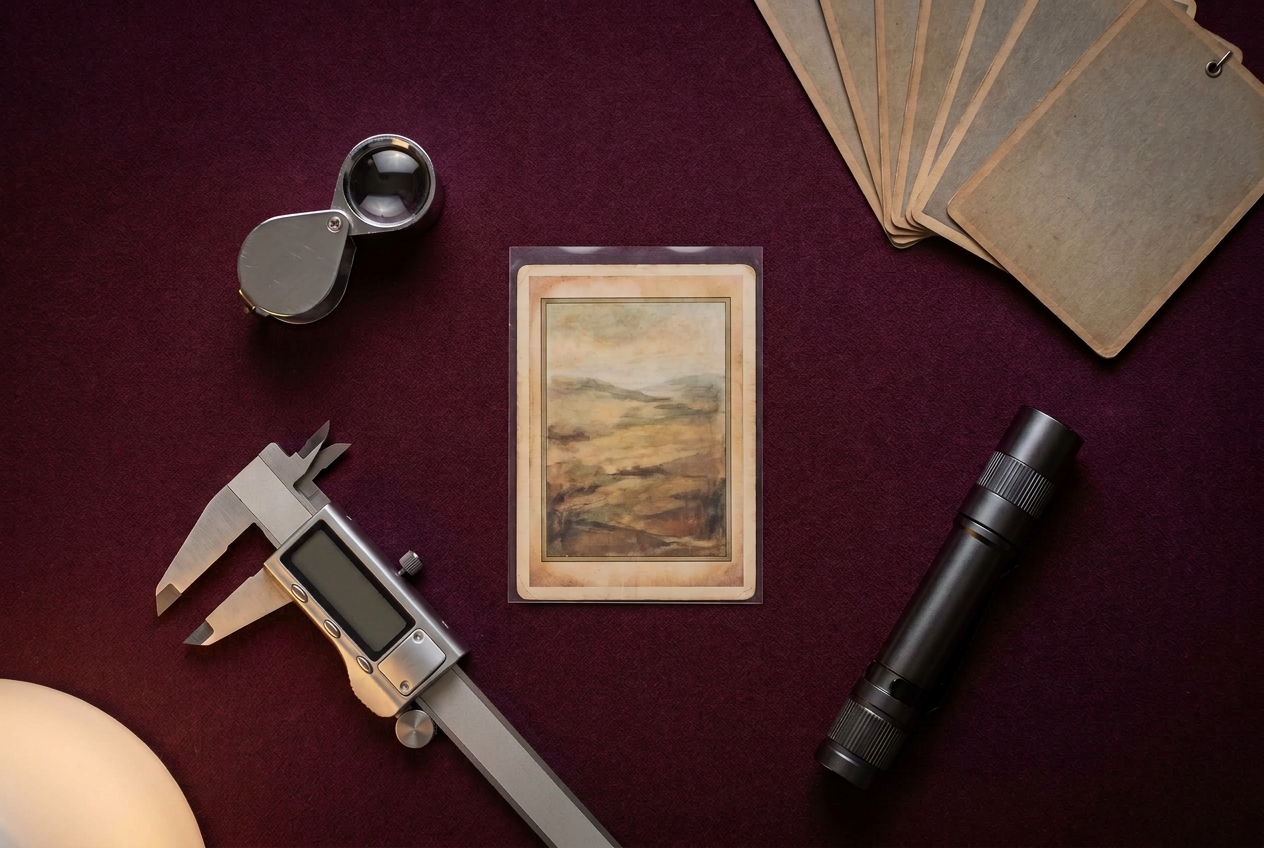
The same basic kit comes up again and again across the sources:
-
A 10x jeweler's loupe.
-
A bright halogen or LED lamp you can shine across the surface at a low angle.
-
A ruler accurate to 1/64 inch, or digital calipers to measure length, width and thickness.
-
A 365nm UV flashlight.
-
A cheap common from the same set as your target card. This is the most important item, because every check below works better against a known-good copy.
Check 1: Measure against a known-good copy, not a published size
Can you tell if a card is trimmed just by measuring it? Not reliably. All Vintage Cards (updated Apr 25, 2025) points out that T206 cards come in many sizes, and factory size variation grows with a card's age. A short card may be factory-short, which is N6 territory rather than N1.
Published sizes are not a safe reference either. Sports Collectors Digest (John McMurray) gives 2-5/8 x 3-5/8 inches for Topps before 1957, while other references give 2-5/8 x 3-3/4 for 1952-56. All sources agree 1957 Topps set the 2-1/2 x 3-1/2 inch standard. When the references disagree, your reference card is a better guide than any printed number.
How to do it: measure both dimensions at several points along each edge, not just once. Compare with your reference common and, if you can, a few more copies from the same set. Check squareness too. An edge that narrows from one end to the other deserves a closer look.
Check 2: Edge texture and the factory cut
This is the core of any answer to how to tell if a card is trimmed. Under a loupe, a factory-cut vintage edge shows small fibers and looks slightly rough and porous. A trimmed edge tends to look razor-sharp, flat or slick. Run a fingertip along each edge: All Vintage Cards says a trimmed edge feels smoother than an original one.
Next, check the tone. A fresh cut exposes paper that has not aged, so a trimmed edge can look lighter or whiter than the naturally toned edges around it (All Vintage Cards; the point is widely repeated in Beckett guidance). Compare all four edges with each other. One bright edge on a card where the other three have aged together is a warning sign. Finally, look along each edge for the hooked or wavy profile PSA describes under N1.
Check 3: Corners too good for the card's age
Corners should wear at about the same rate as the rest of the card. All Vintage Cards describes several mismatches that point to a trim:
-
Two near-mint corners on one edge and two worn corners on the opposite edge. The sharp pair may sit on a trimmed edge.
-
A lopsided wear triangle, which can happen when someone cuts across a dinged corner.
-
A "bat-ear" profile, where the corners sit higher than the middle of the edge.
Ask a simple question: do these corners match the surface and edge wear? Sharp corners on a card with soft edges, surface wear and toning do not add up.
How can you tell if a card has been pressed?
Tilt the card under a low-angle light and look for "crease ghosts", the faint line a pressed-out crease leaves behind. PreGradeCards (Jun 13, 2026) lists other red flags: a surface that is unnaturally smooth or has an odd sheen, stock that is thinner than normal, and a surface that has lost its original coated feel. Measure thickness with your calipers and compare it with your reference common. Watch for gloss patches and warping as well.
Treat these signs as guidance from a secondary source, not as grader policy. They tell you when to be careful, not what PSA or SGC will decide.
Can a blacklight detect a trimmed card?
Usually not. A blacklight finds things that were added to a card, such as paint, glue or paper. It does not find a clean trim. Use it for recoloring and restoration, not trimming.
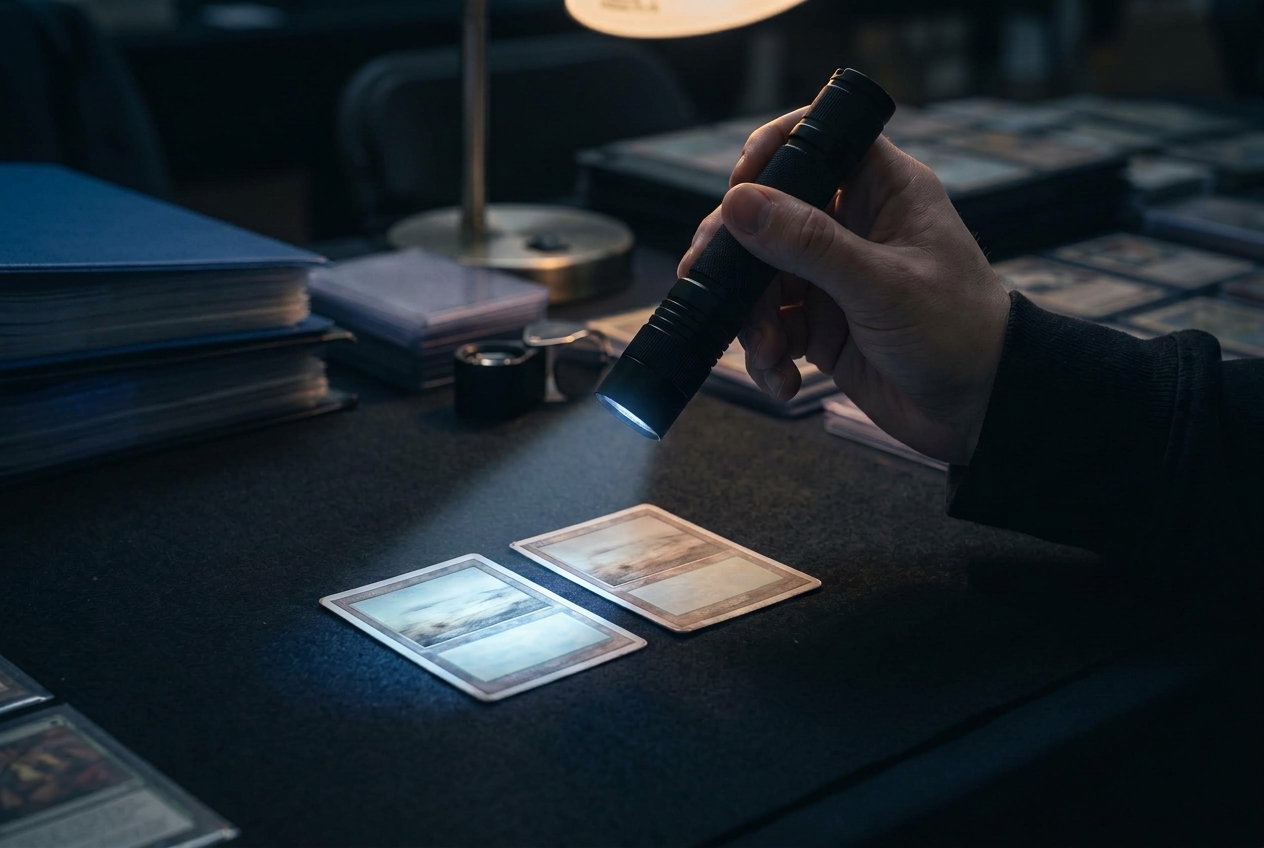
The SABR Baseball Cards Research Committee (David Cycleback, Jan 10, 2017) explains that added paint, glue or paper often glows differently from the original surface. Most post-1940s card stock contains optical brighteners that glow bright blue-white, which helps expose reprints of pre-war cards. A weak glow does not prove a card is authentic.
CardLines (updated Feb 14, 2021) says UV checks work best on pre-1950 cards and get harder on later issues. It also notes that skilled card doctors may coat the whole card to beat a UV check, so compare against an unaltered card from the same series every time.
Signs of recoloring to look for, according to PreGradeCards and Collectors Universe forum threads, include perfectly white borders on a card more than 50 years old, uneven border color, color bleeding into the image, and ink that has soaked through to show on the edge.
Gray areas: cleaning, wax removal and decertified slabs
Not every treatment is clearly legal or clearly illegal. According to Cardhound Vintage (Felumlee, Apr 20, 2024), PSA decertified cards it had already graded after they had been treated by Kurt's Card Care. Felumlee counts moisture-and-pressure wrinkle relaxation as an alteration, but notes that wax and album-residue removal often go undetected.
Two practical lessons follow. First, a raw card that looks clean may still have been worked on in ways no loupe will show. Second, an old slab is not a permanent guarantee. If a card's history matters to its price, ask about it.
At the table
-
Get the return terms in writing before you pay, including what happens if the card comes back altered or with an N1 or N6.
-
Photograph all four edges and the corners in good light, so you have a record of the card as sold.
-
Walk away when the price looks too good for a raw card with sharp corners from a condition-sensitive set.
-
Run the numbers before submitting a borderline card. If you are unsure whether grading makes sense, the card grading break-even tool compares net proceeds using the costs and prices you enter. It does not predict grades or current values, and it cannot tell you whether a card will be flagged as altered.
Printable checklist
| Check | Pass if | | --- | --- | | 1. Size | Both dimensions line up with your known-good copy at several points, and the card is square. | | 2. Edges | All four edges show fibers under the loupe, feel alike to the fingertip, and have toned the same. | | 3. Corners | Corner wear matches edge and surface wear, with no mismatched pairs, lopsided triangles or bat ears. | | 4. Surface | No crease ghosts under low-angle light, no odd sheen, and thickness matches the reference card. | | 5. UV | The glow matches the reference card, with no patches on borders or edges. |
Walk away if: one edge is whiter or slicker than the other three, the corners are too sharp for the rest of the card, or the seller will not put return terms in writing.
Related reading
Sources
-
PSA Grading Standards (wording in this article comes from search results; check the page directly)
-
Vintage FAQ: Understanding 'A' Grades from SGC and PSA, Cardhound Vintage, May 12, 2024
-
Altered States: PSA, Kurt's Card Care, and the Gray Areas, Cardhound Vintage, Apr 20, 2024
-
How To Spot a Trimmed Card, All Vintage Cards, updated Apr 25, 2025
-
Using a Black Light in Baseball Card Authentication, SABR Baseball Cards Research Committee, Jan 10, 2017
-
Using a Blacklight To Detect Altered Sports Cards, CardLines
-
Detecting Doctored Cards: Red Flags Before You Buy 2026, PreGradeCards, Jun 13, 2026
-
1957 Topps Brought Standardization to Baseball Cards, Sports Collectors Digest, John McMurray
DISCLAIMER: PureGrail articles are for informational and entertainment purposes only. Nothing on this site constitutes financial, investment, or legal advice. Collectibles are speculative assets and values can decrease significantly. Always conduct your own research before buying or selling. Past price performance does not indicate future results.
Note: This article contains AI-assisted content and has been reviewed in our editorial workflow.
