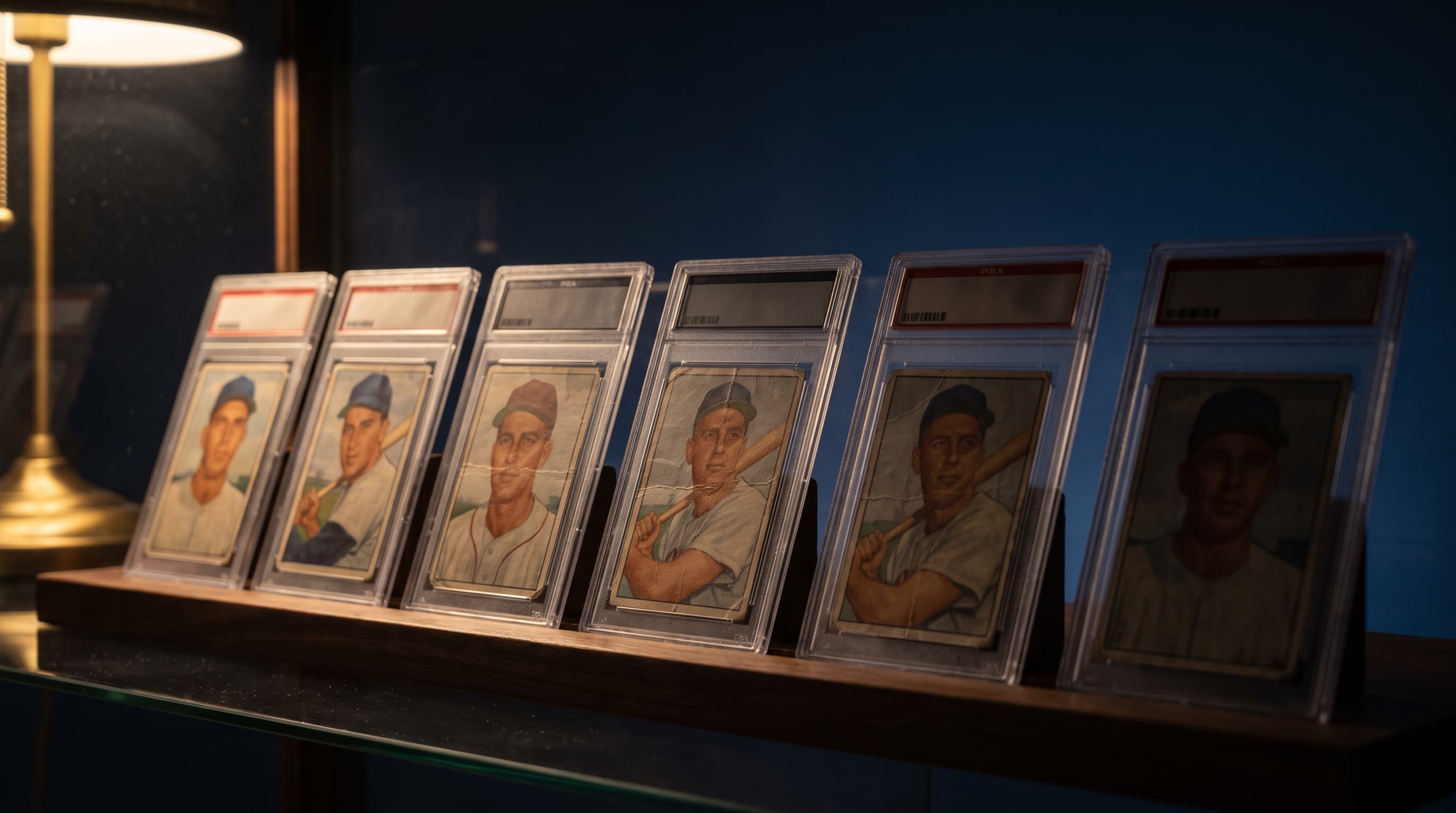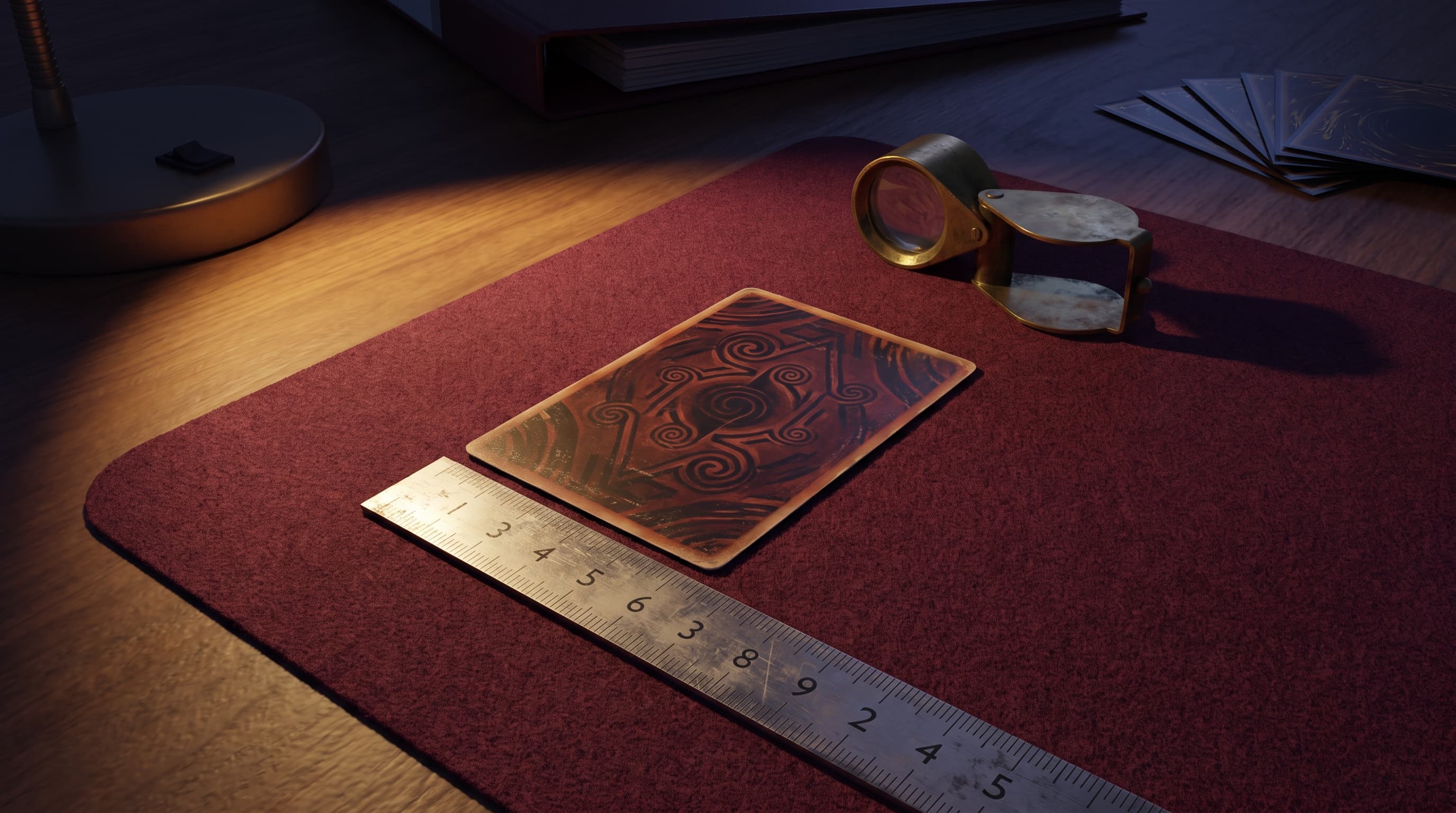
How to spot fake T206 cards: go from the cheapest check to the most technical. Measure the card against 1-7/16 x 2-5/8 inches. Confirm the player name on the front is printed in dark brown. Make sure the back brand fits its factory line. Look for splotchy ink under a 30x loupe, try a black light, and look for faked aging. Do all of this before you pay a raw-card price.
-
Size: 1-7/16 x 2-5/8 inches, with known exceptions
-
Front text: the name and team should be dark brown, not black
-
Back: a known brand, a factory line, and a brand/factory pairing that makes sense
-
Loupe: irregular, splotchy ink, not a neat dot grid
-
Black light: look for any fluorescence
-
Aging: burnt edges, soak wrinkles, corners worn too evenly
-
Reprint tells: Dover, Topps, scraped "Reprint" marks, glued backs
-
Seller and listing: item specifics, a written return policy
Raw T206s carry most of the reprint and trimming risk in pre-war collecting. The American Tobacco Company issued the set from 1909 to 1911 in cigarette and loose tobacco packs. It has 524 cards, all color lithographs. Pre-War Cards notes that the count is somewhat ambiguous depending on what you include. The 524 fronts appear with many different backs, and AllVintageCards counts more than 5,000 front/back combinations. With that many legitimate variations, a fake has plenty of room to blend in. It also means there are many specific details a fake can get wrong.
The checks below run in order. The first three can usually be done from listing photos, provided the seller shows a sharp front, a sharp back and a ruler. The loupe and black light checks need the card in hand, so they belong in the inspection window of a return policy.
1. Size: measure first, because it costs nothing
Pre-War Cards and Wikipedia both give the standard T206 size as 1-7/16 x 2-5/8 inches (3.7 x 6.7 cm). Six cards in the set are horizontal, so on those the measurements are rotated. Two cautions apply before you treat a short card as trimmed:
-
American Beauty backs were cut thinner so they would fit cigarette packs, according to Scot Reader's guide in Sports Collectors Digest. If an American Beauty is narrow, that is expected.
-
Manufacturing tolerances caused size variation across the set, Reader also notes.
A short card can still have been trimmed, though, and the grading companies handle undersized cards strictly. CGC's grading scale says its "Authentic" designation covers cards that are authentic and unaltered but cannot get a numeric grade, and that includes cards below minimum size. According to Cardhound Vintage, SGC gives "A" grades to factory miscuts that are too small, too large or not square, and the "tolerances appear to be trade secrets." So you can't check a card against a published minimum.
Collector reports show how this goes in practice. In a 2007 Collectors Universe forum thread, one collector said SGC rejected a Tolstoi-back T206 Cy Young because the "minimum size requirement was not met," with no evidence of trimming noted. Another collector in the same thread said PSA graded a T206 Evers that was almost 1/16 inch short. These are anecdotes, but they show that a grade is not predictable when a card is near the size line.
What to do: ask for photos of both dimensions against a ruler, with the card lying flat. Ask for a photo of all four edges as well. Price a short raw card as if it will come back "A" or "Authentic," not as a future numeric grade.
2. Front text: brown, not black
AllVintageCards' step-by-step T206 guide says the player name and team on the front should be dark brown, and that "Black text is a near-certain fake." This is the fastest visual check you have, and a decent listing photo is enough to run it. Phone cameras and screens can shift colors, so if the text looks borderline, ask for a photo in daylight.
3. The back: brand, factory, and combinations that exist
Reader's SCD guide lists 16 consensus T206 brands:
American Beauty, Broad Leaf, Carolina Brights, Cycle, Drum, El Principe De Gales, Hindu, Lenox, Old Mill, Piedmont, Polar Bear, Sovereign, Sweet Caporal, Tolstoi, Ty Cobb, Uzit.
The back colors include black, several shades of blue, brown, green, purple and red. Reader names Drum (purple), Uzit (light blue), Ty Cobb (green) and Lenox (black or brown) among the rarer backs. AllVintageCards notes that Piedmont and Sweet Caporal are the common backs that set the pricing baseline. If a rare back is listed cheaply, that is a reason to look harder, not a bargain.
Factory line. AllVintageCards says "Every authentic T206 card has a factory number printed on the back. Missing factory designation is a major red flag." The same guide says to check the advertising brand against the factory number, because "mismatches indicate a fake." Reader's SCD guide gives some reference points. Seven ATC factories in four states produced T206 cards. Factory 25 in Virginia made most American Beauties and Piedmonts, and Factory 33 produced the ultra-rare Ty Cobb backs.
Combinations that don't exist. Not every front was printed with every back. Pre-War Cards notes in its "Ten Ways" guide that T206 Honus Wagners exist only with Piedmont or Sweet Caporal backs. AllVintageCards gives a less famous example: Ray Demmitt (St. Louis) appears only with a Polar Bear back. Before buying any raw card with an unusual back, check the front/back pairing against a checklist.
4. Under a loupe: irregular ink is good
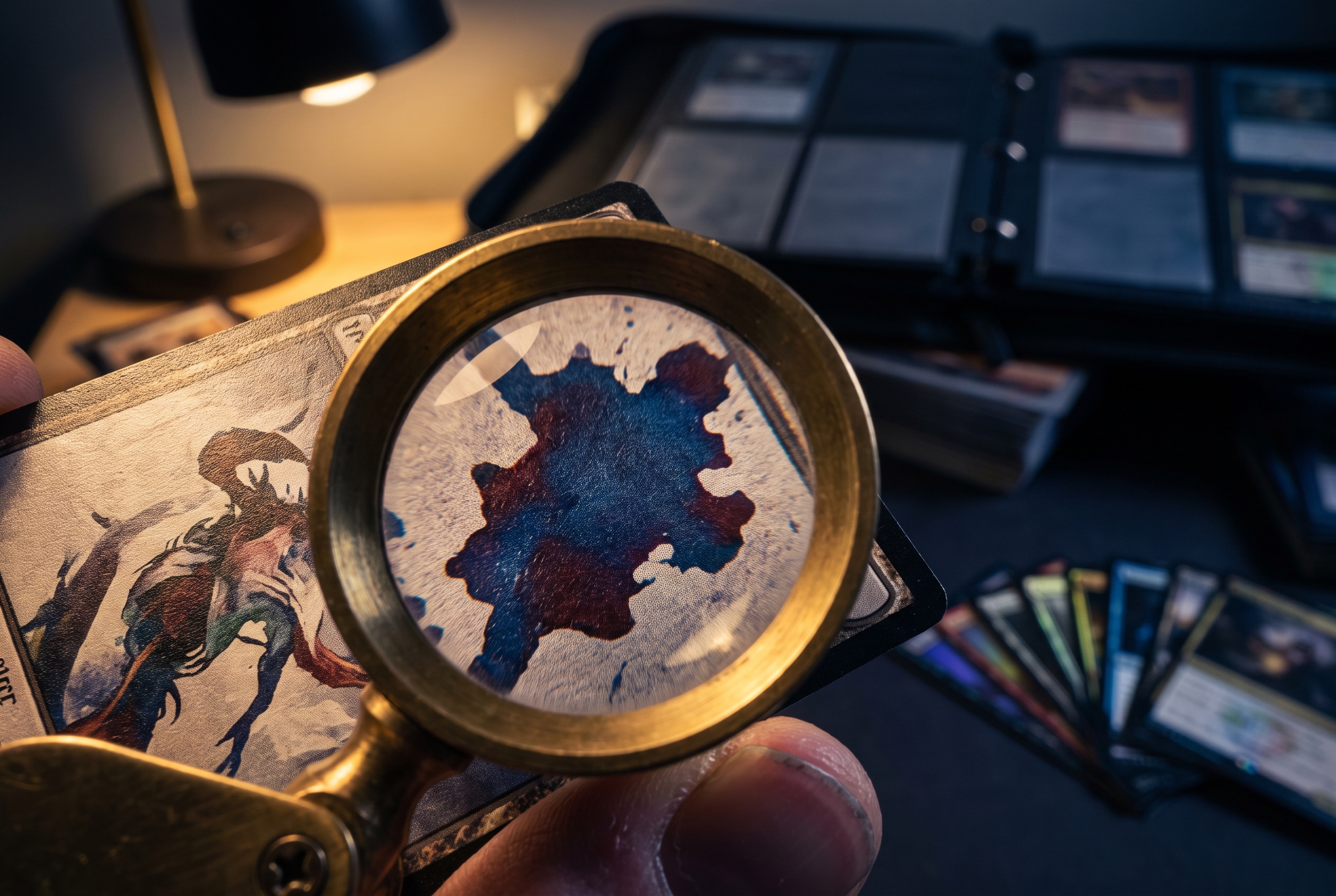
T206 fronts are color lithographs, and they don't look like modern printing up close. AllVintageCards says that at 30x, "authentic T206 printing shows irregular, splotchy ink dots." Modern reprints show a neat, uniform dot pattern, and the guide says the difference is "immediately obvious under a loupe."
Two more details from the same source are worth checking:
-
Registration is often slightly off on real cards, so the color layers don't line up perfectly.
-
Ink outside the borders should be splotchy and inconsistent.
A perfectly registered card with a crisp, even dot grid is the one that should worry you.
5. Black light: a quick screen for modern paper
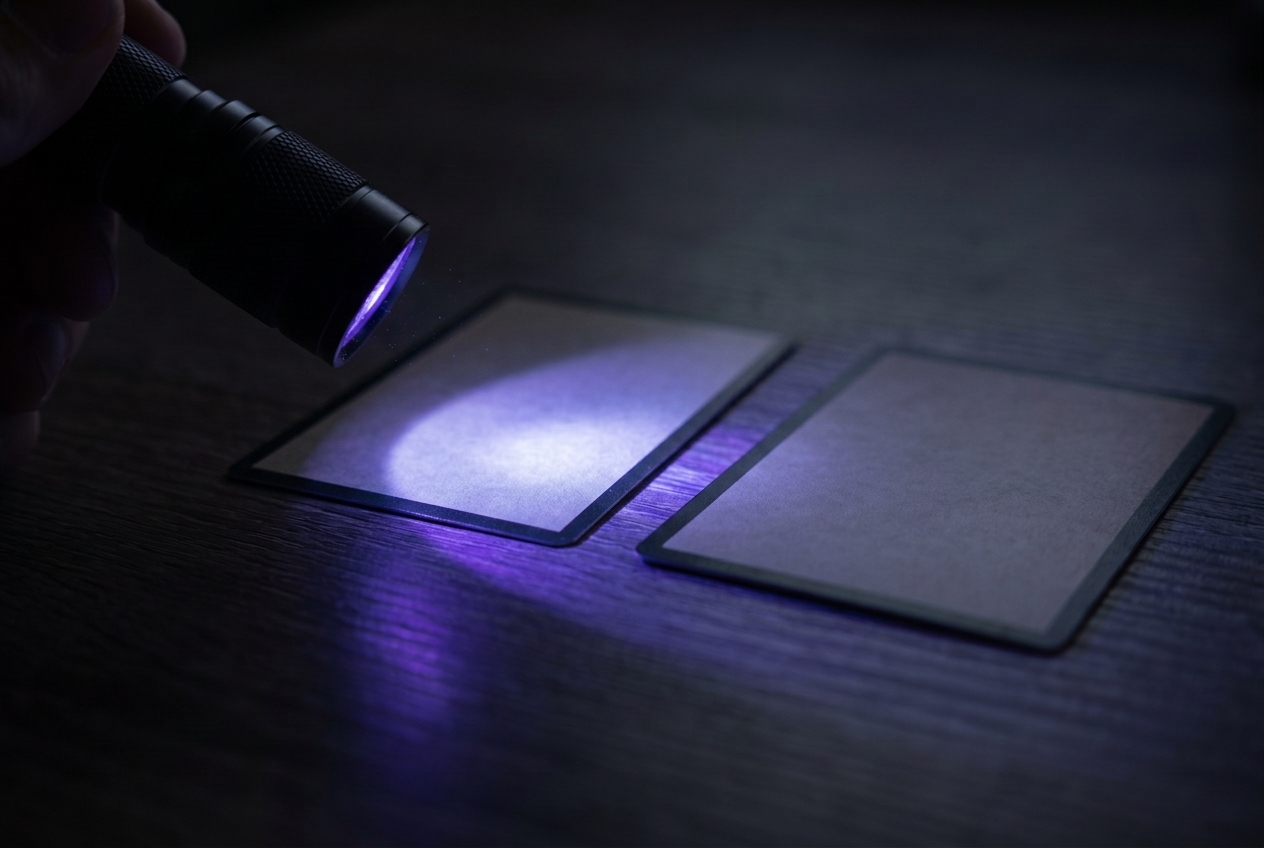
AllVintageCards says authentic T206 cards were printed before optical brighteners were added to paper in the late 1940s. On that basis, it says that if a card fluoresces at all under a black light, the card was not printed in 1909-11. This is AllVintageCards' rule, not a published grading standard. Still, an inexpensive UV light lets you rule out a card that glows. A card that passes this test has not been proven genuine. It has only avoided one specific failure.
6. Faked aging: wear that looks too even
Someone who has a convincing reprint still has to make it look 115 years old. AllVintageCards lists these signs of artificial aging:
-
Burnt edges
-
Spider wrinkles from soaking
-
Forced corner rounding
-
Unnatural white scratching on the surface
Pre-War Cards adds two more. One is fake brown cracking. Cracking is legitimate on T207s, so a forger copying that look onto a T206 is a warning sign. The other is corners worn suspiciously evenly. Real wear is usually uneven: one corner is soft, another is sharp, and one edge has more scuffing. If all four corners look identical, ask how that happened.
7. Reprint signs sellers don't mention
Reprints are legal and widely sold. The trouble is a reprint listed as an original, or one altered so it looks like one. Pre-War Cards covers the main types in its 2018 piece on reprints and fakes and its 2020 reprint guide:
-
Dover reprints: "A Dover Reprint" is printed on the back. The cards have oversized borders, perforated edges, a glossy finish (originals are not glossy) and black-and-white backs. The pictures are fuzzy, and the image quality is "not nearly as sharp" as the originals.
-
Topps reprints: Topps has made modern T206 reprints since 2002, according to Wikipedia, including a Wagner reissue with background color variations. Pre-War Cards notes that modern reprints from companies like Topps use different dimensions, so your size check from step 1 should catch them.
-
A 1980s Wagner reprint: it has a short history of the card printed on the back instead of a tobacco ad.
-
Scraped "Reprint" marks: sellers sometimes remove the "Reprint" marking, and that leaves detectable paper loss. If a back shows a thin, scuffed or abraded patch, ask for a close-up taken with raking light.
-
Glued backs: determined counterfeiters may glue authentic backs onto reprint fronts. A real back will pass the factory check from step 3. That is why the loupe check on the front matters even when the back looks right.
8. The listing and the seller
Pre-War Cards' "Ten Ways" guide covers buying hygiene, and it applies to every raw pre-war purchase:
-
Read the eBay item specifics, not only the title. Sellers sometimes disclose "reprint" there and leave it out of the title.
-
Look beyond the feedback score. A high number doesn't tell you whether the seller knows vintage.
-
Get a written return policy that covers a failed third-party authentication. Without one, your only protection is the checks you can run yourself.
-
Be skeptical of cheap listings and "new discoveries."
-
Buy graded for expensive purchases. AllVintageCards' set guide gives the same advice.
9. Raw or graded: what the labels mean
If the card is expensive enough that a mistake would hurt, a graded copy hands the authentication work to the grader. You should still know what a non-numeric label means before you pay for one.
-
PSA: According to AllVintageCards (Chris Rogers, 2020), "Authentic" means PSA is "only certifying that the item is genuine, without a numerical grade." "Authentic Altered" means the card is genuine but altered, such as by trimming, recoloring, restoration and/or cleaning. Before 2010, PSA labels named the alteration, for example "Authentic Trimmed."
-
CGC: "Authentic" is for cards that are authentic and unaltered but cannot get a numeric grade, including cards below minimum size. "Authentic Altered" is for a card that is authentic but altered, for example trimmed or recolored.
-
SGC: Cardhound Vintage reports that SGC "A" labels now "clearly state the reason" a card was disqualified. Reasons on the label include Altered, Color Added, Evidence of Trimming and Miscut.
These labels affect price. Cardhound Vintage says "A" cards typically sell for much less than numerically graded copies, and they are sometimes priced "like a 2" even when the eye appeal is good. On older slabs and on CGC, check whether "Authentic" means an unaltered card with a size or other issue, or an altered one. The two are not the same.
If you already own a raw T206 and are deciding whether to submit it, our card grading break-even tool compares your net proceeds selling raw against submitting and then selling, using fees, shipping and sale prices that you enter. It does not predict what grade a card will get, what it is worth now, or how it will perform as an investment. That is especially relevant for a near-minimum-size card, where an "A" or "Authentic" result is a real possibility.
Sidebar: other ATC tobacco sets at a glance
| Set | Year | Cards | Size | Notes | | --- | --- | --- | --- | --- | | T206 White Border | 1909-11 | 524 | 1-7/16 x 2-5/8 in. | 16 consensus brands; six horizontal cards | | T205 Gold Border | 1911 | 221 | 1-7/16 x 2-5/8 in. | 11 brands, 17 backs (Wikipedia) | | T207 Brown Background | 1912 | 200 (207 with error variations) | 1-7/16 x 2-5/8 in. (per Pre-War Cards) | Recruit and Napoleon backs common; Broadleaf, Cycle, anonymous and Red Cross scarcer; brown cracking is legitimate | | T3 Turkey Red | 1910-11 | 126 (100 baseball) | 5-3/4 x 8 in. | Cabinets redeemed with coupons, not pack cards; six back types |
The size and back checks apply to all of these sets, but each set has its own correct values. A T3 is a large cabinet card, so a Turkey Red image at pack-card size is not a T3.
Printable checklist: raw T206
| Check | What passes | Pass | Fail | | --- | --- | --- | --- | | 1. Size | About 1-7/16 x 2-5/8 in.; narrower only on American Beauty | ☐ | ☐ | | 2. Front text | Name and team in dark brown, not black | ☐ | ☐ | | 3a. Brand | One of the 16 consensus brands | ☐ | ☐ | | 3b. Factory line | Present, and fits the brand | ☐ | ☐ | | 3c. Combination | Front/back pairing exists on a checklist | ☐ | ☐ | | 4. Loupe (30x) | Irregular, splotchy ink; slightly off registration | ☐ | ☐ | | 5. Black light | No fluorescence | ☐ | ☐ | | 6. Aging | Uneven, natural wear; no burns, soak wrinkles or fake cracking | ☐ | ☐ | | 7. Reprint tells | No perforations, gloss, oversized borders, paper loss on back, or glued layers | ☐ | ☐ | | 8. Listing | Item specifics read; written return policy covers failed authentication | ☐ | ☐ |
One fail is enough to walk away or to require grading before money changes hands. Ten passes lower the risk, but they don't replace a grader's opinion on an expensive card.
Related reading
-
The 2026 Topps Update Rookies Worth Chasing, and the Ones to Skip
-
A Vintage Card Centering Guide for Raw 1950s Topps and Bowman
Sources
-
AllVintageCards: Step By Step Guide To Spotting a Fake T206 Card
-
AllVintageCards: T206 White Borders Set, Complete Collector's Guide
-
AllVintageCards: What Does "Authentic" Mean In Card Grading?
-
Sports Collectors Digest (Scot Reader): A collector's guide to the T206 White Border set
-
Pre-War Cards: Ten Ways to Help Avoid Fakes in the Vintage Card Market (2018)
-
Pre-War Cards: Reprints and fakes shouldn't be viewed as the same (2018)
-
Pre-War Cards: Reprints are Cheap, Popular ... but Should They Exist? (2020)
-
Pre-War Cards: 1910-11 Turkey Red Cabinets Set and Checklist
-
Cardhound Vintage: Understanding "A" Grades from SGC and PSA (2024)
-
Collectors Universe forums: T206 Cy Young Rejected by SGC, too small? (2007)
Note: This article contains AI-assisted content and has been reviewed in our editorial workflow.
DISCLAIMER: PureGrail articles are for informational and entertainment purposes only. Nothing on this site constitutes financial, investment, or legal advice. Collectibles are speculative assets and values can decrease significantly. Always conduct your own research before buying or selling. Past price performance does not indicate future results.