This vintage card centering guide works on any raw 1950s Topps or Bowman card. Measure each border at two points as far apart as possible, front and back. Divide the larger border by the sum of both opposing borders, and grade on the worst reading. Compare that ratio to the grader's published line, then check for diamond cut.
-
Measure left and right borders on the front, two readings each.
-
Measure top and bottom borders on the front, two readings each.
-
Repeat both steps on the back.
-
Convert the worst pair to a ratio (larger ÷ (larger + smaller)).
-
Check whether the two readings on any single border disagree (a sign of diamond cut).
-
Check for any part of an adjacent card showing (a sign of miscut).
-
Compare against the target grade's line before you price the card.
Centering is the first thing to check on a raw 1950s card because it sets a ceiling. Corners, edges and surface can only pull a grade down from wherever the borders allow. Clean corners on a card that measures 75/25 do not make it a high-grade candidate. Nothing below guarantees a grade. Graders apply judgment, and two careful collectors can measure the same card slightly differently. The aim is to stop you paying a high-grade price for a card whose borders already rule that grade out.
The vocabulary: off-center, miscut and diamond cut
Three defects come up again and again with 1950s cards, and the grading companies do not use the words the same way.
-
Off-center. The design is shifted toward one edge, but all four borders are present and the card is rectangular. This is the most common problem and the easiest to measure.
-
Miscut. According to Cardhound Vintage, PSA's MC qualifier is for cards that are far off center, usually to the point where part of the next card is showing or a border is completely missing.
-
Diamond cut. The 1967ers blog puts it plainly: "A card with a diamond cut is not actually rectangular. It's a parallelogram." The design lines up on one axis but is skewed on the other.
The terms matter because SGC uses "miscut" differently. Cardhound Vintage reports that SGC uses the word to "refer to a card that is diamond cut or not square," and that "an SGC 'miscut' is considered Authentic only and cannot receive a number." A tilted card that might get a numeric grade elsewhere could come back from SGC with no number. Factor that in before choosing where to submit a visibly skewed card.
Why 1950s cards came out crooked
Topps has not published the details of its 1950s cutting process, so the best explanation available comes from collectors. In a Collectors Universe forum thread, user baz518 described it this way: "the sheet was gripped on the left side while horizontal slits were cut for the rows. Then from right to left, a vertical blade cut off a column of cards at a time." The same user added that "if the left side of the sheet isn't flush when it's gripped and they start cutting, the horizontal slits and the vertical cuts would actually be at a slant relative to the sheet."
Another user in the thread, mcolney1, named three other causes: printing misregistration, a sheet that was not loaded square, and blades getting dull. Treat all of this as forum explanation, not company documentation. It still tells you what to look for. A slant introduced at the cutting stage shows up as borders that change width along their length, and a single ratio taken at one point on each side will miss it.
The measuring checklist
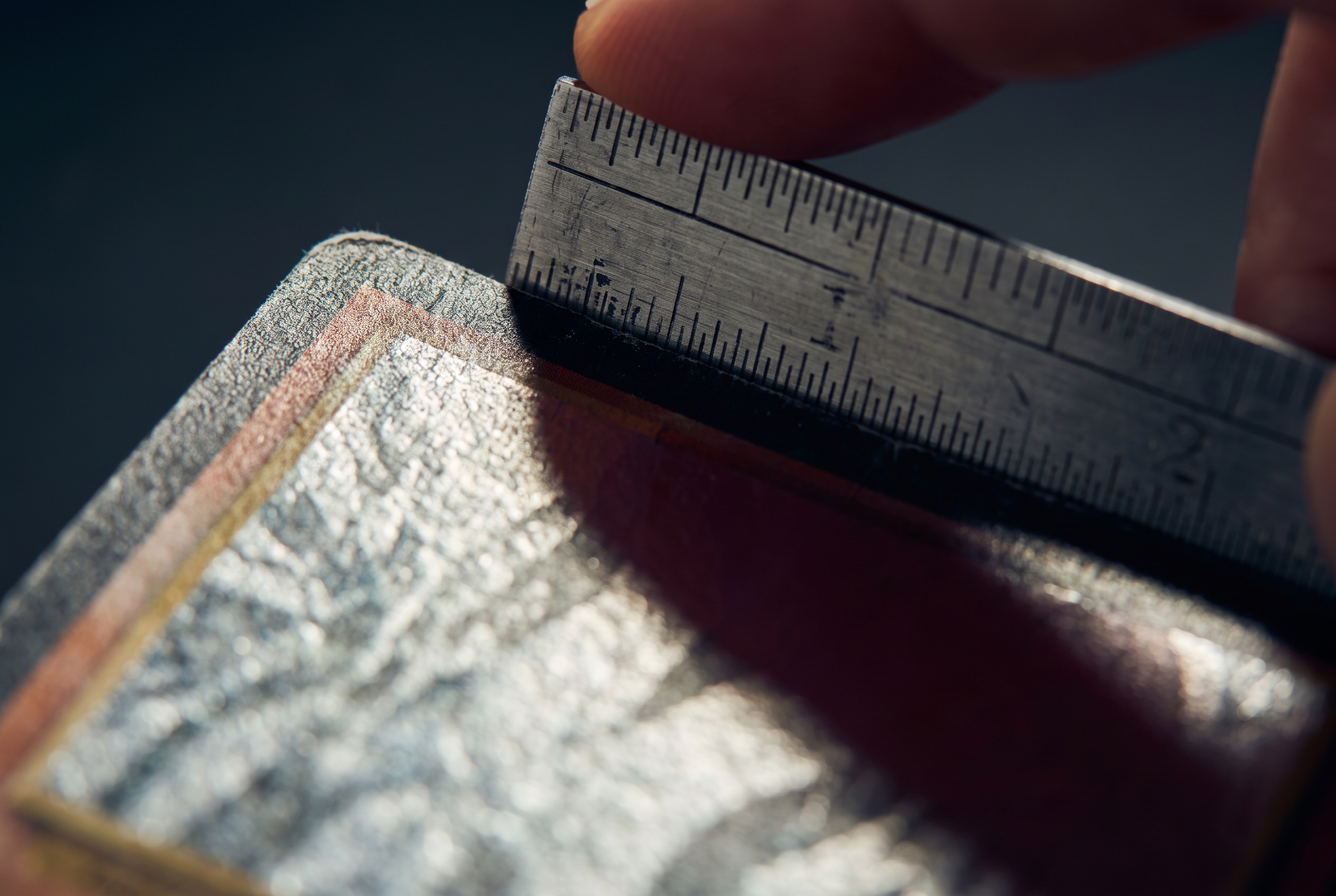
Tools: a millimeter ruler or caliper, and good, even light. If the card is in a sleeve or top loader, measure through it carefully or take it out if you are allowed to. The method below comes from a 2013 Collectors Universe guide to centering.
-
Take two readings per border. Measure each border at two places as far apart as possible, for example at the top and bottom of the right border. Do the same for the left, top and bottom borders.
-
Use the worst pair. The guide's rule: "The only one that is important is the one that has the worst balance." Don't average a bad reading with a good one.
-
Convert to a ratio. Divide the larger border by the two opposing borders combined. A 3 mm left border and a 2 mm right border give 3 ÷ 5 = 60%, so the card is 60/40. Put another way, 60/40 means one border is 1.5 times as wide as the other.
-
Repeat on the back. Backs are judged much more loosely, but they are still judged.
-
Compare the two readings on each border. If the top of the right border measures noticeably different from the bottom of the same border, the card is probably diamond cut, even if the left/right ratio at one point looks fine.
-
Look at every edge for a sliver of the neighboring card. Any part of an adjacent card's design or color strip points toward miscut territory.
Useful width ratios, worked out from the percentages: 55/45 is about 1.22 to 1. 60/40 is 1.5 to 1. 65/35 is about 1.86 to 1. 70/30 is about 2.33 to 1. 75/25 is 3 to 1. 85/15 is about 5.67 to 1. 90/10 is 9 to 1. If the wide border is three times the narrow one, you're at 75/25.
Tolerances by grade: CGC and PSA
CGC's lines below are quoted from its own published grading scale, the only primary grader page used for this guide. The PSA figures are as summarized by CardCenteringCalculator (August 22, 2026), not taken directly from PSA.
| Grade | CGC front | CGC back | PSA front (per CardCenteringCalculator) | PSA back (per CardCenteringCalculator) | | --- | --- | --- | --- | --- | | Pristine 10 (CGC only) | 50/50 | Not listed here | n/a | n/a | | Gem Mint 10 | Approximately 55/45 | 75/25 | Approximately 55/45 | 75/25 | | Mint 9 | 60/40 or better | 90/10 | Approximately 60/40 | 90/10 | | NM/Mint 8 | 65/35 or better | Not listed here | Approximately 65/35 | 90/10 | | Near Mint 7 | 70/30 or better | Not listed here | Approximately 70/30 | 90/10 | | Ex/NM 6 | No worse than 75/25 | Not listed here | 80/20 | 90/10 | | 5 and 4 | 85/15 at VG/Ex+ 4.5 | Not listed here | 85/15 | 90/10 | | 3.5 and below | 90/10 at Very Good+ 3.5 | Not listed here | 90/10 (grades 3 to 1.5) | 90/10 |
Two points stand out. First, the lines are close through grade 7 and split at 6: CGC's published line is 75/25, and CardCenteringCalculator's summary of PSA is 80/20. A raw card measuring 78/22 sits on different sides of the line depending on the company. Second, backs get far more room. Under the PSA summary, every grade below 10 allows 90/10 on the reverse, and CGC lists 90/10 on the back at Mint 9.
The PSA 10 change
Older PSA wording, quoted by a user in an Elite Fourum thread from January 29 to 30, 2025, read: "The image must be centered on the card within a tolerance not to exceed approximately 55/45 to 60/40 percent on the front, and 75/25 percent on the reverse." CardCenteringCalculator quotes the current wording as "within a tolerance not to exceed approximately 55/45 percent on the front, and 75/25 percent on the reverse." Forum users said PSA made no public announcement of the change. The 2013 Collectors Universe guide shows the same older range ("Between 55/45 and 60/40 or better" for a PSA 10 front). In practice, a card measuring 58/42 on the front used to fall inside the PSA 10 range and now appears to fall outside it. For most 1950s cards a 10 is not realistic anyway, but the change shows these numbers can move without notice. Recheck them before a big submission.
Diamond cut allowances by grade
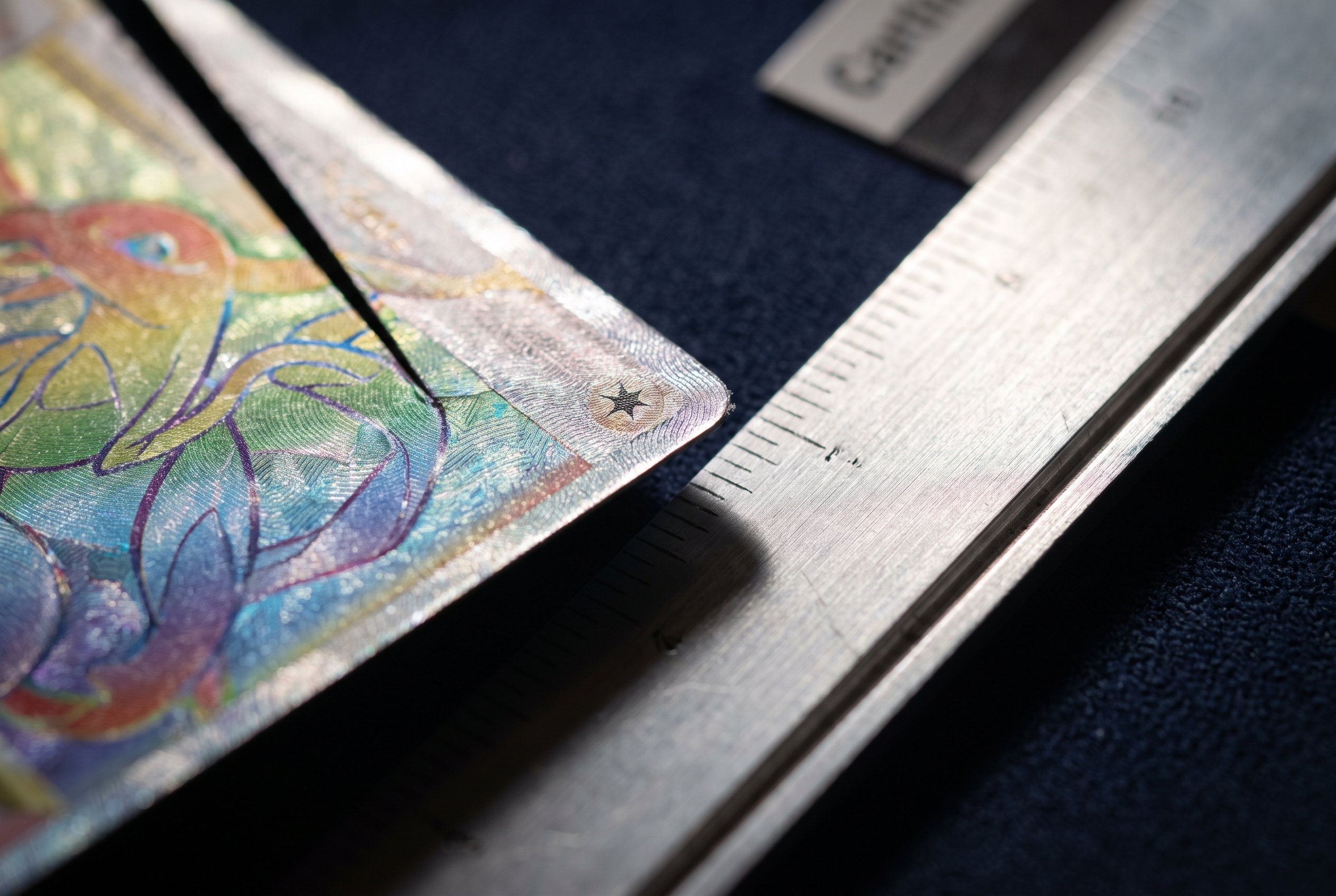
CGC is the only grader in this research that publishes diamond-cut allowances grade by grade. From its grading scale:
-
NM/Mint+ 8.5 and NM/Mint 8: "A very slight diamond cut is allowed."
-
Near Mint+ 7.5 and Near Mint 7: "A slight diamond cut is allowed."
-
Ex/NM+ 6.5 and Ex/NM 6: "A moderate diamond cut is allowed."
-
VG/Ex+ 4.5 and VG/Ex 4: "an extremely noticeable diamond cut is allowed."
-
Good+ 2.5 and Good 2: "An extremely heavy diamond cut resulting in a near miscut is allowed."
The takeaway for a raw purchase: a tilt you can see without a ruler is not "very slight," so a visibly skewed card is unlikely to land in CGC's 8 range even with a clean left/right ratio. And because SGC treats diamond-cut and out-of-square cards as miscut and Authentic only, according to Cardhound Vintage, the same card could come back with very different outcomes depending on where you send it.
Qualifiers and how the market prices them
PSA changed its qualifier policy in June 2021. CardCenteringCalculator quotes the change: "PSA no longer requires card submitters to decide on qualifiers," and OC, ST, PD and OF "will be assigned at the grader's discretion, and most typically will impact the numerical grade rather than carrying a qualifier." Cardhound Vintage (Matt Felumlee, November 26, 2024) sums it up: "Miscut (MC) and Marked (MK) are required if present, but it is up to the grader to decide whether to assign (OC)."
So a badly off-center card at PSA will most likely come back with a lower number, while a miscut card gets the MC qualifier on its label. As Cardhound explains it, a qualified grade means the card meets the stated grade apart from the qualifier. On price, the author's rule of thumb is that "most will value a PSA 6 (MC) in line with a PSA 4." The same piece gives the advice that applies to this whole checklist: "Buy the card, not the grade." Two MC cards with the same number can look very different, so look at the card itself.
Set-specific watch list
Only a few card-level centering notes could be verified for this guide, all from 1952 Topps:
-
1952 Topps Pee Wee Reese #333. Old Sports Cards says the card "suffered less from kids handling it than from bad factory cuts, making it tough to find well-centered."
-
1952 Topps Bill Dickey #400. The same source says it "often suffers from poor centering, making high-grade copies tough to find."
For cards like these, a well-centered raw copy is the scarce part. Measure before you pay a premium for "sharp corners."
Icons work differently. Sports Collectors Digest (Larry Canale, July 2022) described an SGC 1.5 1952 Topps Mantle as "off-center with predictable corner wear" and reported a sale of $37,643. It also reported that a "badly centered, roughed-up Mantle rookie sold in April for $10,000." For the most-wanted cards, the name drives the price more than eye appeal does. That doesn't apply to a commons lot, where a centering grade cap goes straight into what the card is worth.
The buy or grade decision
When the worst-side ratio falls outside the line for your target grade, price the card at the grade its centering allows, not the grade its corners suggest. A raw card with crisp corners that measures 72/28 on the front is, under both CGC's line and the PSA summary above, not a 7 candidate on centering. Pay for what the borders support.
If you're deciding whether to submit at all, PureGrail's grading break-even calculator compares net proceeds from selling raw against grading and then selling, using costs you enter yourself. It doesn't predict grades, current prices or returns. You supply those assumptions, so use the grade your measurements support, not the one you're hoping for.
Printable checklist: raw 1950s card centering
Card: ____________________ Set/No.: ________ Asking price: ________
| Check | Reading 1 (mm) | Reading 2 (mm) | Worst ratio | Notes | | --- | --- | --- | --- | --- | | Front: left border | | | ___ / ___ | | | Front: right border | | | | | | Front: top border | | | ___ / ___ | | | Front: bottom border | | | | | | Back: left border | | | ___ / ___ | | | Back: right border | | | | | | Back: top border | | | ___ / ___ | | | Back: bottom border | | | | | | Diamond cut? (do two readings on one border disagree?) | Yes / No. Which border: ________ | | | | | Miscut? (any part of an adjacent card showing, or a border missing?) | Yes / No | | | | | Target grade | ________ | | | |
Front lines by grade (CGC / PSA per CardCenteringCalculator): 10: 55/45 / about 55/45. 9: 60/40 / about 60/40. 8: 65/35 / about 65/35. 7: 70/30 / about 70/30. 6: 75/25 / 80/20. 4.5 (CGC) and 5 to 4 (PSA): 85/15. 3.5 (CGC) and 3 to 1.5 (PSA): 90/10.
Back lines: 10: 75/25 at both. 9: 90/10 at both. PSA summary: 90/10 at all grades below 10.
Ratio formula: larger border ÷ (larger + smaller). 1.5 to 1 = 60/40. 3 to 1 = 75/25. 9 to 1 = 90/10.
Related reading
Sources
-
Vintage FAQ: Understanding Qualifiers at PSA (Cardhound Vintage)
-
Vintage FAQ: 5 Misunderstood Aspects of Grading with PSA and SGC (Cardhound Vintage)
-
25 Most Valuable 1952 Topps Baseball Cards (Old Sports Cards)
-
Condition matters, unless it's a 1952 Mickey Mantle (Sports Collectors Digest)
Note: This article contains AI-assisted content and has been reviewed in our editorial workflow.
DISCLAIMER: PureGrail articles are for informational and entertainment purposes only. Nothing on this site constitutes financial, investment, or legal advice. Collectibles are speculative assets and values can decrease significantly. Always conduct your own research before buying or selling. Past price performance does not indicate future results.