On June 2, 2026, the cheapest legitimate way to get a new card into a PSA holder became $79.99. That is not a promotional line or a temporary surcharge — it is the practical floor left standing after PSA paused new submissions across all four of its Value service tiers to dig out of a backlog that had swelled toward roughly 10 million cards. Routine price bumps come and go in this hobby. This is different: it quietly repriced what is actually worth grading, and it is engineered to hold for months.
What PSA actually paused
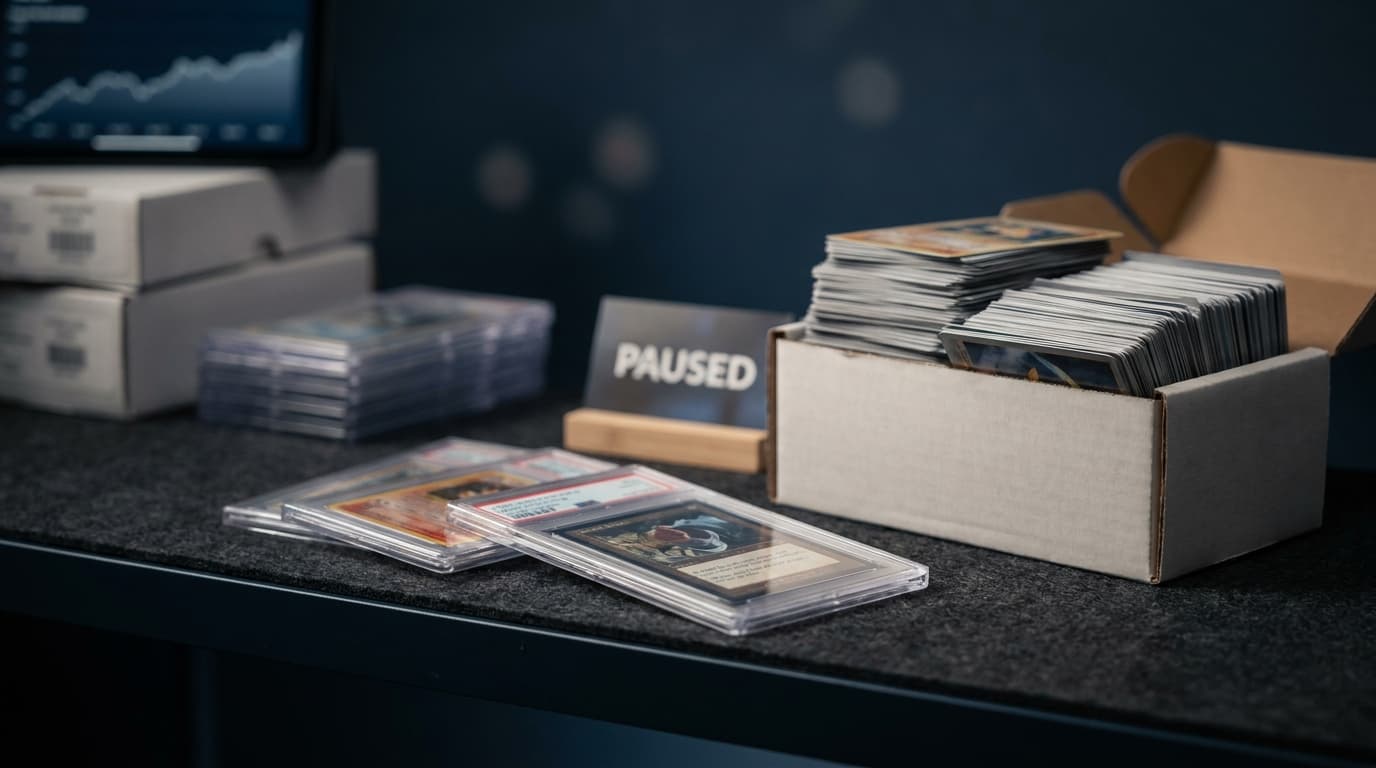
Effective June 2, PSA stopped accepting new submissions on its four entry-level tiers: Value Bulk ($24.99), Value ($32.99), Value Plus ($49.99), and Value Max ($64.99). With those closed, the cheapest orderable new-submission tier is now Regular at $79.99 per card. That is roughly a 142% jump over the $32.99 Value tier, and about 3.2x the $24.99 Value Bulk rate it effectively replaces at the bottom of the menu.
Value Bulk was never a wide-open door to begin with. It was a Collectors Club-only tier carrying a 20-card minimum, a $500 maximum declared value per card, and a turnaround that ran around 95 business days. It was the tier built specifically for grading in volume — and it is the tier the pause takes off the table.
Worth noting for context: these were not the pre-pause prices from a year ago. PSA's February 2026 pricing update had already lifted Value Bulk from $21.99 to $24.99 and Regular from $74.99 to $79.99. So the $79.99 floor was fresh even before the Value tiers went dark, a sequence trade coverage flagged at the time.
Why the pause happened
PSA framed this as a capacity problem, not a pricing strategy — and the numbers back the framing. The pause was driven by a backlog approaching about 10 million cards, with a stated goal of working that number down to roughly 5 million before the Value tiers reopen. To reduce the incoming flood while it catches up, PSA also temporarily stretched the Regular tier's turnaround from 40 to 50 business days.
This is a demand story, not a throughput collapse. PSA reports current grading capacity of roughly 90,000 cards per day, up from about 15,000 per day in 2021, according to reporting on the pause. The company is grading faster than it ever has and still fell behind — which tells you the surge is on the submission side. Closing the cheapest tiers is the lever that most directly throttles the highest-volume, lowest-value inflow.
The new break-even math
Here is where the pause stops being a headline and starts changing behavior. At an ~$80 grading cost, before you add shipping and insurance both ways, the economics of "grading the commons" simply stop working.
Run the arithmetic conservatively. A raw card generally needs to clear well over $150-$200 in value — and grade cleanly to a high PSA 9 or 10 — before submission is rational. Below that, the grading fee eats too much of the upside, and a 7 or 8 can leave you underwater on the fee alone. The tiers that made it sane to slab $10-$40 cards in bulk are exactly the ones now closed. During the pause, that entire category of submission is priced out of the market.
The takeaway is not "grading is dead." It is that the marginal card — the one you were on the fence about — is no longer a coin flip. At $79.99, the fence is much higher up the value ladder.
Timeline reality: plan for months, not weeks
The single most important thing to understand is that PSA did not set a date. Reopening the Value tiers is tied to a condition: the backlog reaching roughly 5 million cards. PSA's public Backlog Tracker, updated bi-weekly, is the instrument to watch.
As of mid-July 2026, that tracker showed about 11 million cards still in the queue — down from around 12 million, and off a peak near 14 million, per Sports Illustrated's reporting. Progress is real, but the target is still roughly 6 million cards away. PSA's own estimate at the late-May announcement was "up to four months," and SI noted that even Value orders already in process may need an additional 6-8 weeks. Put those together and the practical reopening window lands somewhere in the late-2026 to early-2027 range — a moving target, not a countdown.
If your plan depends on cheap grading returning "soon," build in a wide margin. This is a months-long strategic shift.
Channel check: no cheaper side door
A reasonable next question is whether retail drop-off gets you around the floor. It does not. GameStop's PSA drop-off grading also rose to $79.99, up from $24.99 earlier in spring 2026 and a $15.99 launch price back in 2024. That channel carries a $1,500 declared-value cap and $9.99 shipping. The point is that the ~$80 floor holds across legitimate channels right now — there is no discount lane hiding behind a different storefront.
Strategic takeaways for collectors
-
Hold marginal cards raw. Anything that doesn't clearly clear the well-over-$150-$200 threshold and grade to a strong 9 or 10 is better left ungraded until Value tiers return.
-
Batch your high-value submissions. If a card genuinely justifies $79.99, the pause doesn't change that — but concentrate your spend on cards where the grade meaningfully moves the price.
-
Watch the Backlog Tracker, not the calendar. Reopening is condition-based. The bi-weekly number is your only reliable signal.
-
Reassess when the tiers come back. When Value grading returns, the commons math changes again — plan to revisit anything you're parking now.
What to watch next
Three things will tell you where this goes. First, the bi-weekly Backlog Tracker updates and how fast the number closes on 5 million. Second, PSA's handling of Collectors Club memberships — the company extended memberships free for members active on May 14, 2026, and further gestures would signal how long PSA expects the pause to run. Third, any indication PSA moves the 5-million reopening trigger, up or down, which would reset every timeline estimate built on it.
Until then, the floor is $79.99, and the honest question before every submission is the same one it always should have been — just with a much higher bar: is this card worth slabbing at all?
Related reading
Sources
-
[PSA Backlog Tracker (official, bi-weekly)](https://www.psacard.com/info/backlog-tracker)
-
[CardGrade.io — PSA Value Tiers Paused in 2026](https://cardgrade.io/blog/psa-value-tiers-paused-2026)
-
Sports Illustrated — PSA Bi-Weekly Update Shows 11 Million Cards Still Backlogged
-
Card Atlas — PSA Paused Every Tier Under $80, GameStop Grading Jumped to $79.99
-
[Athlon Sports — PSA Grading Price Increases February 2026](https://athlonsports.com/collectibles/psa-grading-price-increases-february-2026-what-collectors-need-to-know)
Note: This article contains AI-assisted content and has been reviewed in our editorial workflow.
DISCLAIMER: PureGrail articles are for informational and entertainment purposes only. Nothing on this site constitutes financial, investment, or legal advice. Collectibles are speculative assets and values can decrease significantly. Always conduct your own research before buying or selling. Past price performance does not indicate future results.