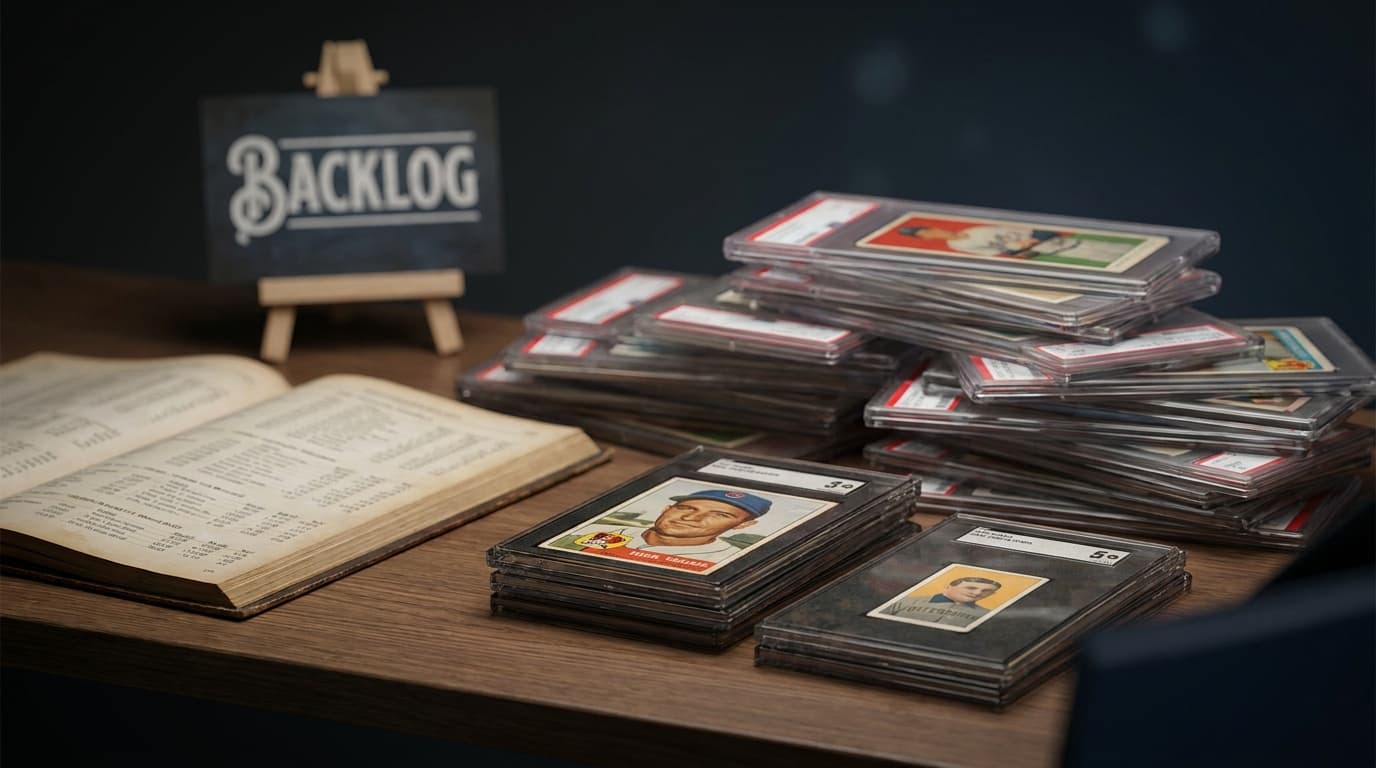
Grading discourse in 2026 has two loud headlines. The first is PSA's backlog: roughly 14 million cards deep by June, with every sub-$80 Value tier paused since June 2. The second is legal: an antitrust class action against PSA's parent, Collectors Holdings, over its roll-up of SGC and Beckett. Both are real, and both matter. But if you collect pre-war or 1950s cardboard, neither is the story that should change how you submit this year.
The story that should is this: in the deepest tier of vintage, SGC is no longer the scrappy alternative to PSA. By raw submission count it is now roughly a coin-flip competitor — and the "PSA premium" that historically justified paying more and waiting longer for the red label has thinned to almost nothing on genuine vintage. This is a market-share shift happening in plain sight while attention sits elsewhere.
The volume reality: small overall, near-parity in vintage
Start with the top line, because it cuts against the thesis if you stop there. In 2025 the industry graded north of 26 million cards. PSA did about 19.26 million of them — roughly 72% of all cards and about 76% of sports — while SGC graded around 1.42 million, actually a 24% year-over-year decline, the largest drop of any major grader (PreGradeCards; Sports Illustrated). On paper, SGC is a rounding error at about 7% of the market.
Now narrow the lens to what SGC actually is. About 27.7% of SGC's 2025 volume was pre-1980 material, up from roughly 20% in 2024 — and SGC was the only major company to increase its vintage percentage year over year. In the deepest tier, the picture inverts entirely. As of June 2025, cards from the 1950s and earlier made up 12.2% of SGC's sports volume — about 17,880 cards — versus just 2.6% of PSA's, roughly 13,650 (Cardhound Vintage). In other words, in pre-war and 1950s sports, SGC is grading more raw cards than PSA. Not more per capita — more, full stop.
That is the number to sit with. A company at 7% of the total market is running effectively 50/50 with the 72% giant in the one segment vintage collectors care most about. The black-label "tuxedo" holder has quietly become a default for pre-war slabs rather than a compromise.
Re-underwriting the "PSA premium"
The usual objection is resale: PSA slabs sell for more, so you grade with PSA even if the wait is longer. On modern, high-grade, marquee cards, that is still often true. On vintage, the data is much weaker than the reputation.
The clearest cross-grade sales work comes from balanced pre-war T206 samples. On a Cy Young Portrait across grades 2–4, PSA and SGC copies "sell for approximately the same price, all else equal" — parity, not a premium ([All Vintage Cards](https://allvintagecards.com/psa-graded-cards-premium/)). A thinner sample on the Cy Young "Glove Shows" variant did show a gap — roughly $1,022 for PSA against $819 for SGC, about 25% — but the sample was small enough that the researchers flagged it as such. That is the pattern across vintage: parity on deep, liquid samples; scattered gaps on thin ones that are as likely to reflect condition and sample noise as a durable brand premium.
Even the marquee 1950s material tells a modest story. Older 2020-era data on the 1952 Topps Mantle put PSA at about a 13% average premium over SGC — real, but far from the multiples people assume, and again on small samples. The honest read: PSA premiums are wide and durable on modern and high-grade cards, and they narrow to modest-or-nonexistent as you move into commons and mid-grade vintage. If you're buying a PSA 3 T206 common and paying up over the identical SGC 3, you are paying for the label, not the market.
Turnaround is doing the work brand used to
Here is the mechanism behind the share shift, and it isn't sentiment — it's queue length. PSA's backlog reached roughly 14 million cards against a stated capacity near 90,000 a day. On June 2, 2026, PSA paused every Value tier — Value, Value Bulk, Value Plus, Value Max, all sub-$80 — and launched a public backlog tracker, projecting five to six months to pull the queue down to around 5 million (PSA; Baseball America). For paid tiers, PSA's 2026 estimates run 40–60 days at Regular, 15–20 at Express, 5–10 at Super Express, and 3–5 at Walkthrough — with the cheap door closed entirely.
SGC's answer is speed at the low end, exactly where PSA retreated. Base and standard service starts around $20–25 at roughly 10–40 days, Express runs 10–20, Premium 5–10, and Turbo turns cards in 2–3 days at about $150 (CardGrade.io; gosgc.com). That positions SGC as the fastest major grader in 2026 — and if PSA and SGC vintage slabs resell for roughly the same, then liquidity per dollar of grading fee, not brand, is the deciding variable. A card back in your hands and listable in a week is worth more than an identical card stuck in a months-long queue. Submitters have noticed, and the vintage volume numbers are the receipt.
Where SGC still trades at a discount
Skepticism cuts both ways, so be precise about where the SGC-equals-PSA claim breaks down. It breaks on buyer-demand-driven cards: registry chases, high-grade marquee pieces, and modern material, where PSA's set-registry gravity and collector preference still command a real premium. If your end buyer is a PSA set-registry participant, an SGC slab may need to be cracked and resubmitted to fit — a cost and a risk that erodes the arbitrage. And the thin-sample gaps like the Cy Young Glove Shows are a reminder that "parity" is a statement about deep, liquid samples, not a guarantee on any single lightly-traded card. On those, price discovery is genuinely noisy and the "discount" may be real, may be sample distortion, and is hard to tell apart in real time.
The overhang: does common ownership close the arbitrage?
The cross-grade arbitrage this thesis leans on assumes PSA and SGC behave as competitors. They increasingly share an owner. Collectors bought SGC in February 2024 and Beckett in December 2025. On April 15, 2026, Rasmussen v. Collectors Holdings (Case 8:26-cv-00897, C.D. Cal.) was filed, naming Collectors, PSA, SGC and Beckett, and alleging the acquisitions pushed Collectors to roughly 80% market control. The complaint claims SGC's prices rose about 20% and its turnaround times lengthened by up to 400% after the 2024 buy, and it seeks forced divestiture of SGC and Beckett plus treble damages; Collectors has moved to dismiss or compel arbitration (Value Added Resource; Athlon Sports). In December 2025, Rep. Pat Ryan demanded an FTC investigation (patryan.house.gov). Post-acquisition, SGC's president departed and resources reportedly shifted toward PSA.
Hold two things at once here. The suit's own allegations — a 20% SGC price bump and dramatically longer SGC turnaround after the buyout — would, if true, blunt the exact speed-and-cost edge driving vintage submitters to SGC. Yet the June 2025 and 2026 data show SGC's vintage share climbing and its turnaround tiers still the fastest on the board. That tension is unresolved, and it's the real risk to this thesis: if common ownership eventually narrows the price and speed gaps by design, the cross-grade edge erodes not because the market changed its mind but because one company owns both sides of the trade. For now, the arbitrage is open. It is not guaranteed to stay open.
Practical takeaways for buyers and submitters
-
Pre-war and 1950s commons and mid-grade: SGC is the default. Prices are at or near parity, turnaround is faster, and the low tiers PSA paused are exactly this material.
-
1950s Hall-of-Famers: expect a modest PSA premium (think the low-teens percentage seen historically on the '52 Mantle), and weigh it against months of PSA queue. On a hold, PSA can still pencil out; on a flip, SGC's speed usually wins.
-
Modern, high-grade, and registry-chase cards: PSA's premium is real and durable here. This thesis is about vintage, and it does not travel to modern.
-
If your buyer is a PSA set-registry collector: price the crack-and-resubmit cost before assuming an SGC slab captures the same number.
-
On thin-sample cards: distrust any single comp. A 25% "gap" on a handful of sales is not a market — it's a small sample.
-
Watch the ownership overhang: the SGC edge is speed and cost. If the antitrust pressure or Collectors' own choices narrow those, re-underwrite. Turnaround estimates and tier availability shift; verify current service levels before you send.
The backlog and the lawsuit are the headlines. The tradeable fact underneath them is duller and more useful: in vintage, the slab on the card matters less than it used to, and the queue behind it matters more.
Related reading
-
[Don't Buy the Darkrai on Day One: Pitch Black's First Four Weeks Are Built to Punish the Release-Hype Buyer](/article/pitch-black-mega-darkrai-day-one-buy-the-dip)
Sources
-
Over 26 Million Cards Graded in 2025, How the Market Exploded — Sports Illustrated
-
26 Million Cards Graded in 2025: The Year Grading Exploded — PreGradeCards
-
SGC: The New Kings of Vintage Grading? Summer 2025 Vintage Grading Trends — Cardhound Vintage
-
Do PSA Graded Cards Sell For A Premium vs SGC & Beckett? — All Vintage Cards
-
[PSA Temporarily Pauses All Card Grading Tiers Under $80 Amid 10-Million-Card Backlog — Baseball America](https://www.baseballamerica.com/stories/psa-temporarily-pauses-all-card-grading-tiers-under-80-amid-10-million-card-backlog/)
-
SGC Grading 2026: Prices, Turnaround & Grade Scale — CardGrade.io
-
[PSA Parent Collectors Holdings Faces Antitrust Lawsuit Over SGC, Beckett Acquisitions — Value Added Resource](https://www.valueaddedresource.net/psa-collectors-antitrust-lawsuit/)
-
[Is PSA Building a Monopoly? The Collectors Holdings Antitrust Lawsuit, Explained — Athlon Sports](https://athlonsports.com/collectibles/collectibles-psa-monopoly-antitrust-2026)
-
Rep. Pat Ryan Demands FTC Investigation into Collectors Holdings — patryan.house.gov
Note: This article contains AI-assisted content and has been reviewed in our editorial workflow.
DISCLAIMER: PureGrail articles are for informational and entertainment purposes only. Nothing on this site constitutes financial, investment, or legal advice. Collectibles are speculative assets and values can decrease significantly. Always conduct your own research before buying or selling. Past price performance does not indicate future results.