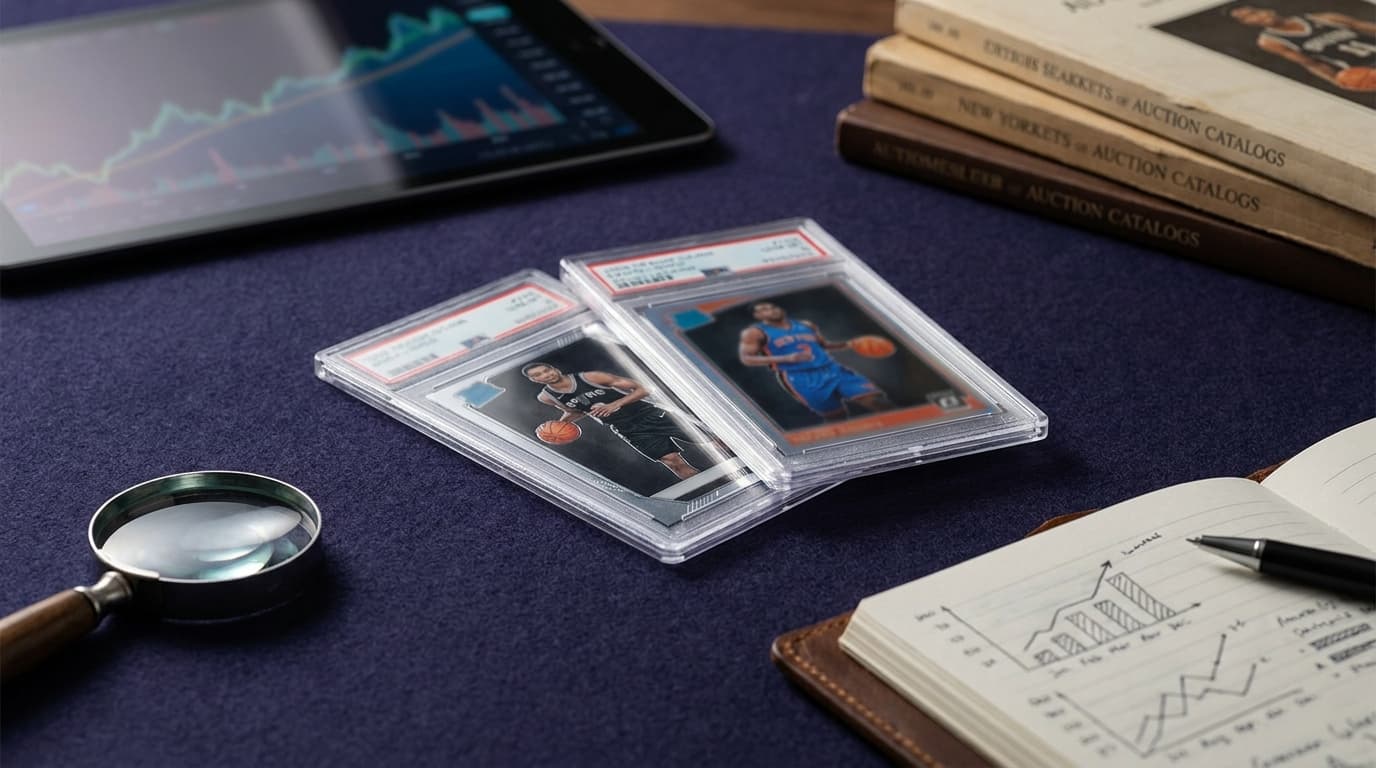
The 2026 NBA Finals tip Wednesday, June 3 at Frost Bank Center, with the San Antonio Spurs hosting the New York Knicks in Game 1 (CBS Sports). Prediction markets have already priced the series: Polymarket has San Antonio around 61% to win the title with New York near 38%, and Kalshi sits at 63¢ / 37¢ on the same outcome - an implied money line in the neighborhood of -170 San Antonio, +170 New York. Combined NBA champion contract volume across the two venues has cleared $382M.
The hobby question is not who wins. The hobby question is how much of the win is already in the card. Five recent Finals give us a data set to answer it - and the answer for collectors holding flagship base rookies is more uncomfortable than the social timeline suggests.
Methodology: what we are measuring
For each comp we are tracking the flagship base rookie PSA 10 - the national-brand base Prizm or Topps Chrome with the heaviest sold-comp density. We are not using parallels, autos, or 1/1s as the bump signal because print-run differences distort the percentage moves. The window is the 30 days before Game 1 and the 30 days after the series-clinching game, with a 12-month look-back to test whether the bump held. Sources are PSA Auction Prices Realized, [Card Ladder](https://www.cardladder.com/), Sports Card Investor, and eBay sold listings where price-tracker indexes are thin.
Comp 1: Kawhi Leonard, 2019 Raptors
The 2012-13 Panini Prizm Kawhi base #209 PSA 10 ran from roughly $60 entering the 2018-19 season to about $330 by July 2019, after the Raptors clinched. That is a greater-than-5x move - the kind of number that gets screenshotted and reposted every May. What gets left out: the same card has faded to a $70-$110 range by 2025 (Sports Card Investor, PSA).
Kawhi is the template for the win-the-ring, lose-the-narrative outcome. A low-charisma star without a follow-up Finals can give back nearly all of the Finals premium within 18-24 months. The trade was the run-up, not the hold.
Comp 2: LeBron James, 2020 Lakers
The 2003-04 Topps Chrome LeBron base #111 PSA 10 doubled from December 2019 into January 2020 to a then-ATH of about $4,000, hit roughly $8,000 by early March 2020, dropped to $5,000-$6,000 during the COVID stoppage, and then ground higher again after the Bubble title (SlabStox, PSA APR).
LeBron is the outlier comp. He is the only case where both the pre-Finals run-up and the post-title hold paid. The reason is unique - legacy-name stack, fourth ring, generational consensus - and it should not be modeled into anyone else's card unless that player is already on a Hall-of-Fame-locked trajectory before the trophy.
Comp 3: Giannis Antetokounmpo, 2021 Bucks
The 2013-14 Panini Prizm Giannis base #290 PSA 10 went from roughly $500 pre-season to just under $2,000 during the title run - about a +247% move (SlabStox, Sports Card Investor). This is the cleanest first-ring, sustained-bump case study in the modern Prizm era: dominant player, MVP-stacked, no obvious narrative ceiling at the moment of clinch.
Giannis is the comp Wembanyama bulls are implicitly trading off. It is also the comp Brunson bulls cannot use, because Brunson is not the offensive engine of a championship favorite.
Comp 4: Stephen Curry, 2022 Warriors
Curry's 2009-10 Topps base #321 is the messier comp because the Chrome Refractor is the cleanest signal. The Refractor PSA 10 sold for $96,000 on eBay on August 28, 2022 and $16,101 at Heritage on September 5, 2022 - a spread that itself tells you Finals-window comps run hot on thin order books (PSA APR).
The takeaway is that the base in a legacy-stack title (fourth ring, first Finals MVP) gets dragged up by the parallels, not the other way around. If you do not own the legacy-name parallel, you are exposed to the same mean reversion as everyone else - with less ceiling.
Comp 5: Nikola Jokic, 2023 Nuggets
Jokic's 2015-16 Panini Prizm base #335 PSA 10 ran up materially into the 2023 Finals and then drifted as the post-title hobby pull failed to match the on-court resume (PSA APR, Sports Card Investor). The Jokic case is the great-player, soft-hobby-pull outcome - a faster mean reversion than Giannis even though the basketball case is arguably stronger.
This is the comp to keep in your pocket the next time someone tells you on-court dominance and hobby price are the same vector. They are not.
The pattern
Across all five comps the same shape repeats: the largest percentage moves happen before Game 1, not after the trophy. The market prices the title into the card during the conference finals window. Unless the player has legacy or MVP-stack narrative attached - Curry, LeBron - the post-clinch tape goes sideways or fades. The losing side's base PSA 10s shed the playoff premium within roughly 30-45 days, a pattern visible on the Suns post-2021, the Heat post-2020, and the Warriors post-2019.
2026 application: the Spurs side - Wembanyama
Victor Wembanyama's 2023-24 Panini Prizm base #136 Silver PSA 10 sold around $3,153 on May 24, 2026, with recent comps in the $2,975-$3,025 band. The PSA APR average across 507 sales is $2,421.85 with a range of $1,438-$3,384 (Card Ladder, PSA APR). The structural anchor sits well above the base: the 1/1 Black parallel traded at $5.11M in a private sale during the Spurs' playoff run - the most ever paid for a non-auto NBA card (Heavy, Bleacher Report).
If Polymarket is right that the Spurs are roughly 61% to win, a significant chunk of the title premium is already in the $3K base. The upside on a Spurs win is narrower than the downside on a Spurs loss, especially on parallels that are more event-sensitive than the base. Wembanyama is also the only name in the matchup where a loss probably still supports the base, given the Year-3 trajectory and the Black-parallel anchor at the top of the market.
2026 application: the Knicks side - Brunson
Jalen Brunson's 2018-19 Panini Prizm base #250 PSA 10 has been listed in a $290-$675 band, with recent sold comps around $250 in June 2025 rising to roughly $300 during the late playoff run (Card Ladder, SI Collectibles, Sports Collectors Daily). The anomaly: a PSA 9 hit $1,100 on May 28, 2026 (PSA APR). PSA 10s typically carry a 3x-10x premium over PSA 9s for modern Prizm and Chrome base, and that multiple usually widens during a Finals window as 10s are pulled into safes and private deals. A $1,100 PSA 9 in front of $250-$300 PSA 10 sold comps is a thin-comp print, not a re-rating - treat it that way.
Brunson is the harder hold. He has a complementary-star ceiling without the MVP narrative runway, which makes him a textbook Kawhi-2019 or Jokic-2023 fade candidate if New York loses in four or five. Even if New York wins, the comp set suggests the base does not run materially higher than where the conference-finals tape already put it.
The fade trade
Whichever side loses, the comp set says the playoff premium on base PSA 10s gets unwound within 30-45 days. The cleaner fade is on parallels, not base - base shows stickier floors across the Suns, Heat, and Warriors post-loss tapes - but parallels of the losing side have historically given back the full event premium by the All-Star break of the following season. Exit targets are easier to set on parallels because their sample size around the event is thicker.
A collector decision framework
-
Hold the generational name with a legacy stack. Wembanyama is the only name in this matchup that clears the bar; the LeBron 2020 and Giannis 2021 comps support holding through the trophy, not selling into it.
-
Sell into the run on the complementary star with limited narrative runway. Brunson is closer to the Kawhi-2019 archetype than the Giannis-2021 archetype, and Kawhi gave back nearly all of the bump within two years.
-
Fade parallels of the loser, not base. The base PSA 10 floor is sticky on losing sides; the parallel premium is not.
-
Do not chase after Game 1. The comp set says the run was already paid before tip-off.
Risk callouts
A handful of things can break this framework. Sold-comp samples thin out during event windows - a single $1,100 Brunson PSA 9 print is not a trend. PSA 10 scarcity itself can be manipulated short-term by holders pulling inventory; the bump and the unwind can both be sharper than indexes suggest. Prediction-market liquidity is uneven on game-by-game contracts, so series-level numbers are more reliable than nightly ones. And the print-run difference between Prizm base and any chase parallel is large enough that headline bump percentages on parallels should not be applied to base without scaling.
The Finals are a tradeable event with a measurable shape. The shape is asymmetric, the timing is earlier than most collectors act on, and the post-clinch payoff is reserved for names with legacy stacks the market has already underwritten. Everything else - including most of the cards you actually own - is a fade-the-loser, sell-into-the-run trade dressed up as a hold.
Related reading
Sources
Note: This article contains AI-assisted content and has been reviewed in our editorial workflow.
DISCLAIMER: PureGrail articles are for informational and entertainment purposes only. Nothing on this site constitutes financial, investment, or legal advice. Collectibles are speculative assets and values can decrease significantly. Always conduct your own research before buying or selling. Past price performance does not indicate future results.