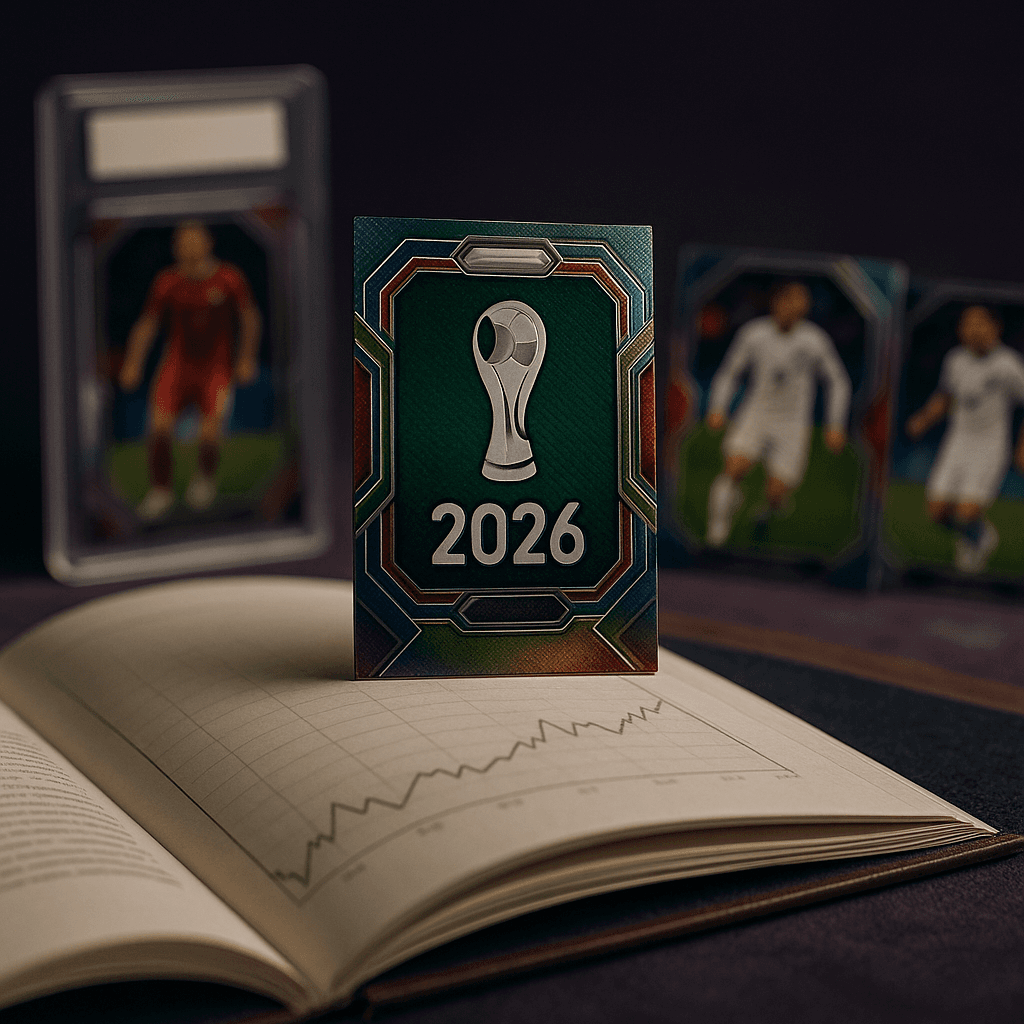
A men's World Cup hosted in North America is the single biggest demand catalyst soccer cards get. The 2026 FIFA World Cup runs June 11 through July 19, 2026 — the first 48-team, 104-match edition, played across 16 host cities in the United States, Canada and Mexico, with the final at MetLife Stadium in East Rutherford, New Jersey on July 19. That last detail matters more than any marketing copy: this catalyst has a fixed, published end date. It is not an open-ended trend. It is a calendar event with a whistle.
That single fact reframes everything that follows. The product calendar is not being constrained by genuine scarcity. It is being timed to a demand window everyone can already see on a schedule.
The bull case, stated fairly
The piece setting the tone for this cycle is Athlon Sports' 2026 FIFA World Cup soccer cards investment and collector guide, whose text is verified through its Yahoo Sports syndication. The argument is coherent on its own terms: World Cup wax runs on a reliable four-year cycle, the flagship Panini Prizm release historically firms during the tournament, and the prescribed move is to buy early and sell into peak hype. The guide explicitly recommends selling into the June-to-August 2026 window, holding only elite numbered parallels longer.
The chase cards are real, too. The same guide highlights first-ever numbered host-nation parallels on Panini Prizm FIFA World Cup 2026 — an Old Glory parallel numbered to 94 and a Maple Leaf numbered to 86 — alongside Color Blast and Manga inserts positioned as four-figure case hits. None of that is fabricated. The question a serious collector should ask is not whether the chase exists, but whether the structure around it rewards the person buying in May.
What the 2026 calendar actually looks like
Look at the release schedule and the "allocation is tight" story gets harder to tell with a straight face. The window is being stacked on both sides of the tournament:
-
Panini Noir 'Road to FIFA World Cup 2026' — releasing around May 13, 2026, ahead of kickoff.
-
Topps Chrome UEFA Women's Champions League 2025-26 — presales opening May 19, 2026, with two hobby autographs per box and a refractor parallel structure. Note what this product is: a women's club release riding World-Cup-adjacent marketing, not a men's World Cup catalyst.
-
The flagship Panini Prizm FIFA World Cup 2026 — around May 22, 2026, days before the opening match.
-
Panini Select 'Road to FIFA World Cup 2026' — around July 22, 2026, after the final has already been played.
Per Beckett's configuration for the flagship Prizm release, corroborated by the Athlon guide, the hobby box is 12 packs of 12 cards covering all 48 nations, with roughly one autograph per box. That is a deep, broadly distributed print run timed to a demand peak — not a constrained one reacting to it. A product engineered to ship the week before the catalyst, with another flagship-tier release scheduled for after the trophy is lifted, is not scarce by design. It is supplied to demand.
The skeptic's column: the documented 2022 hangover
The cleanest evidence against the buy-and-sell-the-hype playbook is what actually happened last cycle. Per SI Collects' post-final review dated February 2, 2024 — and note that Argentina won in 2022, the best-case scenario for the sport's biggest name — modern tournament-linked cards still bled after the whistle:
-
Messi's 2022 Panini Instant World Cup base in PSA 10 fell 43%, to roughly $116, across 500-plus recorded sales.
-
His 2014 Prizm World Cup base PSA 10 fell 29%, from about $165 to about $117, and his overall graded market was down roughly 9% over 365 days.
The Mbappé numbers are the cautionary case. Elite on-pitch status did not translate into a card base deep enough to absorb the post-event sell-off. "Generational talent" and "durable card demand" are not the same variable, and the 2022 data priced the difference.
What actually survived
Not everything fell. In the same review, Messi's vintage and ultra-rare cards held or appreciated through the identical window — his 2004 Panini Megacracks #71BIS base PSA 10 rose 21% (a recent sale near $322,000), and his #45 base PSA 10 rose about 2% (around $8,700). Same player, same calendar, opposite outcome.
That split is the entire investable lesson. Cards carried by durable global demand — established legends, genuinely scarce vintage, true one-of-ones — do not depend on a six-week window to clear. Event parallels do. When the catalyst expires on July 19, 2026, the first group still has buyers and the second is competing for a shrinking pool of them.
Sorting durable demand from event speculation
Before buying anything this cycle, sort each candidate into one of two buckets:
-
Durable demand: established-legend cards with a buyer base independent of any tournament, ultra-rare vintage with a fixed historical print, and genuine one-of-ones. The 2004 Megacracks behavior is the template — these did not need the World Cup to hold value.
-
Event speculation: nation-themed and numbered tournament parallels — including the Old Glory /94 and Maple Leaf /86 host-nation parallels — whose demand is almost entirely a function of the next six weeks. These can run hard into the quarterfinals and still finish the year red, exactly as the 2022 modern-card declines show.
Sizing exposure to a hard-expiry catalyst
There is a second-order risk specific to this cycle: crowding. The dominant guide explicitly tells its entire readership to exit into the same June-to-August 2026 window. When the prescribed sell window is public and synchronized, that window itself becomes the disappointment mechanism — concentrated supply hitting a demand peak that has a known expiry on July 19, 2026.
Practical implications, not advice: treat event parallels as short-dated positions, not holdings. If you buy them, size them as money you can watch decay, and pre-commit an exit ahead of the field's prescribed window rather than into it. Reserve real position size for the durable-demand bucket, which does not require you to time the whistle. And discount any "allocation is tight" framing against a 12-pack, 48-nation flagship print deliberately timed to the catalyst.
Bottom line
The 2026 World Cup is a genuine demand catalyst — the largest soccer cards will see this cycle — but it is a calendar event with a hard expiry, and the post-final supply scheduled into late July indicates the manufacturers know it too. Allocate to durable global names and genuine 1/1 scarcity. Treat nation parallels and event inserts as short-dated options that decay at the whistle, and decide your exit before everyone else is told to take theirs.
Related reading
Sources
-
2026 FIFA World Cup — dates, format, host cities, final venue (Wikipedia)
-
2026 FIFA World Cup Soccer Cards: Complete Investment & Collector Guide (Athlon Sports)
-
2026 FIFA World Cup Soccer Cards guide — verified syndication (Yahoo Sports)
-
World Cup Ripples: Examining Messi & Mbappé Sports Cards After the Final (SI Collects, Feb 2, 2024)
-
2026 Panini Prizm FIFA World Cup Soccer — checklist & box info (Beckett)
-
2025-26 Topps Chrome UEFA Women's Champions League Soccer (Beckett)
-
2025-26 Panini Noir Road to FIFA World Cup 2026 Soccer (collectosk)
-
2025-26 Panini Select Road to FIFA World Cup 2026 Soccer (collectosk)
Note: This article contains AI-assisted content and has been reviewed in our editorial workflow.
DISCLAIMER: PureGrail articles are for informational and entertainment purposes only. Nothing on this site constitutes financial, investment, or legal advice. Collectibles are speculative assets and values can decrease significantly. Always conduct your own research before buying or selling. Past price performance does not indicate future results.