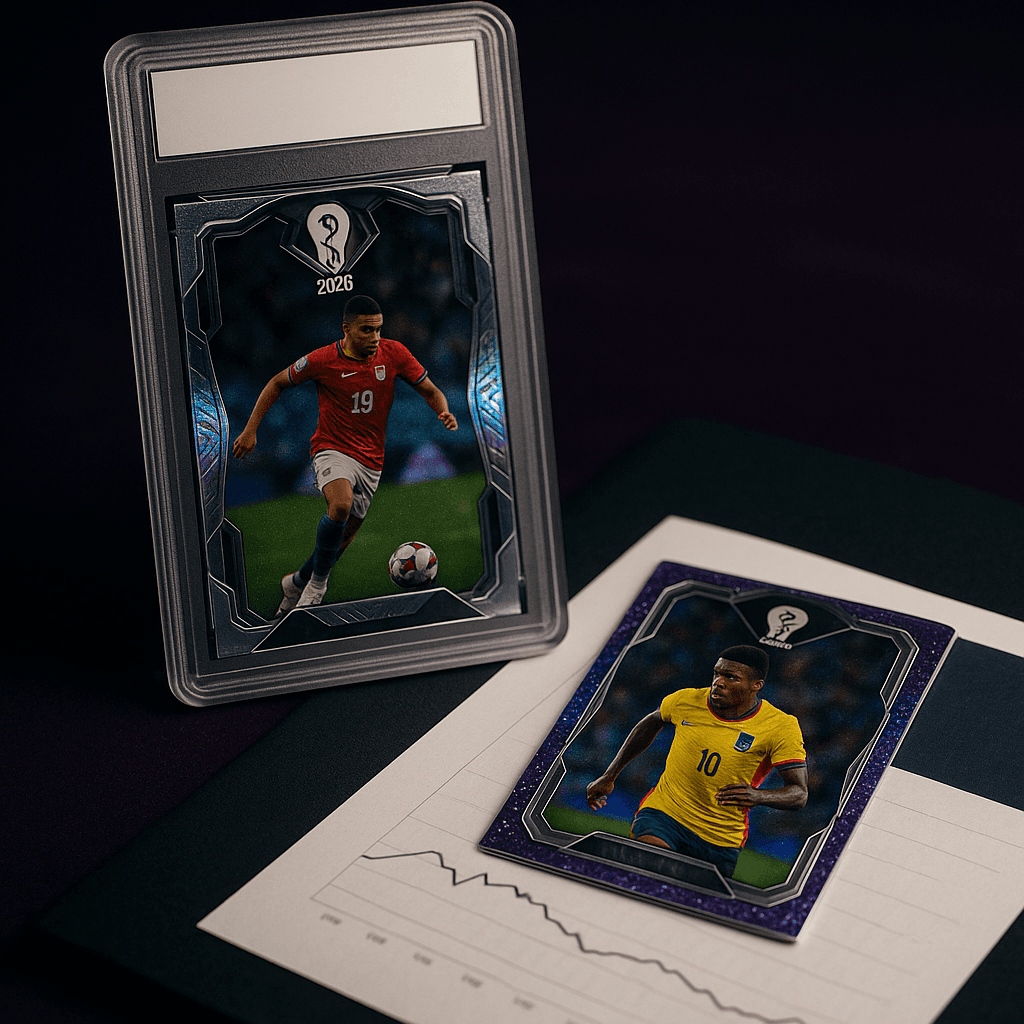
The men's World Cup arrives in North America on June 11, 2026, and runs through July 19 — 48 teams, 104 matches, 16 host cities across the United States, Mexico, and Canada, opening at Estadio Azteca and closing at MetLife Stadium in New Jersey. For collectors, the relevant calendar isn't the bracket. It's the roughly six-week window in which soccer wax and rookie cards get marketed into a market that is primed to overpay. This piece is about telling the durable cases apart from the event-driven froth — and the work starts with clearing up who actually controls the product.
Clear the biggest misconception first: who holds the license
The framing you'll see repeated — "Panini vs. Topps for the 2026 World Cup" — is wrong, and the error changes how you should shop. Panini retains the exclusive official FIFA World Cup card and sticker license through the 2030 men's tournament, a window that also covers the 2027 Women's World Cup. The Fanatics/Topps FIFA collectibles deal announced in May 2026 does not begin until 2031. Sports Collectors Digest confirms Fanatics' exclusive FIFA rights start in 2031, with Topps producing under the Fanatics Collectibles brand and a reported $150 million free-collectibles commitment attached. None of that touches 2026.
So the real 2026 split is not a license fight — it's product fragmentation. Panini owns the official tournament product: 2026 Panini Prizm FIFA World Cup, Donruss Road to FIFA World Cup, Panini Instant World Cup, and the official Panini sticker album and app. Topps holds club and confederation product only — Topps Chrome UEFA Club Competitions and the 2025-26 Topps Chrome UEFA Women's Champions League (Topps.com pre-order around May 19; roughly 2 autos and 5 numbered parallels per hobby box, case hits including Arise, Helix, Oslo At Night, and Rhythmic). That product is arriving into the same primed market, but it is not the official World Cup set. The practical consequence: there is no single canonical 2026 World Cup rookie. Player chases are spread across two ecosystems, which dilutes the "one card to own" narrative the marketing leans on.
Why tournament-form spikes mean-revert
The strongest argument against buying into the pre-tournament froth is the last cycle's data. After the 2022 final, SI Collects tracked the fallout: Lionel Messi's overall graded market fell roughly 9% over the following 365 days. His 2022 Panini Instant World Cup Base PSA 10 dropped about 43%, to roughly $116 — and notably, that card still logged 500-plus sales, meaning it stayed liquid while it depreciated. His 2014 Prizm World Cup Base PSA 10 fell about 29% (roughly $165 to $117). Kylian Mbappé's overall graded market fell about 27%, and his 2017 Topps Chrome UCL PSA 10 dropped about 46%. These are not edge cases; they are the two biggest names of the tournament, both losing value after winning on the pitch.
The contrast is instructive. Scarce vintage rookies decoupled from the hype entirely. Messi's 2004 Panini Megacracks #71BIS PSA 10 rose about 21%, to roughly $322,000, and his #45 Base PSA 10 was up about 2%, near $8,700, over the same window. Durability tracked genuine scarcity and iconic rookie status — not tournament timing. The pattern that matters for buyers right now is the reversion itself: form-driven spikes tend to give back gains, and the post-tournament weakness in 2022 set in well within the year. Pre-tournament momentum is the setup for exactly this kind of round trip.
The print-run trap
The word doing the most marketing work on event product is "limited," and on Panini Instant World Cup it is largely misleading. Panini Instant is print-to-order: base cards have open-ended print runs equal to whatever collectors order during the sales window. The scarcity that exists is confined to limited "hits" — not the base cards most buyers actually purchase. Calling open-ended base product limited is a structural sleight of hand.
The on-demand precedent is unambiguous. SI Collects documented Victor Wembanyama's Panini Instant print runs collapsing within weeks — a Draft Night card around 31,324 copies, a peak (#5) near 44,142, then #98 down to roughly 5,530, an approximately 87% drop in print interest. SI Collects also notes on-demand cards "lose relevance and value" once flagship sets such as Prizm and Donruss arrive. That is a direct analog for World Cup Instant: froth during the matches, then the flagship product lands and the on-demand base evaporates. Soccer Cards HQ reinforces the broader point — cards with similar print runs can carry dramatically different values because design appeal, set prestige, and collector awareness drive liquidity far more than raw rarity. Print-run scarcity alone is not an investability signal.
What's actually investable
The usable definition of investability here is liquidity that exists outside the six-week window — names with year-round trading volume across multiple sets, not assets that only move when the cameras are on. Lamine Yamal is the clearest example of breadth: tracked across 102-plus sets and 13,210-plus card listings, with a 2024 Topps Chrome Euro SuperFractor Auto sale of $396,500 that, per Yahoo Sports, topped career-best Ronaldo and Mbappé sales. That kind of distributed market — globally traded names like Yamal, Messi vintage rookies, Erling Haaland, Jude Bellingham, and Mbappé — is what survives a post-tournament cooldown. The hierarchy that has held up: prestige sets over on-demand product, and genuine scarcity over manufactured scarcity. The 2004 Megacracks outcome is the template, not the 2022 Instant base.
A decision framework: buy now, buy the dip, or sit out
Three options, scaled to the calendar. Buy now means paying pre-tournament prices into the froth — the weakest position, especially on event base product like Panini Instant or freshly released 2026 Panini Prizm FIFA World Cup (official release around May 22, some retail shipping estimated June 17; hobby box of 12 packs/12 cards, roughly 1 auto and 5 numbered Prizms, 12 boxes per case, all 48 nations). Buy the post-group-stage dip is the better-timed play: the group stage runs June 11–27, and reversion historically follows form. Targeting scarce, durable rookies on weakness after group play — rather than chasing the pre-tournament run-up — aligns with how the 2022 cycle actually traded. Sit out is entirely defensible for event base product with open-ended print runs and event-only liquidity; there is no scarcity thesis to wait on. The framework is not "don't buy soccer cards." It's: avoid peak event base product, and if you want exposure, accumulate genuinely scarce rookie cards on post-tournament weakness.
Caveats and unknowns
Three honest uncertainties. First, the debut-patch timing is unsettled: Front Office Sports reports Fanatics debut patches "can start being worn this summer" (2026), while Yahoo Sports places the Lamine Yamal World Cup Debut Patch Auto in 2031, not 2026. We do not assert either as fact — but any 2026 "debut patch" chase should be treated as speculative until the program's applicability is confirmed. Second, the Panini antitrust litigation context noted by Sports Collectors Digest is part of the backdrop to this license transition and adds uncertainty to the longer arc. Third, the reversion thesis cuts both ways on momentum: Yamal's market was reported up roughly 33% in a single month heading into the tournament. By the same logic that says tournament spikes mean-revert, that pre-tournament run-up is itself a candidate to fade — momentum that historically gives back gains within about 90 days. Strong year-round liquidity makes Yamal investable as a name; it does not make a price spike a good entry.
Bottom line: a checklist
Durable signals — genuine scarcity (fixed, low, verifiable print runs), iconic rookie status, year-round liquidity across many sets, prestige flagship set. Froth signals — open-ended print-to-order base product, liquidity that exists only during the event, a tournament-timed price spike, and on-demand product released ahead of flagship sets. If a card you're considering checks the froth boxes, the 2022 cycle and the Wembanyama Instant collapse both say the same thing: let the tournament end, let the marketing fade, and revisit on weakness. The World Cup will reliably manufacture excitement. It does not reliably manufacture value.
Related reading
Sources
-
2026 FIFA World Cup — dates, venues, format (Sky Sports)
-
2026 FIFA World Cup (Wikipedia)
-
World Cup Deal Is Latest in Endless Fanatics 'Takeover' (Front Office Sports)
-
Fanatics, Topps to take over FIFA soccer card deal from Panini (Sports Collectors Digest)
-
World Cup Ripples: Messi & Mbappé Cards After the Showdown (SI Collects)
-
Manufacturers Are All-In For On-Demand Cards (SI Collects)
-
Analyzing Lionel Messi Case Hit Print Runs and Prices (Soccer Cards HQ)
-
Lamine Yamal Soccer Cards Price Guide (Sports Card Investor)
-
Lamine Yamal Joins the Debut Patch Chase (Yahoo Sports)
-
2026 Panini Prizm FIFA World Cup Soccer — checklist & box details (Beckett)
-
2025-26 Topps Chrome UEFA Women's Champions League Details (Checklist Insider)
Note: This article contains AI-assisted content and has been reviewed in our editorial workflow.
DISCLAIMER: PureGrail articles are for informational and entertainment purposes only. Nothing on this site constitutes financial, investment, or legal advice. Collectibles are speculative assets and values can decrease significantly. Always conduct your own research before buying or selling. Past price performance does not indicate future results.