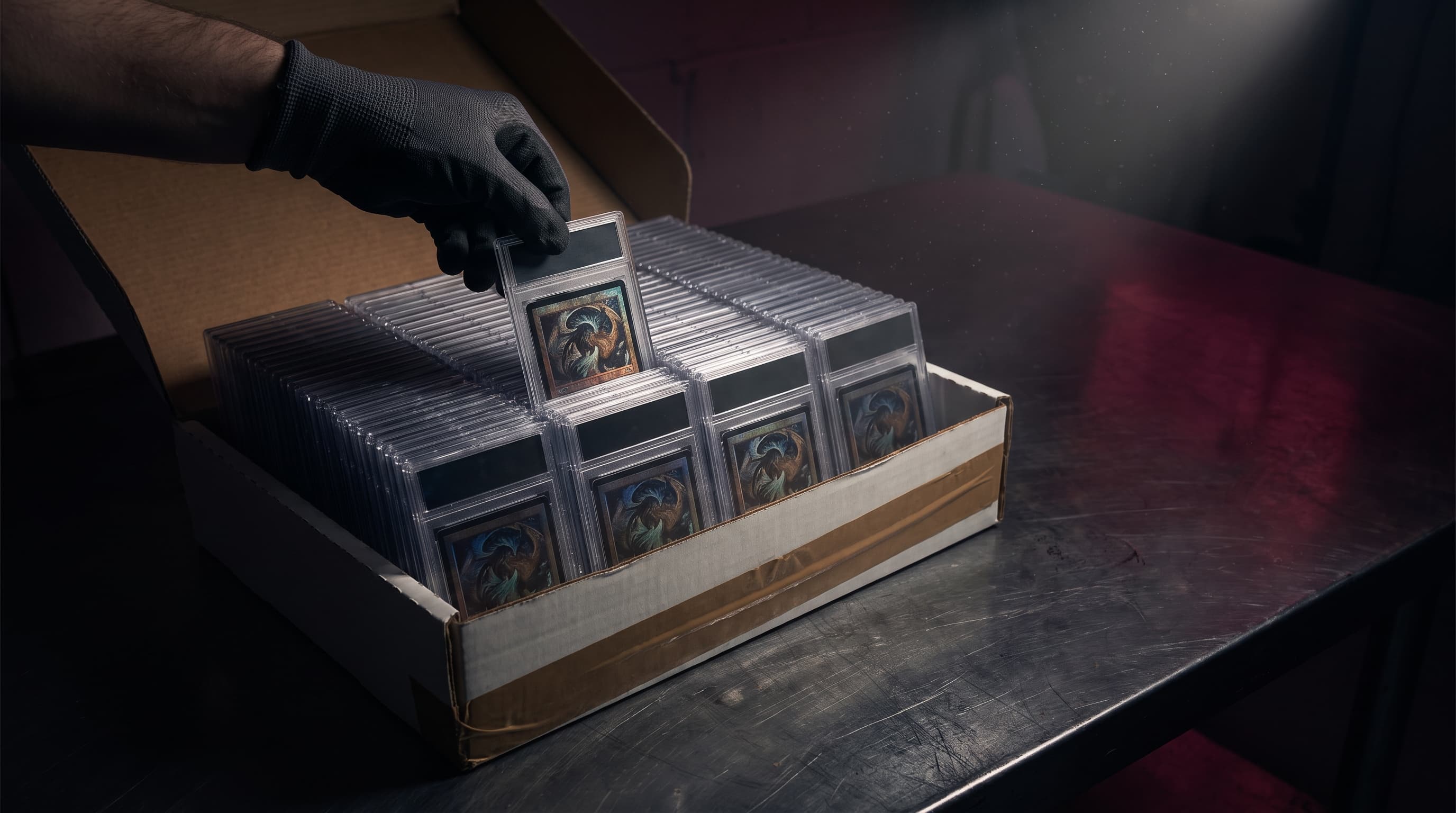
PSA population report explained
A PSA population report counts how many times PSA has graded a card at each grade. To get the gem rate, divide the PSA 10 count by the total number of copies PSA has graded. Then compare it with the PSA 10 multiple, which is the PSA 10 sold price divided by the raw price. If the gem rate is rising and the multiple is shrinking, the premium is eroding.
On 24 Sep 2026, two Pokémon cards on PriceCharting sat at opposite ends of the premium scale. Base Set Charizard #4 (unlimited) showed 486 PSA 10s out of 99,246 PSA-graded copies. That is a gem rate of about 0.49%, and its PSA 10 value was about 28 times its raw value. Evolving Skies Umbreon VMAX #215 (the alt art) showed 20,819 PSA 10s out of 29,737. That is a gem rate of about 70%, and its PSA 10 value was about 2.1 times raw. All ratios in this article are our calculations from PriceCharting's figures.
The point for anyone buying or grading this week is simple. A PSA 10 premium isn't a permanent property of a card. It is a ratio, and it can move as more copies get graded. You can't read that movement from one day's pop report. You have to log it yourself, and the method below takes about ten minutes a month per card.
The two numbers that matter: gem rate and multiple
The Business of Card Grading newsletter (18 Jan 2026) gives two definitions worth using exactly as written:
-
Gem rate: "The amount of times a card has graded as a PSA 10, divided by the total graded population."
-
Multiple: "The value of a PSA 10 of a certain card, divided by the value of an ungraded copy of the same card."
Gem rate tells you how hard a 10 is to get compared with every other copy that went through grading. The multiple tells you what the market is paying for that difficulty right now. The useful signal comes from watching the two together over time.
Where to get the numbers
Population. PriceCharting added a combined PSA and CGC Pop Report tab to its card pages, announced on 6 Feb 2026. Three details on those pages affect your math:
-
The pages say "The population counts are updated monthly." One snapshot a month is enough, and checking more often adds nothing.
-
"Half grade populations are included in the nearest whole grade numbers. For example: 8.5 is counted in 8." Half grades don't disappear from the total. They are folded into the grade below.
-
When we checked on 24 Sep 2026, the pages showed current counts only, with no history. If you want a trend line, you have to keep your own log.
Keep PSA and CGC counts separate. The premium in this article is the PSA 10 premium, so use PSA counts only in the gem rate. The two graders can produce very different figures for the same card. Umbreon VMAX #215 had a PSA gem rate of about 70.0%, while its CGC figures (1,723 CGC 10s out of 2,946 CGC-graded) work out to about 58.5%. If you blend them, you are measuring neither.
Sold comps. Take them from the same card's price page. According to its FAQ, PriceCharting combines sold listings from eBay and its own marketplace into one value per condition using a "proprietary algorithm," with automated outlier detection and user reporting of problem sales. That headline value is convenient but algorithmic. Where individual sales are listed, work out your own median from them as well.
How to build a monthly gem rate log
-
Pick a fixed day each month, after the pop page has refreshed.
-
Record the date, the PSA 10 count and the total PSA graded.
-
Calculate the gem rate: PSA 10 count divided by total PSA graded.
-
Record the median of the most recent PSA 10 sales and the median of the most recent raw sales. Use the same time window for both.
-
Calculate the multiple: PSA 10 median divided by raw median.
-
Note how many sales each median is based on. A median of two sales is a guess.
A simple template:
| Date | PSA 10 pop | PSA total | Gem rate | PSA 10 median (n sales) | Raw median (n sales) | Multiple | | --- | --- | --- | --- | --- | --- | --- | | Month 1 | | | 10 pop ÷ total | | | 10 median ÷ raw median | | Month 2 | | | | | | |
Warning signs across several months:
-
The PSA 10 count grows faster than PSA 10 sales volume. More supply is arriving than the market is absorbing.
-
The gem rate keeps creeping up, so a 10 is becoming a more ordinary result for this card.
-
The multiple narrows while raw prices hold. That means the premium itself is shrinking, not the whole card.
One bad month proves nothing. What matters is when all three signals point the same way over several entries.
A same-day snapshot of three cards
Figures from PriceCharting price and pop pages, checked 24 Sep 2026. Gem rates and multiples are our calculations.
| Card | PSA 10 / PSA total | PSA gem rate | Raw | Grade 9 | PSA 10 | PSA 10 multiple | Grade 9 multiple | | --- | --- | --- | --- | --- | --- | --- | --- | | Base Set Charizard #4 | 486 / 99,246 | about 0.49% | $436.95 | $2,976.69 | $12,275.00 | about 28x | about 6.8x | | Prismatic Evolutions Umbreon ex #161 | 5,487 / 17,990 | about 30.5% | $1,214.00 | $1,412.02 | $5,450.00 | about 4.5x | about 1.16x | | Evolving Skies Umbreon VMAX #215 | 20,819 / 29,737 | about 70.0% | $1,931.18 | $2,098.10 | $4,125.00 | about 2.1x | about 1.09x |
Across these three cards, a lower gem rate goes with a higher PSA 10 multiple. Be clear about what this is. It compares different cards on one day. It is not a time series, and it doesn't show that pop growth caused any price change on any of them. The cards differ in age, demand and collector base, and all of those also affect price.
A few details are still worth noting:
-
Umbreon VMAX #215: A PSA 9 is worth only about 1.09x raw. With a gem rate near 70%, a 9 is below the typical result, and the market prices it that way. PSA 10 sales listed on 17-18 Sep 2026 ranged from $3,750 to $4,650.
-
Prismatic Umbreon ex #161: PSA 9s (9,195) outnumber PSA 10s (5,487). The most recent PSA 10 sale was $5,200 on 23 Sep 2026, and PriceCharting lists about one sale per day at each grade. Monthly medians for this card will rest on a decent number of sales.
-
Base Set Charizard #4: PSA 10s trade about once a month, so any single month's multiple here rests on very little data. More on that below.
Why pop counts keep climbing
If grading volume were flat, the pop reports for most cards would barely move. It isn't flat. According to GemRate data reported by Sports Illustrated:
-
26.8 million cards were graded across the major graders in 2025, up 32% from 20 million in 2024. PSA graded 71.8% of them (19.26 million).
-
PSA graded 2.17 million cards in March 2026, up 16% from February and 47% from March 2025. Pikachu and Charizard led Pokémon submissions.
-
June 2026 set a record of 3.5 million cards graded. PSA graded 2.50 million, up 21% from May and 74% year over year. TCG made up slightly over 71% of volume (1.78 million).
That TCG share matters for Pokémon collectors in particular. It means a large part of new supply is going into the kinds of cards in the table above.
The link between volume and premiums has been reported before. In a September 2024 SI column, John Dudley wrote: "Premiums for 10s have gone from five to six times raw to three to four times and even less for non-rookies." He tied this to fast growth in the graded population. The same column says PSA graded 80 million items from 1991 to 2020, and that at current rates the graded population from the big four graders will have at least tripled between 2020 and 2030.
Caveats before you trust the numbers
Pop reports can overcount. When a slab is cracked open and the card is resubmitted, the same physical card gets a second serial number. SlabStox documented cases in 2019 where this pushed graded counts above the print run. A 2016 Bowman Chrome Juan Soto Orange Refractor Auto /25 showed 36 graded. A Vladimir Guerrero Jr. Orange Refractor Auto /25 showed 37. Mike Trout Blue Refractor Autos /150 showed 163. Treat the pop as a count of grading events, not of unique cards. This matters most for low-pop 10s, where a few resubmissions are a large share of the total.
Thin comps mislead. Base Set Charizard #4's listed PSA 10 sales went from $37,100 (26 Mar 2026), $34,755 (4 Apr) and $30,100 (4 May) to $10,300 (14 Aug) and $9,629 (16 Aug), at roughly one sale a month. Those sales cover a wide range, and PriceCharting's headline PSA 10 value on 24 Sep was $12,275. With volume that low, the single "price" you see can depend on which few copies happened to sell and in what condition. Don't read that swing as a pop effect. Nothing in the data links the two. Treat any multiple built on a handful of sales as low confidence.
Aggregated prices are algorithmic. PriceCharting's value per grade comes from its own processing of eBay and marketplace sales. That is useful for consistency from month to month, but check the individual sales underneath whenever a number looks off.
What to do this week
Before paying a PSA 10 premium: Work out the card's current gem rate and multiple. If you have been logging the card, compare them with last month. If the gem rate is high and the multiple has been narrowing, you are paying for a result that grading is producing more often. If the gem rate is low and stable and the multiple is holding, the premium has more support. Either way, check how many sales the multiple rests on.
Before submitting a card with a high gem rate: A high gem rate means a PSA 10 is common for that card, and the 9 may be priced close to raw, as with Umbreon VMAX #215 at about 1.09x. Run the numbers with your own costs in the card grading break-even tool. It compares the extra net proceeds from selling graded versus raw, based on the grading, shipping and selling costs you enter. It does not predict what grade you will get, what current prices are or what returns you will earn. Use current sold comps and PSA's current fee schedule when you fill it in.
Start the log now: Pick the two or three cards you are most likely to buy or submit in the next few months and record today's figures. The value of a gem rate log only builds with time.
The bottom line
A PSA 10 premium holds up best when the gem rate is low and the pop grows slowly compared with demand. Neither of those can be seen on a single day's pop report. They show up in a monthly log you keep yourself. This doesn't tell you where any specific card's price is heading. It gives you a way to check whether the premium you are about to pay, or hoping to earn, still has the scarcity behind it.
Related reading
-
Delta Reign Preorders Open Before the Set Has a Price History
-
What Collectors Lose When Pokemon Launches Worldwide on One Day
Sources
-
Umbreon VMAX #215 Prices, Pokemon Evolving Skies, PriceCharting (checked 24 Sep 2026)
-
PSA/CGC Pop: Umbreon VMAX #215, PriceCharting (checked 24 Sep 2026)
-
Umbreon ex #161 Prices, Pokemon Prismatic Evolutions, PriceCharting (checked 24 Sep 2026)
-
PSA/CGC Pop: Umbreon ex #161, PriceCharting (checked 24 Sep 2026)
-
PSA/CGC Pop: Charizard #4, PriceCharting (checked 24 Sep 2026)
-
Population Reports for PSA & CGC, PriceCharting Blog (6 Feb 2026)
-
Understanding Gem Rates and Multiples, Business of Card Grading (18 Jan 2026)
-
The Hidden Reason PSA 9s Are Close to Raw Pricing, Sports Illustrated (John Dudley, 24 Sep 2024)
-
Over 26 Million Cards Graded in 2025, Sports Illustrated (Conor B. McGrath, 4 Jan 2026)
-
March GemRate Report, Sports Illustrated (Conor B. McGrath, 4 Apr 2026)
-
PSA Leads Record-Breaking June, Sports Illustrated (Conor B. McGrath, 6 Jul 2026)
-
The Curious Case of Population Reports, SlabStox (5 Mar 2019)
DISCLAIMER: PureGrail articles are for informational and entertainment purposes only. Nothing on this site constitutes financial, investment, or legal advice. Collectibles are speculative assets and values can decrease significantly. Always conduct your own research before buying or selling. Past price performance does not indicate future results.
Note: This article contains AI-assisted content and has been reviewed in our editorial workflow.