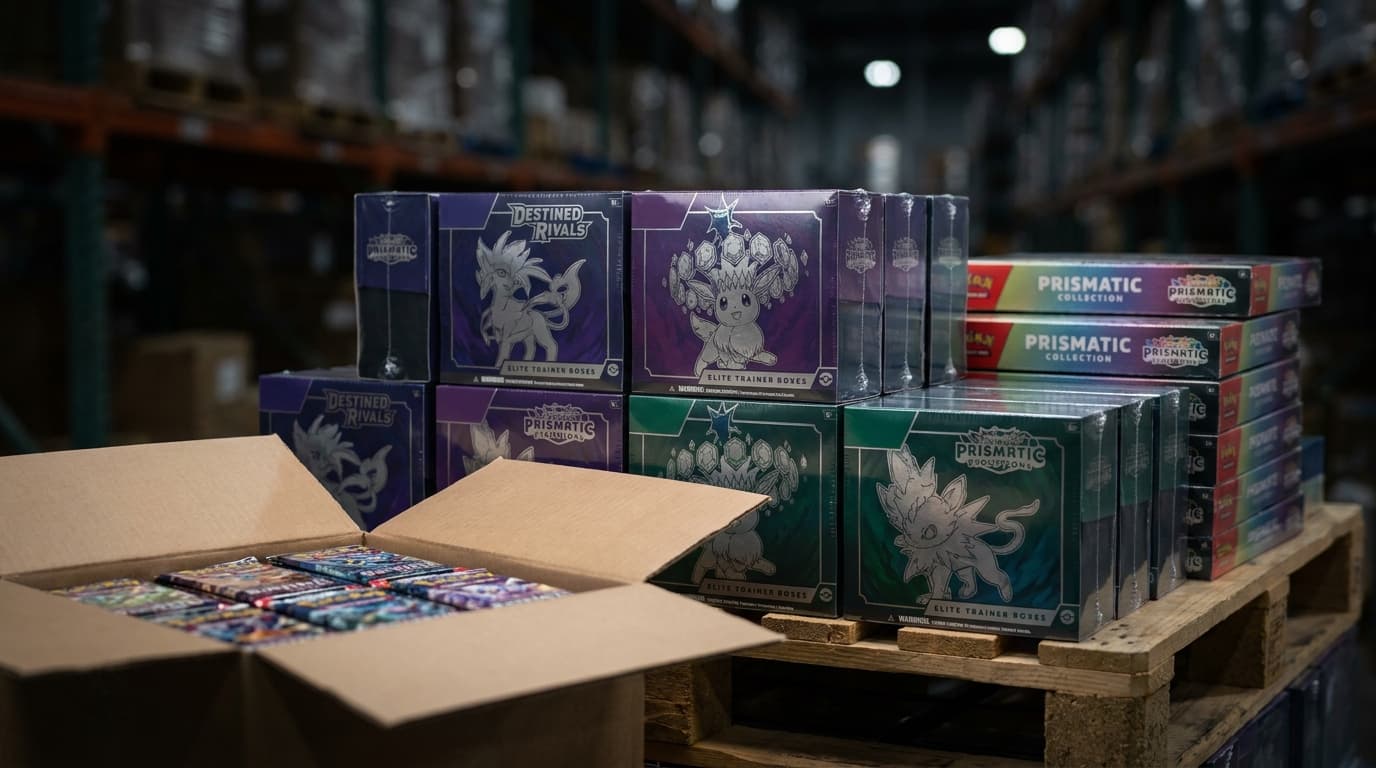
The headline number is doing the wrong work. When reporting describes more than a million Destined Rivals units and over two million combined special-collection and Prismatic Evolutions units flowing into Costco, Sam's Club, Walmart, and Best Buy across summer and fall 2026, the instinct is to read it as a supply crunch finally breaking. It isn't. A flood is not a famine. Those figures describe a deliberate print-to-demand action, and its stated purpose is not to feed scarcity but to erase it.
Per Collector Station's breakdown of the reprint allocations, the distribution is staggered by design: 1M+ Destined Rivals ETBs, 2M+ Prismatic Evolutions Super Premium units routed to Costco and Sam's Club, roughly 300k Walmart Prismatic ETBs online, all released in waves through the summer–fall window specifically to prevent instant sellouts. Yahoo Finance's July 2026 sealed-product coverage frames the intent plainly: The Pokémon Company is trying to return the two most-inflated recent products — Destined Rivals and Prismatic Evolutions — to normal retail pricing rather than scalper markups. That is a market-cooling action. If you own sealed product, the question is not whether prices are falling. The question is which of your premiums was always going to evaporate the week product hit shelves, and which one the restock cannot touch at all.
Two kinds of premium, and only one is exposed
Every dollar you pay above MSRP on a sealed box is one of two things, and the distinction is the whole ballgame.
A distortion premium is a temporary-scarcity markup. It exists only because demand is outrunning distribution in the moment — the product is still in active print, the manufacturer can and will make more of the identical SKU, and the gap between shelf price and secondary price is purely a distribution timing problem. When allocations land, that premium unwinds. It was never anchored to anything structural.
A genuine scarcity premium is the opposite: it sits on product that is capped or rotated out, that cannot be reprinted into the same SKU. Vintage originals, 1st Edition print runs, discontinued sets, clearly-distinguished commemoratives. No amount of 2026 warehouse flooding changes the supply of a thing that is no longer being printed. That premium is defensible because it is not a distribution gap — it is a hard structural cap.
The 2026 restock threatens the first category and leaves the second essentially alone. Sorting your shelf into those two buckets is the entire exercise.
Why the price moves before the boxes do
The most counterintuitive part of a reprint wave is that much of the damage is done before a single pallet reaches a store. The announcement itself is the catalyst. PokemonPriceTracker's 2026 reprint value-impact analysis documents this repeatedly: after Ascended Heroes reprint news, the Surging Sparks Pikachu ex Special Illustration Rare moved from roughly $320 to $254 — about a 21% drop — at the announcement stage, before product shipped. Charizard ex variants fell in the 15–25% range on the same news cycle.
The mechanics from there are well-mapped. For modern chase SIRs, alt-arts, and secret rares, the same analysis lays out a correction curve: a first reprint wave in months 4–6 drives roughly a 15–25% correction; months 7–12 stabilize the card around 30–40% below peak; and multi-wave sets can reach 40–50% drawdowns. The Prismatic Evolutions Umbreon ex SIR is the textbook case — from a peak near $1,550 in April 2025 down to roughly $882–991. That is not a crash narrative. It is a documented, repeatable normalization pattern, and it applies to sealed positions on actively-reprinted sets just as it applies to the chase singles inside them.
The vulnerable list: what the 2026 restock actually threatens
The exposed class is narrow and specific: sealed positions on in-print, sub-three-year-old Scarlet & Violet-era sets that are being routed to warehouse retail right now. In concrete terms:
-
Destined Rivals (SV10) sealed ETBs and boxes. Per The Pokémon Company's official expansion page, Destined Rivals is an active, in-print SV10 set — the Team Rocket-themed release whose chases include Team Rocket's Mewtwo ex, Cynthia's Garchomp ex, and Ethan's Ho-Oh ex. Because it can be reprinted into the identical product, its sealed premium is a distortion premium by definition. TCGplayer's SV10 price guide is the reference for where those positions actually sit today.
-
Prismatic Evolutions ETBs, bundles, and Super Premium collections. This is where the flood concentrates — the Super Premium warehouse push has been described as the single biggest move of the entire reprint wave. Sealed premiums here are the most directly targeted.
-
Special-collection SKUs routed to Costco and Sam's Club. These are the units being deployed specifically to collapse markups back toward baseline retail.
If you are holding any of these above MSRP, you are holding a distribution gap that the manufacturer is actively closing on purpose.
The reprint-proof list: premiums the restock does not touch
The other side of the ledger barely moves. PokemonPriceTracker's analysis identifies the categories that show minimal impact from reprint waves, and the logic is structural rather than sentimental:
-
Vintage pre-2003 originals. Not being printed. Cannot be flooded.
-
1st Edition print runs. An extreme structural cap — the analysis cites roughly 120 PSA 10 Base Set Charizards in existence. A 2026 Costco pallet does nothing to that number.
-
Sealed product from rotated-out or discontinued print runs. Once a SKU is off the line, warehouse restocks of other products don't refill it.
-
Clearly-distinguished commemorative reprints. When a reprint is visibly distinct from the original, the original's premium survives intact.
These premiums are not what the restock threatens. They were never distribution gaps.
The three-question checklist
Before you decide whether a sealed position is safe or exposed, run it through three questions:
-
Is the exact SKU still in active print? If the identical product is still being manufactured, you are exposed.
-
Can it be reprinted into the identical product? Not a lookalike, not a commemorative — the same SKU. If yes, the supply side is not capped.
-
Is the current premium above MSRP purely a distribution or scarcity-timing gap? If the markup exists only because product hasn't reached shelves yet, it's a distortion.
Three yeses means you are holding a distortion premium. Expect erasure — and expect much of it to arrive on the next announcement, not the next shipment.
The singles caveat: sealed-down does not mean singles-down
Here is the cross-current that trips up a mechanical reading of the flood. A reprint sealed flood can paradoxically firm certain singles. When buyers rip reprinted product chasing a specific SIR and miss it, they return to the singles market to buy the card outright — which supports the price of that individual card even as sealed normalizes. Sealed-down is not the same signal as singles-down. Yahoo Finance's coverage flags exactly this legacy-recovery-versus-new-hype split, distinguishing genuine recovery in established singles from the inflation on brand-new releases. Don't assume a falling sealed box drags its chase card down with it; sometimes the mechanism runs the other way.
The demand backdrop: even a flood hasn't fully landed
One reason to stay skeptical of a simple "prices are collapsing" story: demand is still ferocious at retail. Kotaku documented crowds of 30–40 people fighting over Prismatic Evolutions restocks at Costco in April 2026, and Resell Calendar corroborated the warehouse scrums and shipment cadence. PriceCharting's Costco SKU data anchors the baseline the distortion premium collapses toward — an ETB-plus-bundle SKU around $57.99 and a two-ETB/two-bundle online SKU around $121.99. Product moving at those retail prices while people queue for it tells you demand is still outrunning even the flood. That's why the correction is a normalization toward baseline, not a collapse below it.
The practical close: patience is the position
During a deliberate flood, the disciplined move on distortion-premium sealed is to hold cash, not inventory. If a SKU is still in active print, still reprintable into the identical product, and priced above MSRP only because allocations haven't landed, you are paying a premium the manufacturer has publicly committed to erasing — often before the boxes even ship. Let it normalize toward the warehouse baseline and buy the thing at retail if you want it to open.
Reserve your premium dollars for structurally-capped scarcity: pre-2003 vintage, 1st Edition, genuinely rotated-out print runs, distinctly-marked commemoratives. Those are the only premiums a two-million-unit warehouse push cannot reach. The 2026 restock isn't a shortage story you need to race. It's a premium-erasure story you can wait out — and knowing which of your boxes is which is the difference between selling into an announcement and holding a bag through one.
Related reading
Sources
-
Best Pokémon TCG Sealed Products and Singles to Buy in July 2026 — Yahoo Finance
-
Upcoming Pokémon Card Game Sets and Reprints — Collector Station
-
Pokemon Card Reprint Guide: Value Impact Analysis 2026 — PokemonPriceTracker
-
Expansion Overview | Pokémon TCG: Scarlet & Violet—Destined Rivals — The Pokémon Company
-
Costco Shoppers Fight for Prismatic Evolutions Pokemon Cards — Resell Calendar
-
Costco 2-Pack Trainer Box & Booster Bundle — Prismatic Evolutions — PriceCharting
Note: This article contains AI-assisted content and has been reviewed in our editorial workflow.
DISCLAIMER: PureGrail articles are for informational and entertainment purposes only. Nothing on this site constitutes financial, investment, or legal advice. Collectibles are speculative assets and values can decrease significantly. Always conduct your own research before buying or selling. Past price performance does not indicate future results.