
Paying $199 for PSA Express Rarely Outruns a Player's Slump
PSA raised Express from $149 to $199 on September 9. Three recent card drops (McCarthy, Mendoza, Raleigh) show why the speed premium rarely beats a falling market.
Library · 139 pieces · Page 2 of 5
Grading primers, collecting strategies, and market analysis — everything we'd tell a friend just starting out, plus what we're watching this week.

PSA raised Express from $149 to $199 on September 9. Three recent card drops (McCarthy, Mendoza, Raleigh) show why the speed premium rarely beats a falling market.

The $299.99 preorder closed on August 10 and the box listed at $329.99 on release day, but street boxes ran roughly $475 to $525 in the September 8 to 12 window. Here is the per-autograph break-even, why only one of the two autos is a guaranteed prospect signature, and what happened to 2025 prospect singles three weeks after release.

Heritage closes September 18 and 19, REA on September 20 and Memory Lane on September 26. Run these five checks first: premium math, centering, label era and qualifiers, alteration status and a comps-based ceiling.

A widely repeated claim says the PSA 10 premium over CGC 10 has shrunk to single digits on modern Pokémon. It traces back to one February 2026 price pair. Sold comps on Sep 10 show a much wider gap, and it varies card by card.

There is no English booster box for 30th Celebration, so every pack arrives inside a bundle. Here is the method for turning MSRP tables, street comps, and Japanese import costs into one comparable cost-per-pack figure.

Four genuine 1st Bowman debuts headline the September 9 release, but the 13-tier refractor ladder hides where scarcity really begins. The line is Gold /50, and the case math says buy the single.

A rookie card comp set is corrupted by parallels, hidden Best Offer prices, shill auctions and qualified grades long before anyone lies to you. Here is the funnel that turns a messy sold list into a defensible price band with a date attached.

The September price comparison explains the break-even math for a $30 card. Updated September 30 to remove expired Beckett reopening and event guidance; verify current quotes before submitting.

Topps carved a reported 10% of Chrome Black Basketball out of the sealed supply chain and sold it as $100 four-card digital rips. The cards are real. The math is close. The disclosure is not.

One week into the English release of The World's Strongest Warriors, the four Emperor Manga Rares are asking $863 to $1,484 — roughly where OP-16's headline Manga Rare ended up after giving back 29% in six weeks. A card-by-card hold, sell, and grade checklist built on dated listings, PSA's 2026 fee table, and the tournament data that does not exist yet.

PSA's four Value tiers have been paused since June 2, 2026, CGC's $20 return shipping costs more than the grade itself on a single-card submission, and eBay takes 13.25% of the sale. Here is the full cost stack, the expected-value math, and a five-minute checklist to run before you ship.

The Japanese 30th Celebration booster box was quoted at ¥47,200 on SNKRDUNK on September 1 and ¥42,999 on September 2 — a ~9% drop before a single box has shipped. Here is what that number is actually evidence of, why "simultaneous global launch" does not mean simultaneous global supply, and the four checks we will run on September 17.

Two days before Wizards warned that Reality Fracture Play Boosters would be tight at launch, Play Booster boxes were already selling about 24% under MSRP while the unaffected Collector Boosters sold about 23% over it. The premium sits on the SKU with no supply problem — and that inversion tells you more about October than the drought does.

Secret Lair x MSCHF: The Zeta Set hits the Chaos Vault September 2 at noon ET — the first randomized booster product Secret Lair has ever sold. Birds of Paradise, Chrome Mox, and Urborg, Tomb of Yawgmoth are all in it. What isn't in it: a print run, a mythic pull rate, a variant distribution, or a foil. We ran the arithmetic on a maxed-out 12-pack allocation, and the numbers are worse than the community's already-unhappy math suggests.

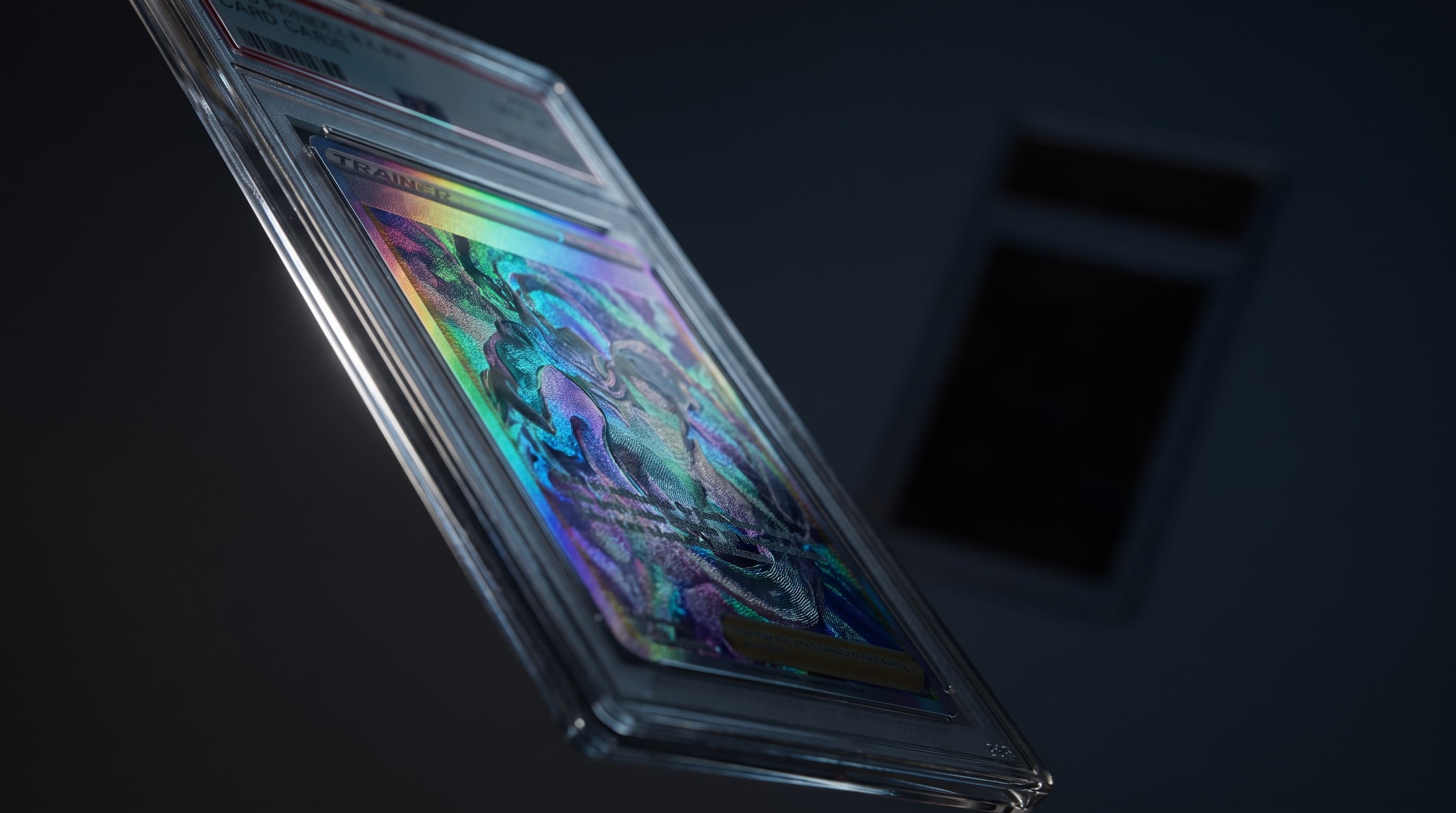
PSA says it stopped more than $200 million in fraudulent collectibles in 2025. The headline number is modeled and unauditable — but the card-level tables underneath it are the real story, because they describe the raw pool that every comp, every "ungraded example" listing, and every pop-versus-print-run scarcity argument is quietly computed from.

Wizards reprinted The One Ring in The Hobbit and the card got more expensive, not less. As of August 28, 2026, the new box topper printing (HOC #44) trades at $145.69 against $112.11 for the 2023 original — because a box topper is a rate-limited slot, not a set slot, and one card drawn from a 40-card pool adds almost no supply at all.

Three Mega Evolution—Ascended Heroes tins arrive August 28 at $21.99, each with a foil Mega ex promo and four booster packs. The promos are reprints trading under $2. The four packs are worth roughly $52. That spread — not promo scarcity — is the entire story.

TCGplayer's August 18 report marks three Ascended Heroes chases down a combined $466.77, while Pokémon Wizard's tracker reads +3.5% on 30 days. Both numbers are real. The contradiction is a methodology artifact — and a second index tracking the same market puts the 30-day move at half that.

Wizards uncapped the print run on the $149.99 Hatsune Miku Secret Lair Commander deck, and Miku-art staples immediately spiked 100–262%. That is not a contradiction. Print-to-demand uncaps the deck, not the skins — and the second wave doesn't ship until May 2027.

A PSA 8 Snap Bulbasaur cleared $809,943 at Goldin — roughly four times what a PSA 9 of the same card brought thirteen months earlier. Three more Snap Best Photo promos set character records the same night, and a PSA 6 outsold a PSA 7. Here is what the population math actually supports, and what it doesn't.

Thirty-seven days after launch, Mega Evolution—Pitch Black's chase card is down roughly 44% from presale while every retail restock still empties in under a minute. Both facts are true at once, and the reconciliation is narrower than the usual takes: restock cadence, not printing capacity, is what got repriced.

Two Shohei Ohtani one-of-one Gold Logoman cards have come to market in three weeks — an $11 million private sale on July 30 and a Goldin lot that opened August 21. Both are unfulfilled Topps redemptions. Neither card has been manufactured. The Goldin close is the first public price discovery in the tier, and the $11M number it will be measured against came from a buyer that had a standing $6.5M bounty out and then bid itself up 69% overnight with no underbidder.

Beckett paused online Base and Standard submissions in early August with a September 15 target, and the hobby immediately started pricing in an October pop-report flood. Run the turnaround arithmetic and that flood lands in January — while the actual overhang, PSA's ~11.85 million-unit backlog, has nothing to do with Beckett at all.

A Macklin Celebrini 1/1 rookie closed at $1,281,000 in a PSA holder carrying no numeric grade at all. That is not the market making a mistake — it is the third Authentic-holder 1/1 in eighteen months to clear six or seven figures, and it suggests the 1-10 scale has stopped being the pricing input at the very top of the modern hockey market.

PSA's Value tiers went dark June 2. Beckett paused Base and Standard on August 5. Both brands answer to Collectors Holdings, and a California antitrust suit seeking divestiture of SGC and BGS is set for its first real test September 11. Here is what the pauses actually do to grading math on a $50–$300 card — and why CGC is the only cheap seat left standing, not a spare one.

Pokémon TCG: 30th Celebration lands September 16, 2026 as what The Pokémon Company calls the first simultaneous global release. That removes the 42-to-56-day Japanese head start English buyers have used as a pricing signal — and the set's reprints appear to be gated behind a $179 SKU that does not ship until November 6.

The figure the hobby has traded all summer — 429 million cards, 1.26 million copies of each base card — traces back to a single unsourced blog post, and it fails its own arithmetic. The real overproduction evidence is structural, not volumetric, and the grading desk is where it shows up.

Cooper Flagg now has two RC-flagged Topps Chrome base cards from the same season — #251 in December's flagship and #151 in August's Chrome Update. Baseball's Update exists to reach players flagship missed. Basketball's Update has nobody new to reach, which makes it duplicative rather than additive, and that distinction is the whole story.

LeBron's move to Philadelphia set off two different card markets in the same week. One was a real repricing on fixed supply — a 2007 Topps Chrome PSA 9 jumping from roughly $160 to $274 overnight. The other was a $11.99 print-to-order card that closed at 211,627 copies, an NBA Topps NOW record. Only one of those is a trade, and the record-sale arguments people are using to defend the second one — the $2.4M Triple Logoman, the $2.928M Exquisite rookie — describe one-of-one objects that have nothing in common with a six-figure print run.

A one-of-one Luffy trophy card brought $713,700 at Goldin's $18M Summer TCG Elite Auction — an all-time One Piece record, and only the second-highest lot of the night behind a PSA 8 Pokémon Snap Bulbasaur at $809,943. Five of the six lots over $500,000 were Pokémon. And a second One Piece award Luffy in the same sale closed at $305,000, a 2.3x spread that says more about one-of-one pricing than the record does.