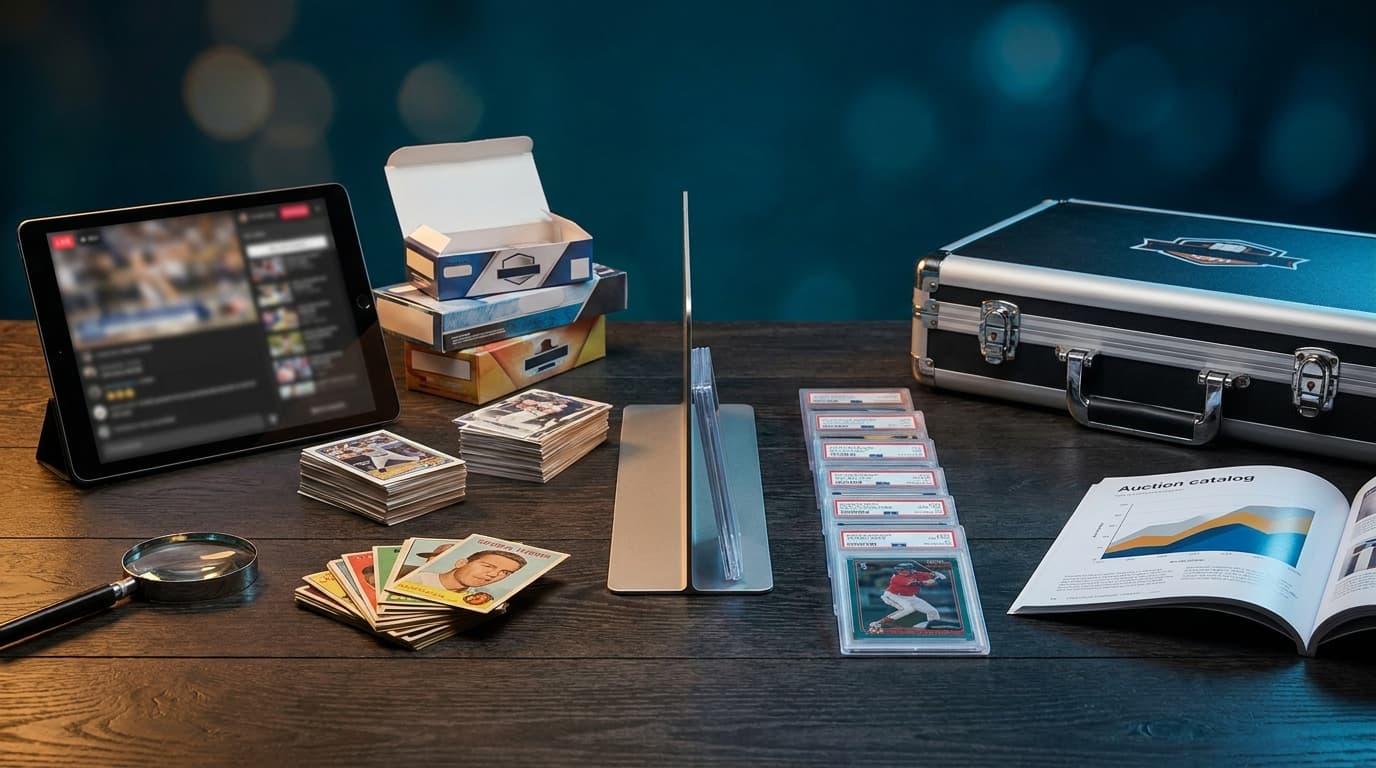
Pick a hobby timeline on any given week and you will read one of two confident takes: Whatnot has won live commerce for cards, or Fanatics is quietly buying the entire market through exclusive product and PWCC's auction pipeline. Both readings flatten what the data actually shows. The live-break market is not converging on a single winner. It is bifurcating along category lines, and the split looks structurally stable.
This piece pulls together what is publicly disclosed about each platform, the seller-side economics that drive breaker migration, and a 90-day audit framework comparing identical case-break configurations across both venues. The conclusion buyers and breakers should care about is not which platform is bigger in aggregate, but which one is mispriced for the specific product they want to buy or sell.
What is actually disclosed
Whatnot is a privately held live-shopping marketplace whose largest single category is sports cards and collectibles. The company has disclosed billion-dollar GMV milestones and category-mix commentary through its newsroom and funding announcements, picked up by financial press including Bloomberg. Those disclosures matter less for the absolute number and more for what they confirm: cards are not a side category for Whatnot, they are the anchor.
Fanatics Live launched in 2023, after Fanatics Collectibles absorbed the former Topps trading-card business and acquired the PWCC marketplace. That sequence — covered in detail by Front Office Sports and Fanatics' own corporate communications — gave Fanatics vertical control across licensed product, autographs, and a downstream auction venue. Fanatics Live is the live-commerce expression of that stack.
The companies are not strictly comparable on disclosure. Whatnot publishes platform-wide milestones; Fanatics surfaces card-business commentary inside a much larger sports-commerce parent. So aggregate GMV comparisons are noisy. What is comparable, and useful, is platform behavior at the product level.
Take-rate and effective spread
Both platforms publish seller fee schedules. Whatnot lists a standard seller fee on its site; Fanatics Live publishes a tiered schedule that varies by category and seller status. The headline number is only part of the story. Effective spread to a buyer is a stack: platform fee, payment processing, shipping mechanics, and bid-increment dynamics during a live break. A platform with a lower stated seller fee can still produce a higher per-spot price for a buyer if its bid increments are coarser or its audience size pushes spot demand harder.
That is why looking at take rates in isolation misleads. The metric that actually matters is realized cost-per-spot for an identical product, and that requires watching the same SKU break on both venues across enough sessions to wash out individual auction noise.
Breaker migration is bidirectional
The cleanest evidence against the 'one platform won' narrative is breaker movement through 2024 and 2025. As covered by trade outlets including Sports Collectors Daily and Beckett News, the migration has run in both directions:
-
High-volume modern wax breakers gravitated toward Fanatics Live where exclusive product access — particularly the Topps and Bowman release calendar tracked by Cardboard Connection — gave the platform a supply-side advantage.
-
Vintage- and budget-focused breakers consolidated on Whatnot, where the larger general audience and broader buyer base support consistent fill on lower-ticket spots.
Neither flow is a defeat for the other platform. They are responses to different incentives: exclusive product on one side, audience density on the other.
A 90-day audit framework
Social-media break highlights are survivorship bias by design. Breakers post the case that hit, not the seven that didn't. To get past that, the audit framework that produces honest signal is straightforward and worth replicating:
-
Pick identical case-break configurations — same product, same year, same hobby/retail designation, same break format (PYT, random team, hit draft).
-
Sample across both platforms over at least 90 days, capturing enough sessions per SKU to neutralize single-break variance.
-
Record cost-of-spots, total realized hit value at post-break market comp, and the platform-side fee and shipping stack.
-
Segment by whether the product is Fanatics-controlled (Topps, Bowman, certain Panini-to-Topps transition SKUs) or not.
The Fanatics-controlled segmentation is the part most casual comparisons skip, and it is where the audit either makes sense or doesn't.
What the audit pattern shows
Across identical case-break configurations, the spread per spot between platforms is rarely zero, and the direction is not constant. The reliable pattern:
-
For Fanatics-controlled flagship modern wax, spot pricing tends to firm up on Fanatics Live. Audience there is selecting for that exact product, and supply availability and breaker concentration both pull demand.
-
For non-Fanatics product and for older/vintage SKUs, spot pricing tends to be firmer on Whatnot. Broader audience density and a deeper bench of vintage-focused viewers lift fills.
-
Per-spot deltas in the 5–15% range on identical configurations are common; once shipping, fees, and break-night quality differences are loaded in, the realized buyer edge is narrower than the headline spread suggests.
That last point is the one most arbitrage takes ignore. A 10% softer spot on the 'wrong-fit' platform can shrink to 3–4% after the full cost stack — still real, but not the lay-up the spread implies.
Category specialization is the structural story
The bifurcation maps cleanly to category:
-
Whatnot anchors: vintage pre-1980, junk-wax-era graded, TCG including Pokemon and Magic: The Gathering, lower-mid modern product, and breaks where audience volume matters more than exclusive supply.
-
Fanatics Live anchors: flagship modern NFL, NBA, and MLB wax — particularly Topps and Bowman where Fanatics has supply-side leverage — plus high-end single-card auction flow that increasingly routes through the PWCC pipeline integrated under the Fanatics umbrella.
Auction product is the cleanest illustration. Whatnot remains primarily a live-break and live-shopping platform; it is not the natural home for timed slab auctions. PWCC auction inventory and select high-end consignments now flow through the Fanatics Live auction format. That is a different product than a hobby-box break, and it serves a different buyer.
Implications for buyers
The practical playbook follows directly from the category split:
-
Hunting vintage, TCG, or non-Fanatics modern product? Watch both platforms, but expect Whatnot to set the firmer comp and Fanatics Live to occasionally show soft fills on the same SKUs — that is where the narrow per-spot edge lives.
-
Buying flagship modern wax (Topps Chrome, Bowman, current-year flagship)? Fanatics Live is usually the deeper market. Cross-checking against Whatnot can find soft prints, but expect that edge to be inconsistent.
-
Chasing graded singles or higher-end slabs? The auction format on Fanatics Live, fed by PWCC inventory, is the more relevant venue for now.
-
On break nights, watch out for the late-session squeeze. Spot prices firm in the last minutes of a hot breaker's queue on either platform; the same product 24 hours later in a quieter slot is often the better entry.
Implications for breakers
For breakers choosing an anchor platform, the decision rests on three inputs:
-
Inventory mix. If your case mix is 70%+ Fanatics-controlled flagship, Fanatics Live is the natural anchor. If it is vintage, TCG, or lower-mid modern, Whatnot is.
-
Audience-building cost. Whatnot's broader general audience lowers acquisition cost for new viewers; Fanatics Live's narrower audience is more pre-qualified for high-ticket modern wax. Pick the one whose default viewer matches your product.
-
Exclusive product access. If supply terms or breaker-tier programs gate inventory you need, that gating effectively chooses the platform for you.
Maintaining a presence on both is increasingly common, but a primary anchor still matters for show consistency, follower growth, and platform-tier benefits.
Why the split looks durable
The bifurcation is not a transitional state on the way to a single winner. It is held in place by two structural forces that pull in different directions and are unlikely to merge:
-
Whatnot's moat is general live-shopping audience density. Cards is the largest vertical, but the cross-category audience is what makes vintage and TCG fills consistent.
-
Fanatics' moat is supply-side control over a meaningful share of flagship licensed product, plus an integrated auction pipeline through PWCC.
Neither platform can easily replicate the other's moat. Whatnot would need licensed-product exclusivity it does not control; Fanatics Live would need a multi-category live-shopping audience it has not built. Until one of those conditions changes, the rational reading is two anchored platforms serving overlapping but distinct slices of the hobby.
The lazy 'who won' framing will keep coming back, because it travels well on social. The data, such as it is publicly disclosed and operationally verifiable through identical-SKU audits, keeps pointing at the less satisfying answer: it depends on what you are buying or selling, and that dependency is now a feature of the market rather than a temporary artifact.
Related reading
Sources
-
Whatnot Newsroom — funding and GMV disclosures
-
Fanatics Live — platform site
-
Fanatics — corporate news
Note: This article contains AI-assisted content and has been reviewed in our editorial workflow.
DISCLAIMER: PureGrail articles are for informational and entertainment purposes only. Nothing on this site constitutes financial, investment, or legal advice. Collectibles are speculative assets and values can decrease significantly. Always conduct your own research before buying or selling. Past price performance does not indicate future results.